Savonia Article Pro: Does Kinect-based rehabilitation improve functional ability in children with cerebral palsy? A mini-systematic review
Savonia Article Pro is a collection of multidisciplinary Savonia expertise on various topics.
This work is licensed under CC BY-SA 4.0


Introduction
Evidence-Based Practice (EBP) in physiotherapy combines the best available research evidence with clinical expertise and patients’ values and preferences to support informed clinical decision-making and high-quality care.
In week 44 of 2026, an international Blended Intensive Programme (BIP) focusing on EBP brought together physiotherapy students and academic staff at École d’Assas (Établissement d’enseignement supérieur en kinésithérapie et en podologie) in Paris, France. The programme introduced participants to the principles of EBP and addressed key challenges in applying scientific evidence across different areas of physiotherapy practice. Students and teachers from 4 universities in France, Czech Republic, Portugal and Finland took part in collaborative learning activities, sharing their knowledge, experiences, and professional perspectives.
As part of the programme, students worked in international teams under the guidance of academic staff to explore topics relevant to evidence-based physiotherapy. Each team conducted a mini-review, developing practical skills in searching for, critically appraising, and synthesising scientific literature. The resulting blog-style articles present the teams’ findings and discuss their relevance to physiotherapy practice.
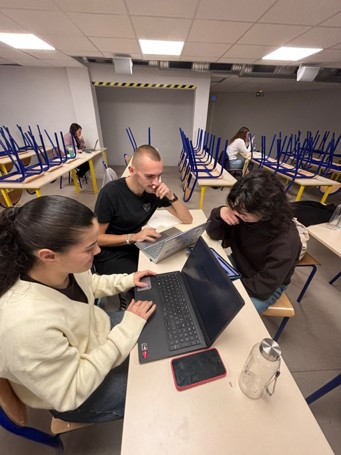
The student team shown in Picture 1 focused on the use of Kinect-based rehabilitation in children with cerebral palsy, with particular attention to functional ability (balance, gross motor function and upper-limb function). Under the guidance of the teachers, the students worked collaboratively to examine the available scientific evidence on whether integrating Kinect into functional rehabilitation leads to greater functional improvements than functional rehabilitation alone in children under 18 with cerebral palsy, and consider its implications for physiotherapy practice. The work involved a literature search and critical appraisal of relevant research findings. This article presents the main findings of the mini-review and discusses their relevance to evidence-based clinical decision-making, with particular emphasis on the potential short-term benefits of Kinect for balance, trunk control and manual dexterity, and on the lack of consistent evidence of its superiority over conventional physiotherapy.
Background and objective
Cerebral palsy (CP) is a non-progressive condition resulting from disturbances in the developing brain, leading to permanent impairments of movement and posture. These impairments can affect balance, walking, upper-limb function and participation in everyday activities. Rehabilitation, particularly physiotherapy and task-specific training, plays a central role in the management of children with CP.
In recent years, virtual reality technologies have increasingly been explored as complementary tools in paediatric rehabilitation. One such technology is Microsoft Kinect, a camera-based motion-tracking system that captures body movements without the need for additional sensors or controllers and translates them into interactive virtual games. Previous studies have investigated its potential benefits in lower-limb function (Jung et al., 2021), balance (Fidan & Genç, 2023) and upper-limb function (Shih et al., 2023; Chou et al., 2026). However, existing research reviews have mainly focused on virtual reality in general or on specific functional areas, such as upper-limb rehabilitation or balance.
The aim of this mini systematic review was therefore to investigate whether incorporating Microsoft Kinect into functional rehabilitation programmes leads to greater improvements in functional abilities in children and adolescents under 18 years of age with CP compared with conventional functional rehabilitation alone.
Methods
A structured literature search was conducted on 28 October 2026 in PubMed (MEDLINE) and Google Scholar using combinations of keywords related to children, cerebral palsy and Kinect technology. In Google Scholar, additional terms related to functional outcomes and randomized controlled trials were used to refine the search results.
Study selection followed the PICO framework. Eligible studies included children under 18 years of age diagnosed with CP (Population), who received functional rehabilitation incorporating Microsoft Kinect (Intervention), compared with functional rehabilitation without Kinect (Comparison). The primary outcome of interest was functional ability, including balance, gross motor function, gait and upper-limb function. Only randomized controlled trials (RCTs) were included, while studies investigating other virtual reality systems, such as Nintendo Wii, or virtual reality in general were excluded.
Three reviewers independently screened the identified records and assessed their eligibility. The initial search yielded 2,193 records (33 from PubMed and 2,160 from Google Scholar). After removing 26 duplicates, 2,167 records remained for screening. Following title and abstract screening and subsequent full-text assessment, four randomized controlled trials met the inclusion criteria.
Data extraction was performed independently by the three reviewers and included participants’ age, Gross Motor Function Classification System (GMFCS) level, intervention duration and functional outcomes. The methodological quality of the included studies was assessed using the PEDro scale, while the risk of bias was evaluated using the Cochrane Risk of Bias 2 (RoB 2) tool. No minimum PEDro score was required for study inclusion.
Results
Four randomized controlled trials involving a total of 114 children and adolescents with CP were included in the review (Jung et al., 2021; Shih et al., 2023; Chou et al., 2026; Fidan & Genç, 2023). The methodological quality of the studies varied, with PEDro scores ranging from 3/10 (Fidan & Genç, 2023) to 8/10 (Chou et al., 2026). The RoB 2 assessment identified some concerns or a high risk of bias across the included trials.
Lower-limb function and balance. Jung et al. (2021, n = 10) compared Kinect-based training combined with conventional physiotherapy against conventional therapy alone. The results showed greater improvements in balance in the Kinect group, with the Pediatric Balance Scale increasing by 16.8 points compared with 2.4 points in the control group. Improvements in selective motor control were also observed at the ankle and knee, although the effects at the hip were more limited. However, no significant between-group differences were found in gait parameters. In contrast, Fidan and Genç (2023, n = 52) reported significant improvements in both balance and gross motor function in both groups (p < 0.05), but did not demonstrate additional benefits of Kinect-based training over conventional physiotherapy.
Upper-limb function. Shih et al. (2023, n = 29) compared Kinect-based constraint-induced movement therapy (CIMT) with therapist-based CIMT. The results showed comparable improvements in upper-extremity motor control and daily motor function in both groups. However, trunk motor control improved significantly more in the Kinect group (p < 0.001), suggesting a potential benefit of technology-assisted training in reducing compensatory trunk movements during upper-limb activities. Chou et al. (2026, n = 23) reported greater improvements in manual dexterity following Kinect-augmented CIMT (p = 0.001), although this advantage was not maintained at the three-month follow-up. Conversely, Fidan and Genç (2023) found significantly greater improvements in upper-limb function following conventional physiotherapy compared with Kinect-based training (p < 0.05).
Discussion
The findings suggest that Microsoft Kinect may offer additional benefits in selected areas of functional rehabilitation for children with CP, particularly balance, trunk control and short-term manual dexterity. However, its effectiveness appears to vary depending on the functional outcome assessed and the type of rehabilitation intervention used. While some studies reported greater improvements when Kinect was incorporated into conventional therapy, others found comparable results or greater improvements following conventional physiotherapy alone.
The positive findings reported by Jung et al. (2021) suggest that Kinect-based exercises may support improvements in balance and selective motor control of the lower limbs. Similarly, the findings of Shih et al. (2023) indicate that Kinect-based training may be a useful alternative to therapist-based CIMT, particularly in relation to trunk motor control. Nevertheless, the absence of consistent improvements across all functional outcomes indicates that the benefits of this technology may be specific to certain aspects of motor performance rather than overall functional ability.
Several factors may explain the differences between studies, including variations in intervention protocols, treatment duration, participant characteristics and outcome measurement methods. In addition, the relatively small sample sizes and methodological limitations of the included trials reduce confidence in the findings. The risk-of-bias assessment also indicated some concerns or a high risk of bias, which should be considered when interpreting the reported treatment effects.
Despite these limitations, Kinect offers an interactive and engaging approach to rehabilitation that allows children to perform task-oriented movements through virtual games and visual feedback. This may provide an alternative way of practising functional movements and could help make rehabilitation sessions more motivating and enjoyable. However, the available evidence does not yet establish whether these potential advantages translate into consistently greater functional improvements compared with conventional physiotherapy.
Conclusion
Microsoft Kinect appears to be a promising complementary tool in the rehabilitation of children with cerebral palsy, with potential benefits for balance, trunk control and short-term manual dexterity. However, the current evidence does not consistently demonstrate its superiority over conventional physiotherapy, and its effects seem to depend on the functional outcome and intervention approach.
These findings should be interpreted cautiously, as only four randomized controlled trials involving 114 participants were included. The studies also differed in their intervention protocols and outcome measures, and their methodological quality ranged from low to moderate. Furthermore, the literature search was limited to two databases, which may have resulted in selection and publication bias.
In clinical practice, Kinect-based exercises may be considered a complementary approach to conventional rehabilitation rather than a replacement for established physiotherapy interventions. Further high-quality randomized controlled trials involving larger participant groups, standardized intervention protocols and longer follow-up periods are needed to clarify the effectiveness of Kinect-based rehabilitation and establish its role in paediatric neurorehabilitation.
Authors
Margaux Descours, physiotherapy student, École d’Assas, France.
Tsumugi Sato, physiotherapy student, Charles University, Czech Republic
Antoine Perrot, physiotherapy student, École d’Assas, France.
Dagmar Pavlu, PT. Assoc. Prof. Charles University, Czech Republic
Ivana Vláčilová, PhD., PT. Charles University, Czech Republic
Marja Äijö, PT, PhD Principal Lecturer of gerontology and rehabilitation, Savonia, University of Applied Sciences, Kuopio, Finland.
Adrien Pallot, PT, MSc, Lecturer at École D´Assas, France.
Carlos Filipe Barbosa Crasto PT. Assoc. Prof., Escola Superior de Saúde de Santa Maria, Portugal
References
Fidan, Ö., Genç, A. (2023) Effect of virtual reality training on balance and functionality in children with cerebral palsy: a randomized controlled trial. Turk J Physiother Rehabil. 34(1):64-72. doi:10.21653/tjpr.1017679
Chou, C.Y., Chen, H.C., Lin, Y.J., Chen, C.W., Wu, K.P.H., Huang, Y.Y. et al. (2026) Augmented effects of a Kinect-based virtual reality on constraint-induced movement therapy for upper extremity function in children with cerebral palsy: a randomized controlled trial. Virtual Reality. doi:10.1007/s10055-026-01427-x
Jung, S.H., Song, S.H., Lee, D.G., Lee, K., Lee, G. (2021) Effects of Kinect video game training on lower extremity motor function, balance, and gait in adolescents with spastic diplegia cerebral palsy: a pilot randomized controlled trial. Dev Neurorehabil 24(3):159-65. doi:10.1080/17518423.2020.1819458
Shih, T.Y., Wang, T.N., Shieh, J.Y., Lin, S.Y., Ruan, S.J., Tang, H.H. et al. (2023) Comparative effects of Kinect-based versus therapist-based constraint-induced movement therapy on motor control and daily motor function in children with unilateral cerebral palsy: a randomized controlled trial. J Neuroeng Rehabil. 20:13. doi:10.1186/s12984-023-01135-6
Main picture: Source: Pexels. Used under the Pexels License.