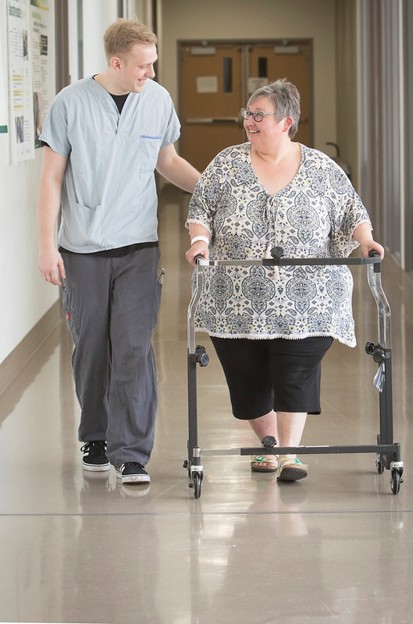
Savonia Article Pro: Effectiveness and safety of early mobilization on functional capacity and recovery in patients hospitalized with acute myocardial infarction
Savonia Article Pro is a collection of multidisciplinary Savonia expertise on various topics.
This work is licensed under CC BY-SA 4.0


Introduction
Acute myocardial infarction (AMI) is a major global health issue and one of the leading causes of hospitalization worldwide (Roth et al. 2020). Historically, patients recovering from AMI were told to rest in bed for a prolonged period of time to avoid straining the heart. Current scientific evidence shows that extended immobility leads to physical deconditioning and increases the risk of complications (Convertino 2007). Suffering an AMI places enormous psychological stress on a person, which appears as cardiac-related anxiety and fear of physical activity.
In physiotherapy, early inpatient cardiac rehabilitation plays an important role in safe recovery from AMI. This topic is essential because determining the optimal timing for rehabilitation, making sure the patient is safe and easing the fear of movement are daily challenges in clinical practice. Scientific research demonstrates that structured early mobilization not only prevents the adverse effects of prolonged bed rest, but also significantly improves the patient’s functional capacity, quality of life and psychological wellness (Peixoto et al. 2015; Askari et al. 2025; Aktan et al. 2026).
This article was prepared within the Professional in Physiotherapy course included in the physiotherapy degree programme. The article represents students’ work completed as part of the evidence-based physiotherapy component of the course. During the course, students work collaboratively in small groups to practice the key stages of a systematic review process by conducting a mini review. This includes systematic literature searching, critical appraisal using the PEDro scale (n.d.) data synthesis, and reporting the findings in the form of a scientific manuscript.
Aim of this mini literature review is to evaluate the effectiveness and safety of early mobilization on patients hospitalized with an AMI.
Methods
To define our research question and guide the study selection process, we structured our eligibility criteria using PICO: Problem: Adult patients hospitalized with acute myocardial infarction, Intervention: Early mobilization and physiotherapy within the first 6-24 hours of admission. Comparison: Prolonged bed rest and Outcomes: Functional exercise capacity, quality of life and psychological metrics.
The literature search was conducted in the PubMed database. Eligibility criteria was peer-reviewed RCTs focusing on adult patients with confirmed AMI, that were undergoing early inpatient mobilization. During the searching process, search results were first evaluated by title and abstract. Based on the search, three studies meeting the inclusion criteria were selected for the review: Peixoto et al. 2015, Askari et al. 2025 and Aktan et al. 2026. Quality of studies was evaluated via the PEDro scale (PEDro 1999).
Results
All 3 studies showed that early mobilization and exercise were both safe and superior to standard care/prolonged bed rest. When inspecting with the PEDro scale (PEDro 1999), all 3 studies score 9 out of 11 points. The 2 points that were lacking was from blinding of subjects and blinding of the therapists that administer the therapy, as that is basically impossible to do in this setting.
Functional capacity and quality of life (Peixoto et al. 2015): The aim of the study was to determine if initiating rehabilitation early helps patients feel better and handle daily life more easily. They were assessed for general physical fitness and quality of life. Intervention was a gradual exercise routine that started in the hospital with guidance and continued at home without guidance. Early rehabilitation group showed significantly higher functional capacity and improved quality of life.
Cardiac anxiety and vital signs (Askari et al. 2025): The aim of the study was to find out if getting patients out of bed quickly reduces their fear of another heart attack and keeps their vital signs stable. Intervention was early mobilization program and they were assessed for heart related anxiety and vital signs such as blood pressure and heart rate. Very early mobilization is an effective strategy for preventing complications from immobility and significantly reduces cardiac anxiety.
Physical capacity and overall wellbeing (Aktan et al. 2026): Aim of the study was to test how well a guided exercise program works when started very soon after a heart attack. Intervention included stopping bed rest within 12-24 hours to do light movement, followed by an 8-weel guided exercise program. Patients were assessed via 6-minute walk test, tiredness levels, sleep quality and overall wellbeing. Early guided exercise significantly enhanced physical capacity, reduced exhaustion and boosted overall wellbeing.
Conclusion
Based on our literature review, very early mobilization is not only safe, but beneficial for patients hospitalized with AMI. Specifically early rehabilitation significantly improved physical and functional capacity (Peixoto et al. 2015, Aktan et al. 2026), reduced fatigue and enhanced overall quality of life (Peixoto et al. 2015, Aktan et al. 2026). Early rehabilititation also maintained stable vital signs like blood pressure (Askari et al. 2025).
These results challenge outdated practices of prolonged bed rest and immobilization following an AMI. Future research should focus more closely on the psychophysical dimension of physiotherapy, because suffering an AMI induces massive psychological stress on a person. Further studies are needed to explore the combination of psychophysical physiotherapy methods and early mobilization.
Authors
Benjami Kosunen, Physiotherapy student, Savonia University of Applied Sciences
Eino Elo, Physiotherapy student, Savonia University of Applied Sciences
Jan Brander, Physiotherapy student, Savonia University of Applied Sciences
Marja Äijö PhD, Principal lecturer of gerontology and rehabilitation, Marja Äijö PhD, Principal lecturer of gerontology and rehabilitation, Savonia University of Applied Sciences
This article was prepared with the help of AI.
References
AI was used to support search for information, to structure the topic and for help in translation to English.
Aktan, Ö.O., Sevgi, Ö., Hüseyin, D., Ahmet, A.B., Aylin, Ö.A. & Dayimi, K. 2026. Early-Phase Exercise-Based Comprehensive Cardiac Rehabilitation Program after Myocardial Infarction: A Randomized Controlled Trial. Acta Cardiologica Sinica. https://doi.org/10.6515/acs.202601_42(1).20250714d. Accessed 2 November 2026.
Askari, R., Yazdannik, A., Shams, I. & Goodarzi-Khoigani, M. 2025. The Effect of Early Mobilization Programs on the Heart-focused Anxiety in Patients with Acute Myocardial Infarction: A Randomized Clinical Trial. Iranian Journal of Nursing and Midwifery Research. https://doi.org/10.4103/ijnmr.ijnmr_86_24. Accessed 2 November 2026.
Convertino, V.A. 1997. Cardiovascular consequences of bed rest: effect on maximal oxygen uptake. Medicine and Science in Sports and Exercise, 29(2), 191–196. https://doi.org/10.1097/00005768-199702000-00005. Accessed 4 November 2026.
PEDro. 1999. PEDro scale. https://pedro.org.au/english/resources/pedro-scale/. Accessed 4 November 2026.
Peixoto, T.C.A., Begot, I., Bolzan, D.W., Machado, L., Reis, M.S., Papa, V., Carvalho, A.C.C., Arena, R., Gomes, W.J. & Guilizini, S. 2015. Early exercise-based rehabilitation improves health-related quality of life and functional capacity after acute myocardial infarction: a randomized controlled trial. Canadian Journal of Cardiology. https://doi.org/10.1016/j.cjca.2014.11.014. Accessed 2 November 2026.
Roth, G.A., Mensah, G.A., Johnson, C.O., Addolorato, G., Ammirati, E., Baddour, L.M. et al. 2020. Global Burden of Cardiovascular Diseases and Risk Factors, 1990–2019: Update From the GBD 2019 Study. Journal of the American College of Cardiology, 76(25), 2982–3021. https://doi.org/10.1016/j.jacc.2020.11.010. Accessed 4 November 2026.
Main picture. Obesity Canada – Obésité Canada n.d. Photograph. Flickr. https://www.flickr.com/photos/obesitycanada/43357599564. Accessed 4 November 2026.