Savonia Article Pro: Respiratory muscle training after burn injury: a mini systematic review
Savonia Article Pro is a collection of multidisciplinary Savonia expertise on various topics.
This work is licensed under CC BY-SA 4.0


Introduction
Evidence-Based Practice (EBP) in physiotherapy combines the best available research evidence with clinical expertise and patients’ values and preferences to support informed clinical decision-making and high-quality care.
In week 44 of 2026, an international Blended Intensive Programme (BIP) focusing on EBP brought together physiotherapy students and academic staff at École d’Assas (Établissement d’enseignement supérieur en kinésithérapie et en podologie) in Paris, France. The programme introduced participants to the principles of EBP and addressed key challenges in applying scientific evidence across different areas of physiotherapy practice. Students and teachers from 4 universities in France, Czech Republic, Portugal and Finland took part in collaborative learning activities, sharing their knowledge, experiences, and professional perspectives.
As part of the programme, students worked in international teams under the guidance of academic staff to explore topics relevant to evidence-based physiotherapy. Each team conducted a mini-review, developing practical skills in searching for, critically appraising, and synthesising scientific literature. The resulting blog-style articles present the teams’ findings and discuss their relevance to physiotherapy practice.
The student team shown in Picture 1 focused on respiratory muscle training after burn injury, with particular attention to the training dose. Under the guidance of the teachers, the students worked collaboratively to examine the available scientific evidence on its effects on breathing-muscle strength, lung function and walking capacity, and consider its implications for physiotherapy practice. The work involved a literature search and critical appraisal of relevant research findings. This article presents the main findings of the mini-review and discusses their relevance to evidence-based clinical decision-making, with particular emphasis on the consistent but modest benefit found in five small randomised controlled trials.

Background
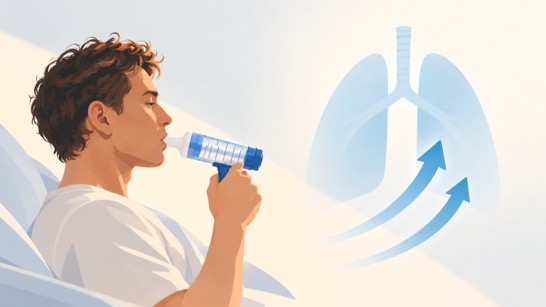
Major burn (including chest burns, inhalation injury, bed rest, hypermetabolism, etc.) weaken the respiratory muscles. Respiratory muscle training (RMT), mostly inspiratory muscle training (IMT), means breathing in against a set load. For this approach a threshold valve is set at a percentage of maximal inspiratory pressure (MIP). In chronic obstructive pulmonary disease (COPD), RMT improves inspiratory strength (Gosselink et al., 2011). Five randomised controlled trials (RCTs) have tested RMT in burns since 2022. No review had brought them together. We asked whether RMT added to usual care improves inspiratory strength and lung function after a burn.
Methods
Selection followed PRISMA 2020 (Page et al., 2021). We included RCTs regarding people with burns that added RMT to usual care versus the same usual care alone or with a sham device. Breathing exercises without a device were excluded. Every trial was checked against a real-dose rule in to make sure RMT was a real intervention: 1) a load of at least 30% of MIP or progressed to a tolerable maximum ; 2) the same usual care in both groups ; 3) a described dose.
PubMed was searched in October 2026 without filters. In addition the search was checked in PEDro, Cochrane CENTRAL, ClinicalTrials.gov and reference lists. Two reviewers worked independently at each step with a third settling disagreements. Rated quality was assessed with the PEDro scale (Maher et al., 2003). Results were not pooled. We report the difference between groups in change from baseline.
Results
Of 44 records, five RCTs with 258 participants were included (Abazarnejad et al., 2022; Abdel-Aal et al., 2025; Al-Amiri et al., 2026; Basha et al., 2024; El-Sayed Attalla et al., 2023). They were small, all from the Middle East and without follow-up. Training lasted 10 days to 8 weeks at 30–50% of MIP. Two trials used a sham device at 5% of MIP. The dose was unclear in two trials. PEDro scores were good in three trials (7–8/10), fair in one (4/10) and poor in one (3/10).
All 20 between-group comparisons favoured RMT. Fifteen were statistically significant (p < 0.05), two were not, and three in Al-Amiri et al. (2026) rest on inconsistent statistics. MIP improved by 1.9 to 10.0 cmH₂O more than in controls. Lung function favoured RMT in every trial that measured it. In the two sham-controlled trials, Basha et al. (2024) and Abdel-Aal et al. (2025), the 6-minute walk improved by 49 and 48 meters; above the 30 meters minimal important difference (Holland et al., 2014).
Conclusion
Added to usual care, RMT gave a modest gain in inspiratory strength and a clinically relevant gain in walking distance. Both sham-controlled trials, the best rated on PEDro, favoured RMT, so the effect is not attention alone. Gains were smaller than in COPD (Gosselink et al., 2011), partly because burn patients recover spontaneously. The evidence remains fragile: small, short, single-region trials without blinded participants or reported harms. For practice, threshold IMT at 30–50% of MIP, re-tested weekly, is a cheap add-on worth considering after a major burn with a low MIP. Larger, registered, sham-controlled trials with follow-up are needed.
Authors
Anna Machová, physiotherapy student, Charles University, Czech Republic.
Jiří Nepraš, physiotherapy student, Charles University, Czech Republic.
Ester Azeredo da Cunha Ramalho Vinagre, physiotherapy student, Escola Superior de Saúde de Santa Maria, Portugal.
Lucas Fontana, physiotherapy student, École d’Assas, France.
Dagmar Pavlu, PT. Assoc. Prof. Charles University, Czech Republic
Ivana Vláčilová, PhD., PT. Charles University, Czech Republic
Marja Äijö, PT, PhD Principal Lecturer of gerontology and rehabilitation, Savonia, University of Applied Sciences, Kuopio, Finland.
Adrien Pallot, PT, MSc, Lecturer at École D´Assas, France.
Carlos Filipe Barbosa Crasto PT. Assoc. Prof., Escola Superior de Saúde de Santa Maria, Portugal
References
Abazarnejad, E., Froutan, R., Ahmadabadi, A., & Mazlom, S. R. (2022). Improving respiratory muscle strength and health status in burn patients: A randomized controlled trial. Quality of Life Research, 31(3), 769-776. 10.1007/s11136-021-02996-x
Abdel-Aal, N. M., Basha, M. A., Aloraini, S. M., Azab, A. R., & Kamel, F. H. (2025). Would integrating inspiratory muscle training into pulmonary rehabilitation of adults with burn injuries have any advantageous effects? A randomized, double-blind, sham-controlled study. Annals of Rehabilitation Medicine, 49(1), 30-39. 10.5535/arm.240092
Al-Amiri, Z. F. A. H., Kadhim, A. J., Ahmadi Chenari, H., & Baumann, S. L. (2026). The effect of inspiratory muscle training on fatigue among burn patients in Iraq. Nursing Science Quarterly. Advance online publication. 10.1177/08943184261461048
Basha, M. A., Azab, A. R., Elnaggar, R. K., Aboelnour, N. H., Kamel, N. M., Aloraini, S. M., & Kamel, F. H. (2024). Inspiratory muscle training impact on respiratory muscle strength, pulmonary function, and quality of life in children with chest burn: A randomized controlled trial. Burns, 50(7), 1916-1924. 10.1016/j.burns.2024.05.007
El-Sayed Attalla, A. F., Ahmed, K. T., & Abd El Monem, M. (2023). Effects of inspiratory muscle training on clinical predictors of respiratory muscle strength and lung function in burned patients with inhalation injury. Journal of Burn Care & Research, 44(1), 140-145. 10.1093/jbcr/irac163
Gosselink, R., De Vos, J., van den Heuvel, S. P., Segers, J., Decramer, M., & Kwakkel, G. (2011). Impact of inspiratory muscle training in patients with COPD: What is the evidence? European Respiratory Journal, 37(2), 416-425. 10.1183/09031936.00031810
Holland, A. E., Spruit, M. A., Troosters, T., Puhan, M. A., Pepin, V., Saey, D., McCormack, M. C., Carlin, B. W., Sciurba, F. C., Pitta, F., Wanger, J., MacIntyre, N., Kaminsky, D. A., Culver, B. H., Revill, S. M., Hernandes, N. A., Andrianopoulos, V., Camillo, C. A., Mitchell, K. E., . . . Singh, S. J. (2014). An official European Respiratory Society/American Thoracic Society technical standard: Field walking tests in chronic respiratory disease. European Respiratory Journal, 44(6), 1428-1446. 10.1183/09031936.00150314
Maher, C. G., Sherrington, C., Herbert, R. D., Moseley, A. M., & Elkins, M. (2003). Reliability of the PEDro scale for rating quality of randomized controlled trials. Physical Therapy, 83(8), 713-721. 10.1093/ptj/83.8.713
Page, M. J., McKenzie, J. E., Bossuyt, P. M., Boutron, I., Hoffmann, T. C., Mulrow, C. D., Shamseer, L., Tetzlaff, J. M., Akl, E. A., Brennan, S. E., Chou, R., Glanville, J., Grimshaw, J. M., Hróbjartsson, A., Lalu, M. M., Li, T., Loder, E. W., Mayo-Wilson, E., McDonald, S., . . . Moher, D. (2021). The PRISMA 2020 statement: An updated guideline for reporting systematic reviews. BMJ, 372, n71. 10.1136/bmj.n71