Savonia Article Pro: The Effectiveness of Virtual Reality and Exergaming in Improving Upper Limb Function in Children with Obstetric Brachial Plexus Palsy: A Mini-Review
Savonia Article Pro is a collection of multidisciplinary Savonia expertise on various topics.
This work is licensed under CC BY-SA 4.0


Introduction
Evidence-Based Practice (EBP) in physiotherapy combines the best available research evidence with clinical expertise and patients’ values and preferences to support informed clinical decision-making and high-quality care. In week 44 of 2026, an international Blended Intensive Programme (BIP) focusing on EBP brought together physiotherapy students and academic staff at École d’Assas (Établissement d’enseignement supérieur en kinésithérapie et en podologie) in Paris, France. The programme introduced participants to the principles of EBP and addressed key challenges in applying scientific evidence across different areas of physiotherapy practice. Students and teachers from 4 universities in France, Czech Republic, Portugal and Finland took part in collaborative learning activities, sharing their knowledge, experiences, and professional perspectives.
As part of the programme, students worked in international teams under the guidance of academic staff to explore topics relevant to evidence-based physiotherapy. Each team conducted a mini-review, developing practical skills in searching for, critically appraising, and synthesising scientific literature. The resulting blog-style articles present the teams’ findings and discuss their relevance to physiotherapy practice.
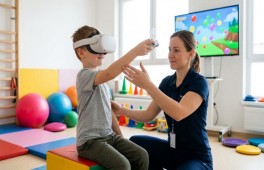
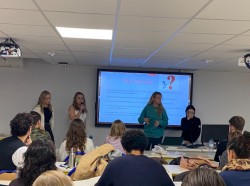
The student team shown in Picture 1 focused on pediatric obstetric brachial plexus palsy (OBPP) rehabilitation, with particular attention to the effectiveness of virtual reality and exergaming compared with conventional physical therapy in improving upper extremity motor function assessed by the Mallet score. Under the guidance of the teachers, the students worked collaboratively to examine the available scientific evidence on whether virtual reality exergaming provides added clinical value over conventional physical therapy in pediatric OBPP rehabilitation and consider its implications for physiotherapy practice. The work involved a literature search and critical appraisal of relevant research findings. This article presents the main findings of the mini-review and discusses their relevance to evidence-based clinical decision-making, with particular emphasis on comparing the functional outcomes of specialized clinical systems against commercial exergaming interventions and their impact on patient engagement.
Background
Obstetric brachial plexus palsy (OBPP) causes persistent motor deficits in the upper extremity, which directly impairs a child’s functional independence and motor development (Alsakhawi & Atya, 2019; El-Shamy & Alsharif, 2017). Achieving optimal neuromuscular recovery requires high-intensity, long-term repetitive exercise protocols. However, conventional physiotherapy over extended periods frequently leads to decreased motivation, treatment fatigue, and reduced adherence among young children (Yeves-Lite et al., 2020).
Gamified therapy and virtual reality (VR) technologies convert routine functional movements into interactive, enjoyable tasks, thereby significantly boosting children’s motivation, active participation, and treatment compliance (Karas et al., 2021). Despite these psychological benefits, clinicians must evaluate whether this heightened engagement translates into superior functional motor gains compared with standard physiotherapy protocols. Therefore, this mini-review synthesizes current evidence regarding the effectiveness of VR and exergaming interventions on upper limb function and Modified Mallet scores in children with OBPP.
Methods
To evaluate the clinical efficacy of technology-assisted therapy, a literature search was conducted on October 28, 2026, across three bibliographic databases: Scopus, Cochrane Library, and PubMed. The PICO framework was defined as follows:
Population (P) consisted of children with obstetric brachial plexus palsy; Intervention (I) involved virtual reality or exergaming; Comparison (C) comprised conventional physical therapy; and Outcome (O) focused on upper limb functional gains measured by the Mallet scoring system.
Eligibility criteria restricted the search to randomized controlled trials (RCTs) published in English within the last 10 years, with full text available, involving children diagnosed with upper OBPP, and incorporating the Mallet score as an outcome measure. Search strings combining terms for OBPP, virtual reality/exergaming, upper limb function, and RCTs initially yielded 114 results (96 from Scopus, 9 from Cochrane Library, and 9 from PubMed). After removing 12 duplicates, 102 titles and abstracts were screened. Eighty-six records were excluded during title screening and six during abstract screening due to inappropriate population, intervention, or study design. Full-text appraisal of the remaining nine studies led to the final inclusion of four RCTs. Methodological quality and risk of bias for each included study were evaluated using the PEDro scale (PEDro, n.d.).
Results
Four randomized controlled trials were synthesized. Alsakhawi and Atya (2019) evaluated an augmented biofeedback system (E-LINK) over 6 weeks in 45 children, reporting significantly greater improvements in active range of motion (ROM) and all Mallet scale criteria compared to traditional therapy alone (p < 0.05). El-Shamy and Alsharif (2017) examined a 12-week robotic VR intervention (Armeo® Spring) in 40 children, demonstrating statistically superior gains in all five Mallet score parameters (p < 0.001, d = 1.29–1.64), ROM, and strength over conventional physiotherapy. Yeves-Lite et al. (2020) showed that a 4-week home-based VR mirror therapy program in 10 children significantly enhanced upper-limb function and Mallet scores (p < 0.02) compared to standard mirror therapy. Finally, Karas et al. (2021) found that adding 6 weeks of Nintendo Wii exergaming to conventional therapy (n = 22) significantly improved shoulder ROM and bimanual task integration (p < 0.05), although total Mallet score gains showed no statistically significant difference between groups (p ≥ 0.05).
Conclusion
Combining virtual reality, exergaming, or augmented biofeedback with conventional physical therapy yields significantly greater improvements in upper extremity function and range of motion in children with OBPP compared to conventional physical therapy alone. All reviewed technological approaches demonstrated positive trends on the Mallet scale. However, a clear divergence exists based on the type of technology utilized.
Specialized clinical and robotic systems (such as E-LINK and Armeo® Spring) consistently drive broader, statistically significant gains across all functional outcome measures, including muscle strength and overall Mallet scores. Conversely, commercial exergaming platforms and mobile VR mirror therapies (such as Nintendo Wii and smartphone VR) excel at increasing child motivation, treatment adherence, and specific task integration (e.g., hand-to-mouth reach), but display a more selective impact on overall structural functional scores. Future research should investigate optimized protocols for integrating accessible VR technologies into home-based rehabilitation to enhance long-term activities of daily living (ADL).
Authors
Eveliina Vidgren, physiotherapy student, Savonia University of Applied Sciences, Kuopio, Finland
Lucie Nechlebová, physiotherapy student, Charles University, Czech Republic
Tayseer Benchaïb, physiotherapy student, École d’Assas, France
Emma Thouvenel, physiotherapy student, École d’Assas, France
Dagmar Pavlu, PT. Assoc. Prof. Charles University, Czech Republic
Ivana Vláčilová, PhD., PT. Charles University, Czech Republic
Marja Äijö, PT, PhD Principal Lecturer of gerontology and rehabilitation, Savonia, University of Applied Sciences, Kuopio, Finland.
Adrien Pallot, PT, MSc, Lecturer at École D´Assas, France.
Carlos Filipe Barbosa Crasto PT. Assoc. Prof., Escola Superior de Saúde de Santa Maria, Portugal
References
Alsakhawi, R. S., & Atya, A. M. (2019). Effect of augmented biofeedback for improvement of range of motion and upper extremity functionality in obstetric brachial plexus injury: a randomised control trial. Somatosensory & Motor Research, 36(4), 259-264.
El-Shamy, S., & Alsharif, R. (2017). Effect of virtual reality versus conventional physiotherapy on upper extremity function in children with obstetric brachial plexus injury. Journal of Musculoskeletal and Neuronal Interactions, 17(4), 319-326.
Karas, G., Karadağ-Saygı, E., & Mansız-Kaplan, B. (2021). The effects of virtual reality on upper extremity in patients with obstetric brachial plexus injury. Journal of Pediatric Rehabilitation Medicine, 14(4), 619-626.
PEDro. (n.d.). PEDro scale. PEDro – PEDro scale. In available: https://pedro.org.au/english/resources/pedro-scale/
Yeves-Lite, A., Zuil-Escobar, J. C., Martínez-Cepa, C., Romay-Barrero, H., Ferri-Morales A., & Palomo-Carrión, R. (2020). Conventional and virtual reality mirror therapies in upper obstetric brachial palsy: a randomized pilot study. Journal of Clinical Medicine, 9(9), 3021.