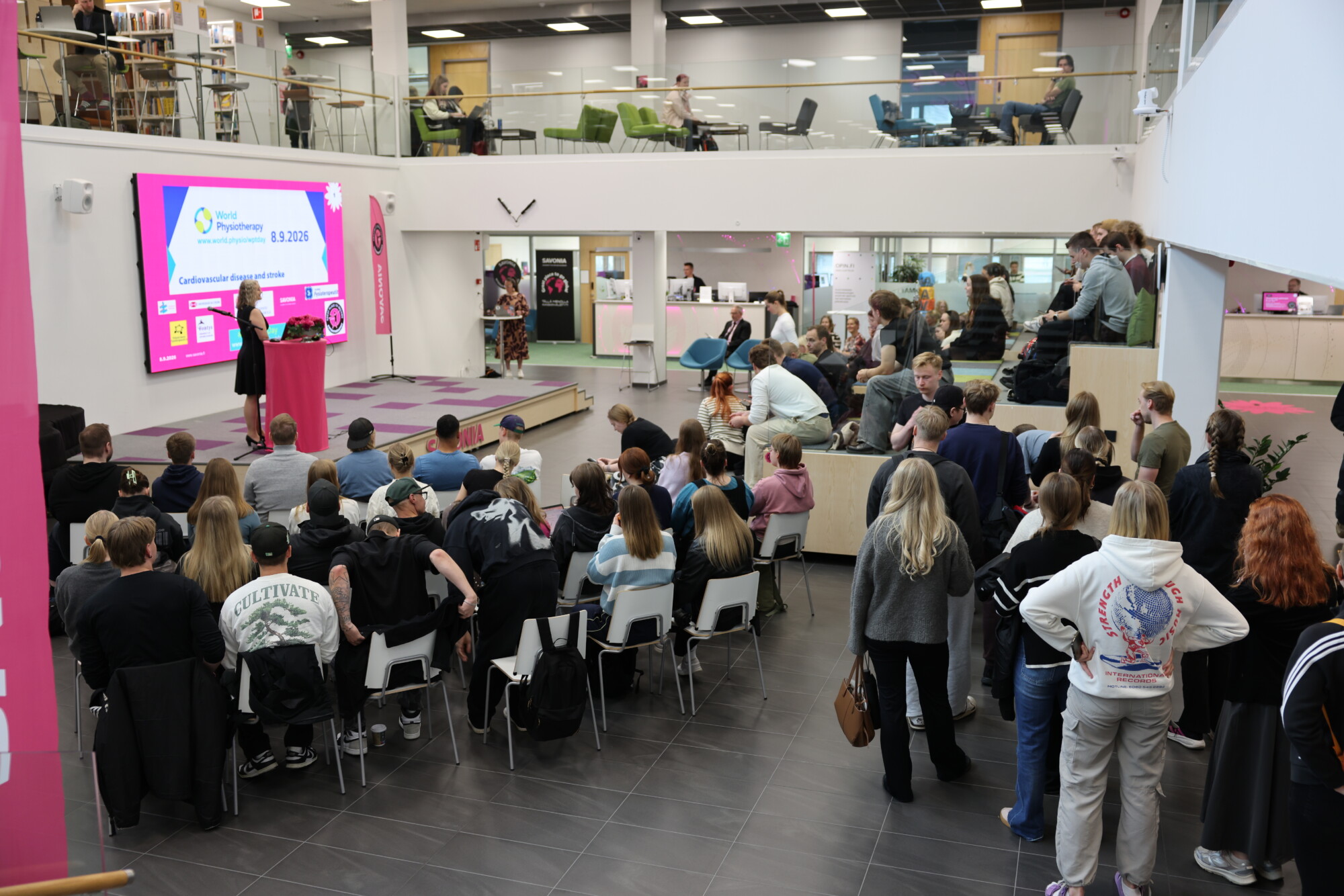
Savonia Article Pro: World Physiotherapy Day 2026: Physiotherapy, Physical Activity and Cardiovascular Health
Savonia Article Pro is a collection of multidisciplinary Savonia expertise on various topics.
This work is licensed under CC BY-SA 4.0


Introduction
World Physiotherapy Day is celebrated annually on 8 September to raise awareness of the important contribution physiotherapists make to global health, prevention, rehabilitation, and quality of life. In 2026, the global campaign focused on cardiovascular disease and stroke, marking the beginning of World Physiotherapy’s four-year initiative on non-communicable diseases and the role of physiotherapy in addressing these growing health challenges. (World Physiotherapy 2026.)
To mark the occasion, Savonia University of Applied Sciences, in collaboration with the European Network of Physiotherapy in Higher Education (ENPHE), organized an international online seminar bringing together experts from Finland, the Netherlands, and Spain (ENPHE 2026). The event highlighted the latest evidence on cardiovascular rehabilitation, innovative digital solutions, personalized physiotherapy approaches, and stroke rehabilitation. The seminar also provided an opportunity for students, educators, researchers, and clinicians to discuss future directions for physiotherapy education and practice.
The Global Theme of World Physiotherapy Day 2026
According to World Physiotherapy, the 2026 campaign focused on the role of physiotherapy and physical activity in the prevention, management, and rehabilitation of cardiovascular disease and stroke (World Physiotherapy 2026). Cardiovascular diseases remain the leading cause of death worldwide, accounting for more than 20 million deaths annually (World Heart Federation n.d., WHO 2025a). Stroke continues to be one of the most common causes of disability and mortality across the globe (WHO 2025b).
Evidence consistently demonstrates that regular physical activity is one of the most effective strategies for reducing the risk of cardiovascular disease and stroke. Physiotherapists play a critical role in supporting healthy lifestyles, identifying risk factors, designing individualized exercise programmes, and guiding rehabilitation for individuals living with cardiovascular conditions and neurological impairments. (WHO 2023, World Stroke Organization. n.d..)
Cardiac Rehabilitation: Does it Improve Outcomes and Save Costs?
Major advances in cardiovascular science and medicine have been reported, showing how the treatment of heart disease has evolved from prolonged bed rest after cardiac events to evidence-based rehabilitation strategies (Levine & Lown 1952; Nabel & Braunwald 2012). The current role of cardiac rehabilitation (CR) emphasizes that modern CR programmes integrate exercise training, risk factor management, lifestyle modification, psychosocial support, and patient education to improve both clinical and patient-reported outcomes (Bäck et al. 2026). High scientific level of evidence demonstrates that participation in CR improves functional capacity, quality of life, and long-term cardiovascular outcomes in patients with coronary artery disease and heart failure (Bäck et al. 2026; Thomas 2024; Dibben et al. 2023; Stens et al. 2026).
Exercise training is presented as a key component, with several physiological mechanisms contributing to cardiovascular protection (Sandesara et al. 2015). Furthermore, evidence suggests that exercise-based CR is generally a cost-effective intervention (Dibben et al. 2021). Findings from Finnish studies further support its economic value, showing significant reductions in healthcare costs (Hautala et al. 2017). In addition, we have also identified depression and diabetes as important determinants of healthcare costs among patients with heart disease, underlining the importance of personalized care strategies (Hautala et al. 2023; Hautala et al 2024).
The future of CR emphasizes the transition toward precision and more personalized rehabilitation. Emerging approaches include technology-assisted exercise programmes, intelligent rehabilitation gym systems, and the integration of sleep and circadian health assessments into patient care (Ghram et al. 2026a; Ghram et al. 2026b). These innovations aim to enhance effectiveness, optimize resource utilization, and tailor rehabilitation to individual patient needs. In conclusion, exercise-based CR is an essential and cost-effective component of comprehensive cardiovascular care. Advances in digital technologies and personalized medicine are expected to further strengthen the impact of rehabilitation on patient outcomes and healthcare efficiency.
The Future of Cardiac Rehabilitation: Telehealth, Monitoring and Personalized Care
Cardiac rehabilitation plays an important role in supporting recovery, promoting healthy lifestyle behaviours, and enhancing long-term management of cardiovascular disease. However, many individuals face challenges in accessing and completing rehabilitation programmes.
The effectiveness of rehabilitation is influenced by several factors, including participation, exercise frequency, training intensity, and overall engagement. Individual differences in needs, preferences, and responses to training further emphasize the importance of personalized approaches.
Telemonitoring and telerehabilitation offer opportunities to improve access to rehabilitation by reducing barriers related to travel, time constraints, and programme availability. These approaches can support the delivery of rehabilitation in home environments while enabling ongoing monitoring and communication between patients and healthcare professionals.
Future cardiac rehabilitation models are expected to increasingly integrate digital technologies, wearable devices, behavioural support, and data-informed decision-making to facilitate more individualized and patient-centred care across the continuum of secondary prevention.
Stroke Rehabilitation and the REMUST Project
Stroke remains the second leading cause of death and the third leading cause of death and disability combined in the world. Its estimated global cost is US$890 billion (Feigin et al. 2025). Current population aging and lifestyle changes such as sedentary behavior are expected to increase the prevalence of stroke worldwide.
Stroke leads to motor, sensory, cognitive, and autonomic nervous system impairments. Approximately 40% of stroke survivors do not regain functional independence because of stroke-related sequelae, and 75% experience long-term disability (Belfiore et al. 2018; Ali et al. 2021). Motor sequelae can lead to respiratory impairments, increasing the risk of ineffective cough, dysphagia, and aspiration pneumonia (leading non-vascular cause of death post-stroke) (Menezes et al. 2018).
These post-stroke impairments increase a sedentary lifestyle predisposition, perpetuating the cardiovascular risk factors that provoke a higher risk of stroke recurrence and other cardiovascular diseases. Sedentarism after stroke also causes physical deconditioning and decreases exercise tolerance, affecting activities of daily living and increasing fall risk in these patients. (Billinger et al. 2014.)
The optimal window of heightened neuroplasticity primarily occurs during the subacute phase, when moderate-to-high intensity aerobic exercise has its peak effectiveness (Penna et al. 2021; Boyne et al. 2024; Dromerick et al. 2021). Therapeutic exercise (aerobic and strength-resistance) and respiratory muscle training have shown beneficial effects in the rehabilitation of patients with stroke (Lin & Dionne 2018; Hao et al. 2024; Liu et al. 2025). Moreover, respiratory muscle function and exercise capacity interact bidirectionally (Fabero Garrido et al. 2022). However, evidence regarding the combined use of exercise and respiratory muscle training in patients with subacute stroke remains limited.
Therefore, the REMUST project aims to determine whether respiratory muscle training combined with an 8-week therapeutic exercise program provides greater improvements in functional exercise capacity compared with therapeutic exercise (with sham respiratory muscle training) in patients with subacute stroke, at post-intervention and 3- and 6-month follow-up assessments. We will also evaluate functional capacity, pulmonary and respiratory muscle function, swallowing and speech/voice function, respiratory signs and symptoms, quality of life, and physical activity.
Conclusion
World Physiotherapy Day 2026 highlighted the crucial contribution of physiotherapy to the prevention, management, and rehabilitation of cardiovascular disease and stroke. The evidence presented during the international event reinforced the importance of physical activity and rehabilitation in improving health outcomes, supporting recovery, and enhancing quality of life.
As emphasized throughout the event, the future of physiotherapy lies in combining research evidence, technological advancement, international collaboration, and person-centred care to address some of the world’s most significant health challenges.
The challenge is no longer proving that cardiac or stroke rehabilitation works, but ensuring that more patients receive the right intervention, at the right dose, and through the most appropriate delivery model.
Authors
Marja Äijö, PT, PhD, Principal Lecturer in Gerontology and Rehabilitation at Savonia University of Applied Sciences, Kuopio, Finland
Verónica Guerra Fandiño, PT, MSc, PhD candidate. Predoctoral fellowship (Xunta de Galicia), Department of Physiotherapy, University of A Coruña, Spain.
Steven Onkelinx, PhD in Biomedical Sciences, President of ENPHE www.enphe.org, Senior Lecturer at Fontys, The Netherlands
Arto Hautala, PT, MSc, PhD, Title of Docent in Physiotherapy, Professor of Physiotherapy and Rehabilitation, University of Jyväskylä, Faculty of Sport and Health Sciences, Jyväskylä, Finland
References
Ali A et al. Effect of Exercise Interventions on Health-Related Quality of Life After Stroke and Transient Ischemic Attack: A Systematic Review and Meta-Analysis. Stroke. 2021;52(7):2445-55. doi: https://doi.org/10.1161/STROKEAHA.120.032979
Belfiore P et al. Adapted physical activity and stroke: a systematic review. J Sports Med Phys Fitness. 2018;58(12):1867-75. doi: https://doi.org/10.23736/S0022-4707.17.07749-0
Billinger SA et al. Physical Activity and Exercise Recommendations for Stroke Survivors. Stroke. 2014;45(8):2532-53. doi: https://doi.org/10.1161/STR.0000000000000022
Boyne P et al. Moderate to Vigorous Intensity Locomotor Training After Stroke: A Systematic Review and Meta-analysis of Mean Effects and Response Variability. J Neur Phys Ther. 2024;1;48(1):15-26. doi: https://doi.org/10.1097/NPT.0000000000000456
Bäck M, Wilhelm M, Marcin T, Machado FV, Sandberg A, Buccheri S, et al. 2026 ESC Guidelines on cardiac rehabilitation. Eur J Prev Cardiol. 2026 Aug 28:zwag417. doi: https://doi.org/10.1093/eurjpc/zwag417
Dibben G, Faulkner J, Oldridge N, et al. Exercise-based cardiac rehabilitation for coronary heart disease. Cochrane Database Syst Rev. 2021;11(11):CD001800. doi: https://doi.org/10.1002/14651858.CD001800.pub4
Dibben GO, Faulkner J, Oldridge N, et al. Exercise-based cardiac rehabilitation for coronary heart disease: systematic review and meta-analysis. Eur Heart J. 2023;44:452-469.
Dromerick AW et al. Critical Period After Stroke Study (CPASS): A phase II clinical trial testing an optimal time for motor recovery after stroke in humans. Proc Natl Acad Sci U S A. 2021;118(39):e2026676118. doi: https://doi.org/10.1073/pnas.2026676118
European Network of Physiotherapy in Higher Education (ENPHE) 2026. ENPHE – European Network of Physiotherapy in Higher Education. Retrieved September 16, 2026. In available: https://www.enphe.org/en
Fabero Garrido R et al. Respiratory muscle training improves exercise tolerance and respiratory muscle function/structure post-stroke at short term: A systematic review and meta-analysis. Ann Phys Rehabil Med. 2022;65(5):101596. doi: https://doi.org/10.1016/j.rehab.2021.101596
Feigin VL et al. World Stroke Organization: Global Stroke Fact Sheet 2025. Int J Stroke. 2025;20(2):132–144. doi: https://doi.org/10.1177/17474930241308142
Ghram A, Loureiro Diaz J, Raghavan P, Hautala AJ, Kaddoura R, Laukkanen JA, et al. Toward precision cardiac rehabilitation: current limitations and future opportunities of omics and artificial intelligence. Sports Med. 2026a Jun 15. doi: https://doi.org/10.1007/s40279-026-02453-0
Ghram A, Loureiro Diaz J, Laukkanen JA, Kunutsor SK, Lippi G, Terada T, et al. Integrating sleep and circadian health into cardiac rehabilitation: a narrative review and practical framework for implementation. Sleep Med Rev. 2026b;90:102349. doi: https://doi.org/10.1016/j.smrv.2026.102349
Hao X et al. The Effect of Respiratory Muscle Training on Swallowing Function in Patients With Stroke: A Systematic Review and Meta-Analysis. West J Nurs Res. 2024;46(5):389–99. doi: https://doi.org/10.1177/01939459241242533
Hautala AJ, Kiviniemi AM, Mäkikallio T, Koistinen P, Ryynänen OP, Martikainen JA, et al. Economic evaluation of exercise-based cardiac rehabilitation in patients with a recent acute coronary syndrome. Scand J Med Sci Sports. 2017;27(11):1395-1403. doi: https://doi.org/10.1111/sms.12738
Hautala AJ, Shavazipour B, Afsar B, Tulppo MP, Miettinen K. Machine learning models in predicting health care costs in patients with a recent acute coronary syndrome: a prospective pilot study. Cardiovasc Digit Health J. 2023;4(4):137-142. doi: https://doi.org/10.1016/j.cvdhj.2023.05.001
Hautala AJ, Shavazipour B, Afsar B, Tulppo MP, Miettinen K. Machine learning models for assessing risk factors affecting health care costs: 12-month exercise-based cardiac rehabilitation. Front Public Health. 2024;12:1378349. doi: https://doi.org/10.3389/fpubh.2024.1378349
Levine SA, Lown B. “Armchair treatment” of acute coronary thrombosis. JAMA. 1952.
Lin SH, Dionne TP. Interventions to Improve Movement and Functional Outcomes in Adult Stroke Rehabilitation: Review and Evidence Summary. J Particip Med. 2018;10(1):e3. doi: https://doi.org/10.2196/jopm.8929
Liu S et al. Impact of inspiratory muscle training on aspiration symptoms in patients with dysphagia following ischemic stroke. Brain Res. 2025;1:1850:149396. doi: https://doi.org/10.1016/j.brainres.2024.149396
Menezes KK et al. Efficacy of Interventions to Improve Respiratory Function After Stroke. Respir Care. 2018;63(7):920-33. doi: https://doi.org/10.4187/respcare.06000
Nabel EG, Braunwald E. A tale of coronary artery disease and myocardial infarction. N Engl J Med. 2012;366(1):54-63.
Penna LG et al. Effects of aerobic physical exercise on neuroplasticity after stroke: systematic review. Arq Neuropsiquiatr. 2021;79(9):832-843. doi: https://doi.org/10.1590/0004-282X-ANP-2020-0551
Sandesara PB, Lambert CT, Gordon NF, et al. Cardiac rehabilitation and risk reduction: Time to “rebrand and reinvigorate”. J Am Coll Cardiol. 2015;65(4):389-395.
Stens NA, Dibben GO, Kelly JP, Ambrosetti M, Bäck M, et al. Exercise-based cardiac rehabilitation for coronary heart disease: the CaReMATCH individual participant data meta-analysis. Eur J Prev Cardiol. 2026;33(1):zwaf493. doi: https://doi.org/10.1093/eurjpc/zwaf493
Thomas RJ. Cardiac rehabilitation: challenges, advances, and the road ahead. N Engl J Med. 2024;390(9):830-841. doi: https://doi.org/10.1056/NEJMra2302291
World Heart Federation. (n.d.). Prevention. World Heart Federation. Retrieved September 16, 2026. In available: https://world-heart-federation.org/heart-health/prevention/
World Health Organization (WHO). 2025a. Cardiovascular diseases (CVDs). Retrieved September 16, 2026. In available: https://www.who.int/news-room/fact-sheets/detail/cardiovascular-diseases-(cvds)
World Health Organization (WHO). 2025b. Stroke. Retrieved September 16, 2026. In available: https://www.who.int/news-room/fact-sheets/detail/stroke
World Health Organization (WHO). 2023. Package of interventions for rehabilitation: Module 4: Cardiopulmonary conditions. World Health Organization. Retrieved September 16, 2026. In available: https://www.who.int/publications/i/item/9789240071162
World Physiotherapy. 2026. World PT Day. Retrieved September 16, 2026. In available: https://world.physio/wptday
World Stroke Organization (n.d.). Stroke and exercise. World Stroke Organization. Retrieved September 16, 2026. In available: https://www.world-stroke.org/world-stroke-day-campaign/prevent-stroke/stroke-and-exercise