Savonia Article Pro: Building a distributed incubator network: how university alliances can connect and strengthen complementary expertise
Savonia Article Pro is a collection of multidisciplinary Savonia expertise on various topics.
This work is licensed under CC BY-SA 4.0


Complementarity creates value only when it answers a need
European universities and regional innovation ecosystems combine different expertise, facilities, entrepreneurship programmes, industry relationships and market knowledge. Yet complementarity alone does not create value. Cross-border collaboration becomes useful when it addresses a concrete development need, such as specialist testing, sector expertise or market knowledge that is not readily accessible in the venture’s immediate environment.
The longer-term ambition is broader: ventures could draw on European expertise and market perspectives early enough that internationalisation becomes part of venture development. The entrepreneurship framework being explored for the next EU4Dual phase builds on experience already gained through entrepreneurial mobility and cross-border collaboration, while extending the perspective towards a broader European venture-development pathway.
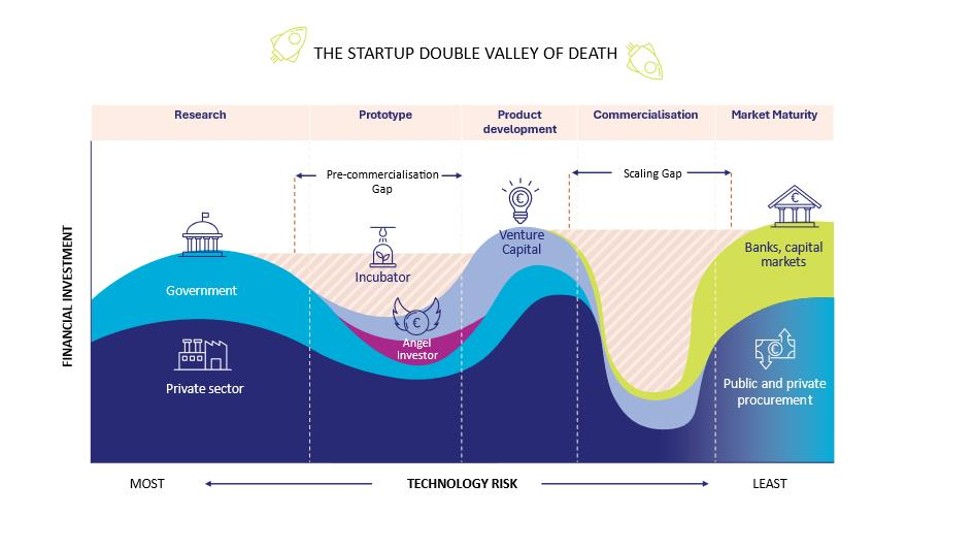
The capabilities needed also change as a venture progresses. Moving from research to a prototype requires different support from commercialisation, market entry or scaling.
From individual exchanges to an access-and-learning model
Entrepreneurial mobility cases implemented at Savonia provide practical examples of how complementary capabilities can be combined around venture-development needs. In one case, a shoulder-orthosis concept brought together business coaching and market research with design and physiotherapy expertise, prototype development and pitch preparation. In another, a venture developing an intuitive analogue instrument for cinematic soundtrack creation combined commercialization planning with electronic-engineering expertise, prototype development and pitching.
The cases show that technical, commercial and domain expertise can be assembled around a concrete venture need. They do not show that mobility is automatically the best response, or that cross-border support by itself produces commercial success. Earlier qualitative analysis identified structured access, adequate hosting resources and clear institutional responsibility as priorities. The institutional question is therefore how useful cross-border connections can become a repeatable support model without turning different incubators into copies of one another.
The proposed distributed incubator has two functions. It can connect a venture with specialist expertise, facilities, programmes or market environments elsewhere when that is the most practical response. It can also help partner incubators learn from one another and strengthen support locally. Customer-validation, pitch-training, mentoring and early-stage coaching methods may be more useful when adapted locally than when ventures are moved across Europe.
Specialist laboratories, highly specific expertise and access to another market ecosystem may be inefficient to duplicate. Methods, learning materials and repeatable programme formats may instead be transferable. A distributed incubator should distinguish between capabilities best accessed elsewhere and practices that can be developed locally. What makes the model more than a directory is continuity in venture development combined with learning between partners.
A pathway that starts with the venture need, not mobility
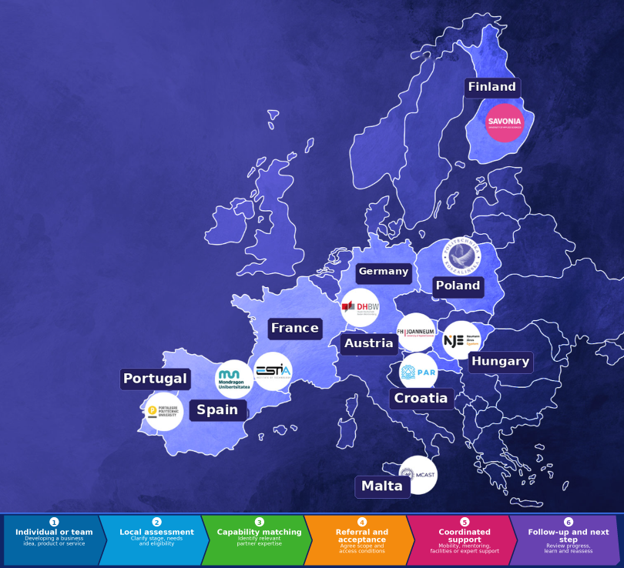
The pathway begins with a person or team developing a business idea, product or service. Local assessment clarifies the development stage, objective, support need and programme eligibility. The first question is whether the current ecosystem can respond effectively. If it can, there is no inherent reason to make the support international.
If a capability gap exists, the next question is how it should be addressed. The response may be local capability development through partner learning, virtual or visiting expertise, access to another partner’s specialist facility or programme, or an approved mobility arrangement. Mobility is therefore one possible delivery format, not the default next step.
The practical choice is between three routes: use suitable local support, strengthen local capability through shared methods, or access specialised capability elsewhere. Pitch training or customer-validation practices may be adaptable locally. A specialised testing environment, discipline-specific expertise or access to customers in another market may justify direct collaboration.
When another partner becomes involved in a venture case, that organisation still decides whether support is feasible and under what conditions. Existing programmes retain their own eligibility and operating rules; a shared pathway creates no automatic access rights. Follow-up then closes two learning loops. For the venture, it asks what changed and what need comes next. For the network, it asks whether the case revealed a capability that should remain specialised, a practice that could be transferred, or a gap that still requires development.
Savonia shows why regional capability and alliance learning both matter
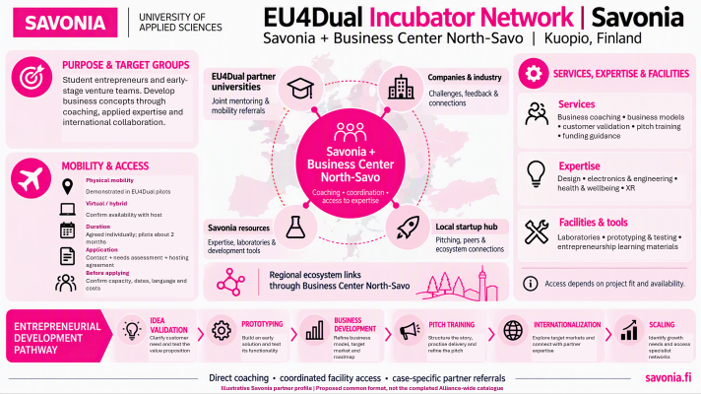
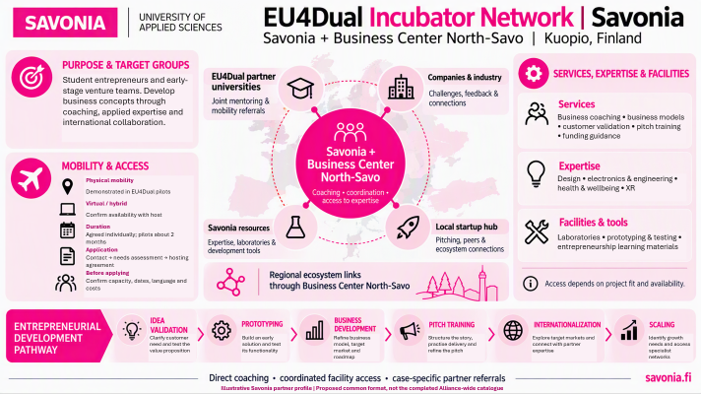
The Savonia capability profile connects Savonia University of Applied Sciences and Business Center North Savo with specialist expertise, research and development environments, companies and the wider startup ecosystem, from idea validation and prototyping to business development, pitching and internationalisation.
Experience from entrepreneurial mobility shows that parts of this capability base can already be assembled around concrete venture needs. Documented activities include prototype development, market exploration, commercialisation planning and pitch preparation supported by combinations of business, design, health and electronic-engineering expertise. These examples demonstrate applied venture development, but not yet long-term commercial success or a complete Alliance-wide incubation system.
A regional ecosystem will not contain every capability a venture may need, nor should every partner reproduce every specialist resource. Alliance cooperation can extend what a venture can reach and, where practices are transferable, strengthen the local incubator for future ventures. Some differences between incubators represent valuable specialisation; others reveal capabilities that partners can help one another develop.
What should be common, and what should remain local?
A shared catalogue of partner incubators and capability profiles can make available expertise and support more visible, but visibility alone does not create a functioning network. At Alliance level, the common layer can remain practical: comparable capability descriptions, identifiable contacts, enough information to understand a venture need, and follow-up on whether support was relevant and what development step followed.
The common layer can also support capability learning. Partners can identify transferable support models, exchange methods and materials, and examine which practices are worth developing locally. This can make the Alliance useful even to ventures that never physically move between institutions.
Actual service delivery remains local. Each university, incubator, laboratory or regional partner retains responsibility for eligibility, capacity, timing, costs, facility access, confidentiality, intellectual property and the support it can realistically provide.
The distributed incubator therefore makes a two-part, testable proposition: the Alliance can make specialist capabilities easier to access and strengthen local incubators through partner learning. The aim is not to move ventures unnecessarily or make every incubator identical. It is to use local support where it is sufficient, shared learning where capability can be strengthened, and cross-border access where specialised expertise or environments genuinely matter.
A distributed European incubator is therefore not one incubator spread across Europe, but a network in which ventures and incubators can both develop through the Alliance’s complementary strengths.
Authors
Matti Laitinen, RDI Expert, Business Center North Savo, Savonia University of Applied Sciences
Dr Jérémie Faham, Startup Manager, ESTIA Entreprendre / Hub ESTIA, ESTIA Institute of Technology
References
EU4Dual. iDual Entrepreneurships. 2026. https://eu4dual.education/learn/mobility-and-internships/idual-entrepreneurship/
Laitinen, M. 2025. Building Entrepreneurial Bridges Across Europe: Insights from the Second EU4Dual Entrepreneurship Mobility at Savonia University of Applied Sciences. Savonia Article Pro. https://www.savonia.fi/en/articles-pro/building-entrepreneurial-bridges-across-europe-insights-from-the-second-eu4dual-entrepreneurship-mobility-at-savonia-university-of-applied-sciences/
Laitinen, M. 2026. From Business Concept to First Pitch in EU4Dual Entrepreneurial Exchange: Entrepreneurial Mobility as a Pathway for Applied Innovation at Savonia University of Applied Sciences. Savonia Article Pro. https://www.savonia.fi/en/articles-pro/from-business-concept-to-first-pitch-in-eu4dual-entrepreneurial-exchange-entrepreneurial-mobility-as-a-pathway-for-applied-innovation-at-savonia-university-of-applied-sciences/
Laitinen, M., Faham, J., Jovanovski, B., & Catinot, A. 2026. Entrepreneurial Mobility as a Pathway Toward a European-Native Environment for Commercialization. Savonia Article Pro. https://www.savonia.fi/en/articles-pro/entrepreneurial-mobility-as-a-pathway-toward-a-european-native-environment-for-commercialization/
Savonia University of Applied Sciences. EU4Dual at Savonia: Partner map. 2026. https://eu4dual.savonia.fi/
Business Center North-Savo. 2026. https://bcpohjois-savo.fi/
EU4Dual Entrepreneurial Task Force. 2025. Entrepreneurial Framework: Concept Note for EU4Dual Extension
European Commission. 2025. The EU Startup and Scaleup Strategy: Choose Europe to start and scale. https://eur-lex.europa.eu/legal-content/EN/TXT/?uri=CELEX:52025DC0270