
Savonia Article Pro: Why Do Some People Experience More COVID-19 Vaccine Side Effects Than Others? Implications for Nursing Practice
Savonia Article Pro is a collection of multidisciplinary Savonia expertise on various topics.
This work is licensed under CC BY-SA 4.0


Introduction
The COVID-19 pandemic affected millions of people worldwide and highlighted the importance of vaccination in preventing severe disease and reducing mortality. Although COVID-19 vaccines have been proven safe and effective, concerns about side effects have remained one of the most common reasons for vaccine hesitancy. As a registered nurse, I have often met patients who were worried about possible vaccine reactions and asked whether side effects differ between individuals. These questions inspired my interest in exploring age- and gender-related differences in COVID-19 vaccine side effects and their implications for nursing practice.
Theoretical Background
Vaccines work by stimulating the immune system to recognize and respond to infectious diseases. COVID-19 vaccines activate immune responses that help the body develop protection against the SARS-CoV-2 virus. This immune activation may cause temporary side effects such as pain at the injection site, fatigue, headache, fever, chills, and muscle pain (World Health Organization 2024).
Most vaccine side effects are mild and disappear within a few days. According to previous research, age and biological sex may influence the frequency and intensity of vaccine reactions because immune responses vary between different population groups (Klein & Flanagan 2016). Younger individuals often have stronger immune responses than older adults, while females generally develop stronger immune reactions than males. These biological differences may affect how side effects are experienced following vaccination.
Understanding these differences is important because side effects can influence people’s attitudes toward vaccination. Fear of adverse reactions may increase anxiety and reduce vaccine acceptance, making patient education an essential part of nursing practice.
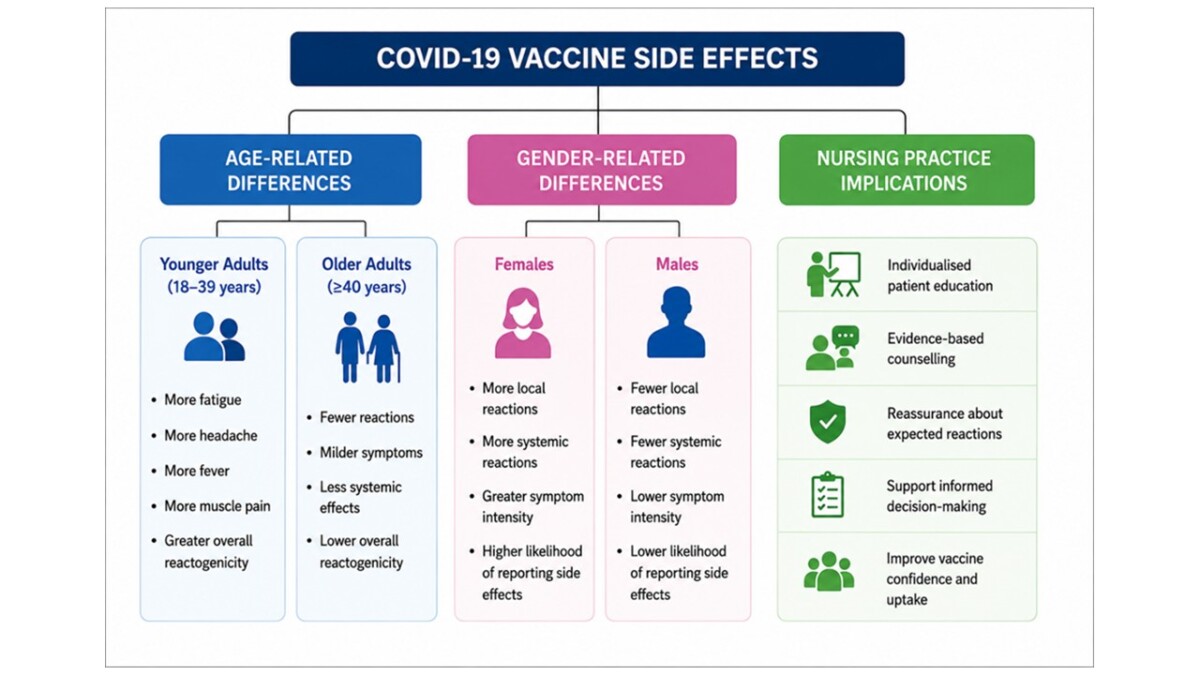
The figure presents a summary of the main findings identified in the literature regarding age-related and gender-related differences in reported COVID-19 vaccine side effects and their implications for nursing practice. The reviewed studies showed that younger adults more frequently reported local and systemic reactions such as fatigue, headache, fever, and muscle pain, whereas older adults generally experienced fewer and milder side effects. Similarly, females reported side effects more frequently and with greater intensity than males. These findings highlight the importance of individualised patient education, evidence-based counselling, reassurance about expected vaccine reactions, and support for informed decision-making. Understanding these differences can help nurses provide patient-centred care and improve vaccine confidence and uptake.
Presentation of the Topic
An important aspect highlighted by the COVID-19 vaccination campaign was the difference between actual risk and perceived risk. Although most reported vaccine side effects were mild and temporary, many individuals were concerned about potential adverse reactions. Research has shown that people often perceive rare events as more dangerous than they actually are, particularly when these events receive extensive media attention. During the pandemic, reports of vaccine side effects were widely discussed in news media and social media platforms, which sometimes increased public anxiety and uncertainty.
At the same time, many people underestimated the risks associated with COVID-19 infection itself. This demonstrates how risk perception can influence health-related decision-making. Individuals may focus on the possibility of experiencing vaccine side effects while paying less attention to the potentially serious consequences of the disease that vaccination is intended to prevent. Understanding this difference between perceived and actual risk is important for healthcare professionals.
The findings of this maturity test emphasise the significant role of nurses in supporting informed decision-making. Nurses are often among the most trusted healthcare professionals and are in a unique position to provide evidence-based information, answer questions, and address concerns related to vaccination. Effective communication requires not only presenting scientific facts but also listening to patients’ fears and acknowledging their concerns in a respectful manner.
The COVID-19 pandemic demonstrated that trust plays a crucial role in public health interventions. When individuals receive clear, accurate, and understandable information, they are more likely to feel confident in their decisions. Therefore, nursing practice should focus on both scientific knowledge and communication skills. By helping patients understand the benefits and risks of vaccination in a balanced way, nurses can contribute to improved health literacy, increased vaccine confidence, and better public health outcomes.
The findings of my literature review demonstrated clear age-related and gender-related differences in reported COVID-19 vaccine side effects. Several studies found that younger adults reported local and systemic side effects more frequently than older adults (Polack et al. 2020; Baden et al. 2021). Common symptoms included fatigue, headache, fever, chills, and muscle pain.
For example, a healthy young adult may experience tiredness, fever, and muscle aches for one or two days after vaccination, whereas an older adult may experience only mild discomfort at the injection site. Researchers suggest that these differences may be related to the stronger immune responses often observed among younger individuals.
The review also showed that females reported side effects more frequently than males (Menni et al. 2021). Women commonly reported injection-site reactions, fatigue, headache, and other systemic symptoms. Biological and hormonal differences are believed to contribute to these findings (Klein & Flanagan 2016).
Despite these differences, the studies consistently demonstrated that most side effects were temporary and self-limiting. Serious adverse reactions were rare, and the protective benefits of vaccination greatly outweighed the risks associated with mild post-vaccination symptoms.
Discussion: A Nursing Perspective
The findings of this review are highly relevant to nursing practice because nurses are often the healthcare professionals who answer patients’ questions about vaccines and side effects. During my nursing career, I have noticed that many patients become worried when they experience fatigue, fever, or muscle pain after vaccination. Some fear that the vaccine has made them sick, while others worry that they are experiencing a dangerous reaction. In most cases, these symptoms are temporary and indicate that the immune system is responding to the vaccine.
I also remember the beginning of the COVID-19 vaccination programme when many healthcare workers, including some of my own colleagues, felt stressed and uncertain about receiving the first vaccine dose. The vaccines had been developed rapidly, and there was a large amount of information and discussion in the media. Some colleagues worried that they might experience severe side effects or be unable to work after vaccination. However, most experienced only mild symptoms such as arm pain, fatigue, headache, or a mild fever. These experiences demonstrated how important it is to provide evidence-based information and reassurance.
As both a nurse and a mother, I also experienced uncertainty when COVID-19 vaccines became available for children. On one hand, I felt that vaccination was important to protect my daughters and help reduce the spread of infection. On the other hand, I worried about possible side effects because, like many parents, I wanted to make the safest decision for my children. This experience helped me understand why many parents had questions and concerns regarding childhood vaccination.
In my opinion, vaccine hesitancy is not always caused by a lack of knowledge. Sometimes it is a natural response to uncertainty and concern for one’s own health or the health of family members. This is why nurses play such an important role in providing accurate information, listening to concerns, and supporting informed decision-making.
In conclusion, younger adults and females appear to report COVID-19 vaccine side effects more frequently than older adults and males. However, most reactions are mild, temporary, and a normal part of the body’s immune response. Understanding these differences can help nurses improve patient education, reduce anxiety, and strengthen public confidence in vaccination programmes.
Authors
Zahedeh Khanlari, Master’s Degree Programme in Public Global Health, Savonia University of Applied Sciences
Maria Luojus, Principal lecturer, Savonia University of Applied Sciences
References
Baden, L.R., El Sahly, H.M., Essink, B., Kotloff, K., Frey, S., Novak, R. et al. 2021. Efficacy and Safety of the mRNA-1273 SARS-CoV-2 Vaccine. New England Journal of Medicine, 384(5), 403–416.
Klein, S.L. & Flanagan, K.L. 2016. Sex Differences in Immune Responses. Nature Reviews Immunology, 16(10), 626–638.
Menni, C., Klaser, K., May, A., Polidori, L., Capdevila, J., Louca, P. et al. 2021. Vaccine Side-Effects and SARS-CoV-2 Infection After Vaccination. The Lancet Infectious Diseases, 21(7), 939–949.
Polack, F.P., Thomas, S.J., Kitchin, N., Absalon, J., Gurtman, A. et al. 2020. Safety and Efficacy of the BNT162b2 mRNA Covid-19 Vaccine. New England Journal of Medicine, 383(27), 2603–2615.
World Health Organization. 2024. COVID-19 Vaccines: Safety and Effectiveness.