
Savonia Article Pro: Healthcare digitalization from a medical diagnostics laboratory employee perspective
Savonia Article Pro is a collection of multidisciplinary Savonia expertise on various topics.
This work is licensed under CC BY-SA 4.0


Digitalization In Healthcare
Digitalization in healthcare is multifaceted. Internal communication, technology acceptance, and digital competence are key factors, though they remain underresearched in medical diagnostics settings.
Internal Communication
Internal communication refers to strategic information exchange aimed at aligning goals and strengthening organizational culture. Different types of internal communication—digital or traditional, formal or informal, rich or lean— have varying strengths, making them suitable for different situations. Digital internal communication can act as a first touchpoint for employees during digitalization. (Kovaitė, Šūmakaris & Stankevičienė 2020; Verčič & Špoljarić 2020.)
Technology Acceptance And Digital Competence In Healthcare
Technology acceptance refers to a person’s willingness to use new technologies (Davis 1989). Better understanding of what affects technology acceptance enables earlier improvements and interventions (Holden & Karsh 2010). In healthcare, it is influenced by organizational support (Morris et al. 2023) and employee digital competence development (Kaihlanen et al. 2024). Digital competence in healthcare involves not only technical skills and knowledge but also attitude, adaptability, collaboration and much more (Konttila et al. 2019). While psychometric instruments exist to describe the diversity of digital competence in healthcare (Jarva et al. 2023), most studies have focused on nurses and physicians in hospital settings (Jarva et al. 2024).
Materials and Methods
The thesis “Internal Communication and Technology Acceptance in Healthcare: Professional and Age-Related Differences in a Medical Diagnostics Organization” (2026) used a mixed-methods approach, combining a survey (n=77) and focus group interviews (n=9), conducted between November 2025 and March 2026. The thesis explored how technology acceptance, digital internal communication, and digital competence affect digitalization from employees’ perspective in a medical diagnostics organization. Quantitative data were analyzed using descriptive statistics, t-tests, and correlations, while qualitative data were analyzed thematically.
Results
Professional Differences In Internal Communication And Technology Acceptance
Out of the different professions, laboratory technicians differed in their internal communication practices, with informal communication linked to greater use of physical bulletin boards. Unlike other professions, client-facing professions did not prefer illustrated “cheat sheets” for learning new digital solutions, likely due to the unpredictability of their work. Non-clinical professions reported higher confidence in their digital competence, especially in ethical skills. Technology acceptance among laboratory technicians was influenced by colleagues, whereas in other professions it was more related to using and evaluating digital solutions.
Age-Related Differences In Internal Communication And Digital Competence
Differences also emerged between age groups. Younger employees (under-35-year-olds) used internal communication channels less frequently and were less satisfied with them, reporting more accessibility issues. Employees aged 35-44 showed highest general digital competence, while older employees (over-44-year-olds) rated their digital competence lower but were more willing to share suggestions regarding digital solutions. Meanwhile, younger employees scored lower in ethical competence, possibly due to limited experience.
Communication, Cooperation And Collaboration In Healthcare Digitalization
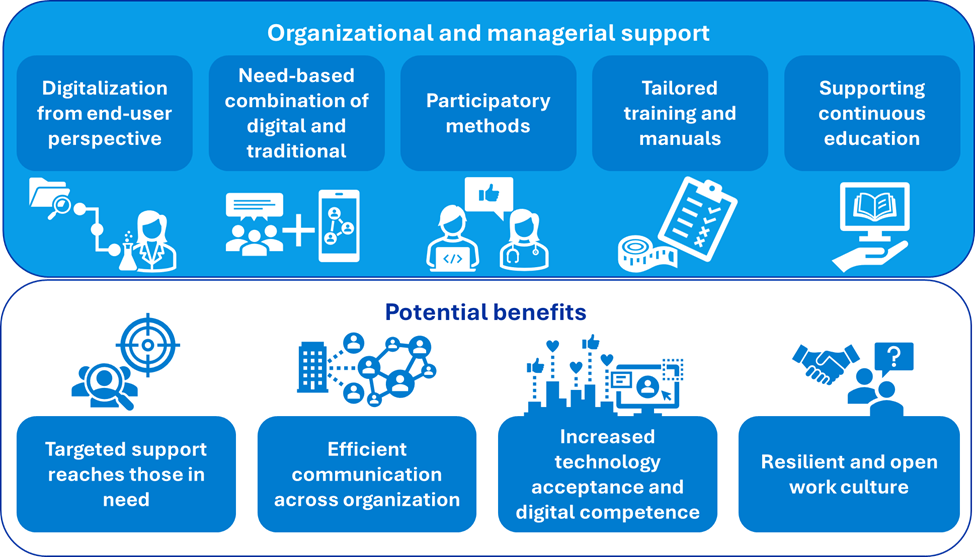
Communication was seen as essential in medical laboratories. Combining formal and informal, digital and traditional channels, helps meet diverse communication needs such as documentation, speed, accessibility, and reliability. Cooperation and collaboration were also essential for technology acceptance among interviewed participants as participatory approaches to digitalization were emphasized, including involving staff in decision-making and providing adequate support and training.
Implications for Digitalization in Healthcare
In conclusion, employees should be involved early in digitalization processes, with attention to perceived ease of use and usefulness of digital solutions. Continuous education, whether in-house or formal, supports developing employee digital competence as well as fostering positive attitudes towards digitalization. Synergy between internal communication, technology acceptance, and digital competence could support healthcare digitalization.
Authors
Käthy Rannaste, laboratory technician and Master’s degree student in Digital Health, Savonia University of Applied Sciences
Liisa Klemola, Senior Lecturer, PhD, RN, Savonia University of Applied Sciences, Unit of Continuous Learning, Master School, Kuopio, Finland
Juhamatti Huusko, Part-time Lecturer, PhD, Savonia University of Applied Sciences, Unit of Continuous Learning, Master School, Kuopio, Finland
Artificial intelligence has been used in the work as follows: ChatGPT 2026. OpenAI. GPT-5.3 model. Accessed for language check, April 2026. https://chat.openai.com.
References
Davis, F. D., 1989. Perceived usefulness, Perceived Ease of use, and User Acceptance of Information Technology. Journal of Risk and Uncertainty [online], 18 (3), 321–325. Available from: https://www.jstor.org/stable/249008 [Accessed 27 Sep 2025].
Holden, R. J. and Karsh, B.-T., 2010. The Technology Acceptance Model: Its past and Its Future in Health Care. Journal of Biomedical Informatics [online], 43 (1), 159–172. Available from: https://www.sciencedirect.com/science/article/pii/S1532046409000963?via%3Dihub [Accessed 28 Sep 2025].
Jarva, E., Oikarinen, A., Andersson, J., Pramila‐Savukoski, S., Hammarén, M. and Mikkonen, K., 2024. Healthcare professionals’ digital health competence profiles and associated factors: A cross‐sectional study. Journal of advanced nursing [online], 80 (8). Available from: https://onlinelibrary.wiley.com/doi/10.1111/jan.16096 [Accessed 9 Feb 2026].
Jarva, E., Oikarinen, A., Andersson, J., Tomietto, M., Kääriäinen, M. and Mikkonen, K., 2023. Healthcare professionals’ digital health competence and its core factors; development and psychometric testing of two instruments. International Journal of Medical Informatics [online], 171, 104995. Available from: https://www.sciencedirect.com/science/article/pii/S1386505623000126 [Accessed 26 Sep 2025].
Kaihlanen, A.-M., Virtanen, L., Kainiemi, E., Sulosaari, V. and Heponiemi, T., 2024. Continuing Education in Digital Skills for Healthcare Professionals — Mapping of the Current Situation in EU Member States. International Journal of Health Policy and Management [online], 13 (1), 1–7. Available from: https://www.ijhpm.com/article_4608.html.
Konttila, J., Siira, H., Kyngäs, H., Lahtinen, M., Elo, S., Kääriäinen, M., Kaakinen, P., Oikarinen, A., Yamakawa, M., Fukui, S., Utsumi, M., Higami, Y., Higuchi, A. and Mikkonen, K., 2019. Healthcare professionals’ competence in digitalisation: A systematic review. Journal of Clinical Nursing [online], 28 (5-6), 745–761. Available from: https://onlinelibrary.wiley.com/doi/10.1111/jocn.14710 [Accessed 26 Sep 2025].
Kovaitė, K., Šūmakaris, P. and Stankevičienė, J., 2020. Digital communication channels in Industry 4.0 implementation. Management, 25 (1), 171–191.
Morris, M. E., Brusco, N. K., Jones, J., Taylor, N. F., East, C. E., Semciw, A. I., Edvardsson, K., Thwaites, C., Bourke, S. L., Raza Khan, U., Fowler-Davis, S. and Oldenburg, B., 2023. The Widening Gap between the Digital Capability of the Care Workforce and Technology-Enabled Healthcare Delivery: A Nursing and Allied Health Analysis. Healthcare [online], 11 (7), 994. Available from: https://www.mdpi.com/2227-9032/11/7/994 [Accessed 29 Sep 2025].
Verčič, A. T. and Špoljarić, A., 2020. Managing internal communication: How the choice of channels affects internal communication satisfaction. Public Relations Review, 46 (3), 101926.