Savonia Article Pro: ÄLLITÄ: How Weather Influences 5G mmW Signal Quality
Savonia Article Pro is a collection of multidisciplinary Savonia expertise on various topics.
This work is licensed under CC BY-SA 4.0


In our ÄLLITÄ -project, (Älyä lämmitysjärjestelmiin Ilmastoystävällisesti tekoälyä hyödyntämällä, Regional Council of Pohjois-Savo, J10756, co-funded by European Union) Work package 2 is focusing on AI and data in smart energy systems. One item was to study the use of 5G signal strength attenuation to detect very local changes in weather and use that information indirectly to predict for example solar panel energy production. Following preliminary results from our 1st experiments and texts were originally generated by using Copilot and we did some minor editing to get better readability.
The measurements are based on Savonia UAS private 5G NSA network measurements and FMI weather station data. FMI weather station is located at Savilahti, Kuopio and it is very close to the Savonia campus area so it is giving local weather information. Dataset cover data from 1st of July, 2025 until 30th of September, 2025.
Preliminary study results
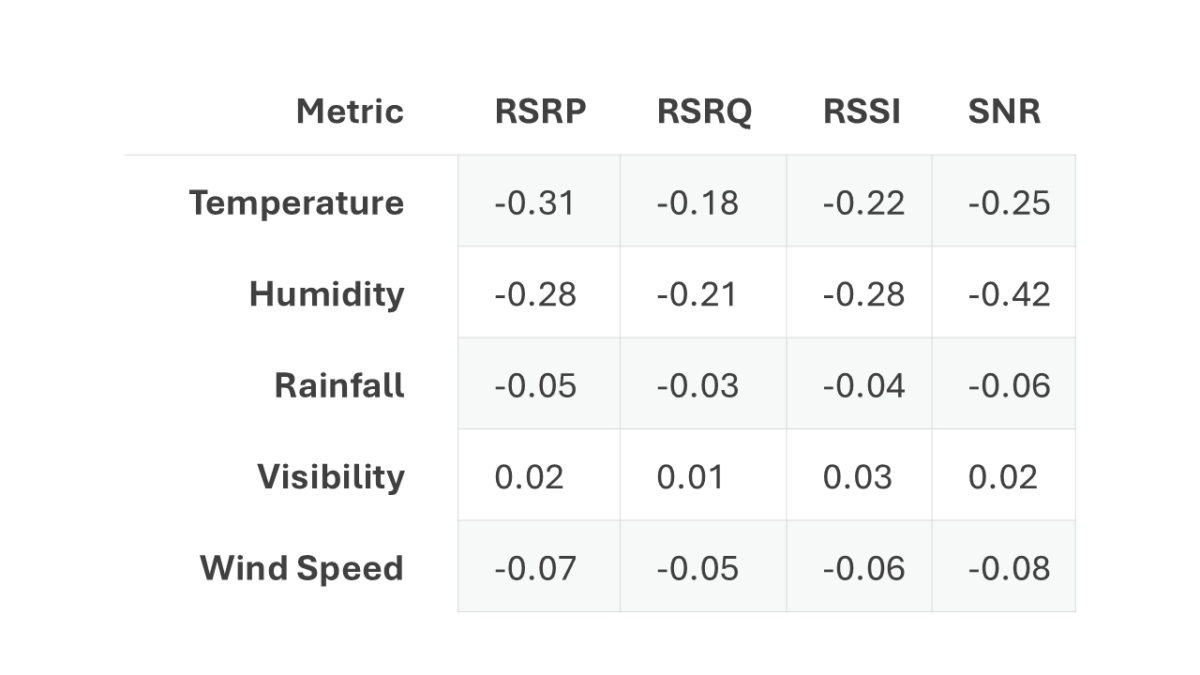
Recent analysis reveals how environmental factors influence wireless signal performance. The strongest correlation observed was between Humidity and SNR (-0.42), indicating that higher humidity significantly reduces signal-to-noise ratio, likely due to increased RF absorption and scattering. This suggests operators should consider adaptive modulation and error correction during humid conditions.
The second notable correlation is Temperature vs RSRP (-0.31). Elevated temperatures slightly weaken signal strength, possibly affecting equipment efficiency and propagation. Proactive cooling strategies and antenna optimization during heatwaves can mitigate this impact.
Finally, Humidity vs RSSI (-0.28) shows that moisture also degrades received signal strength, reinforcing the need for additional small cells or repeaters in high-humidity zones.
These insights highlight the importance of weather-aware network planning. By leveraging predictive analytics and dynamic resource allocation, operators can maintain robust connectivity even under challenging atmospheric conditions.
Future direction
We aim to further analyse and validate these results and if the results are promising and those supports our hypothesis we plan to submit results in some suitable scientific conference.
Authors:
Aki Happonen, Digital Development Manager, DigiCenter, Savonia-ammattikorkeakoulu, aki.happonen@savonia.fi
Shahbaz Baig, RDI Specialist, DigiCenter, Savonia ammattikorkeakoulu, shahbaz.baig@savonia.fi
Mika Leskinen, RDI Specialist, DigiCenter, Savonia-ammattikorkeakoulu, mika.leskinen@savonia.fi
Laura Leppänen, RDI Specialist, Savonia-ammattikorkeakoulu Oy, laura.leppanen@savonia.fi