Savonia Article Pro: Impact Pathway – A Tool for Evaluating Alternative Futures, Action Portfolios, and Adaptive Pathways
Savonia Article Pro is a collection of multidisciplinary Savonia expertise on various topics.
This work is licensed under CC BY-SA 4.0


The more complex the operating environment, the more difficult it becomes to identify the most impactful actions and assess their performance across different futures. Impact Pathway is an open-source prototype that integrates the evaluation of alternative futures, action portfolios, and adaptive pathways into a single framework. Alternative futures, or scenarios, help decision-makers understand what may happen. Portfolio analysis identifies which combination of actions is most worth pursuing. Adaptive analysis evaluates how well selected solutions can withstand disruptions, risks, and uncertainty. The approach enables focused workshops that, with relatively modest resources, generate new insights, support well-founded prioritization, and produce concrete action plans for implementation.
Introduction
Socio-technical systems—such as transportation, energy, food production, forestry, digital services, and critical infrastructure—create highly challenging environments for decision-making. Cause-and-effect relationships are difficult to understand, multiple stakeholders are involved, objectives may conflict, and operating environments change rapidly. Such situations are often described as complex or wicked problems (Rittel & Webber 1973; Sitra 2021a; Sitra 2021b).
In these contexts, there is a need for methods that help structure alternatives, identify interdependencies, evaluate the combined effects of actions, and assess the performance of decisions across different futures (Unruh 2000). At the same time, it is important to understand how well proposed solutions can withstand disruptions, uncertainty, and changes in the operating environment.
Impact Pathway is an open, facilitator-led approach that combines scenario analysis, action portfolios, and adaptive pathways within a single analytical framework. The method is based on participant assessments, analysis of interdependencies, and an open web-based application. Its aim is to produce transparent analyses that support focused and resource-efficient workshops (Belton & Stewart 2002).
Many real-world decision situations are simultaneously scenario, portfolio, and adaptation problems. Scenarios describe alternative futures. Portfolio analysis examines combinations of actions, including their synergies and conflicts. Adaptive analysis evaluates how well selected solutions perform across different future pathways and changing circumstances.
The core idea of the approach can be summarized through three questions: 1. What could happen? 2. What should be done? 3. How well will the plan perform under different futures?
Scenario analysis addresses the first question, portfolio analysis the second, and adaptive analysis the third.
The method can be applied, for example, in municipal climate and adaptation programmes, corporate investment and development portfolios, and planning related to safety, security of supply, and service continuity. Although numerous methods exist for scenario development and portfolio decision analysis, integrating them into a single analytical process has often been cumbersome and dependent on multiple separate software tools (Association of Finnish Local and Regional Authorities 2022).
Impact Pathway builds upon a long line of methodological development at Savonia University of Applied Sciences, including the A’WOT approach (Kurttila et al. 2000), its applications in scenario planning and decision support (Leskinen et al. 2006; Puurunen et al. 2020), business model evaluation (Kajanus et al. 2014), and the PRIA approach (Paldanius & Kajanus 2021). In recent years, this work has been extended to the assessment of interdependencies, climate actions, sustainability, and systemic impact (Mustajoki et al. 2024; Lukmine et al. 2025; Heikkinen 2025).
Despite these developments, challenges remain regarding tool accessibility, the workload associated with assessments, the transparency of analyses, and the ability to utilize results directly during workshops. Furthermore, scenario analysis, portfolio analysis, and resilience assessment have often remained separate stages within planning processes.
For these reasons, the objective was to develop an open prototype based on transparent computational principles. The prototype was developed iteratively using AI-assisted methods; however, all key decisions and approvals were based on expert judgment, testing, and human quality assurance. This article first presents the methodological foundations of the tool, then an illustrative application example, and finally discusses the results and future development opportunities.
2. Methods and Tool Development
2.1 Methods
Impact Pathway is based on impact pathway thinking, in which decision-making challenges are structured into future states, actions, impacts, and goals. The method helps transform threats, opportunities, development needs, and ideas identified in workshops into analyzable entities. Rather than focusing on individual solutions, the analysis examines the broader system formed by alternative futures, actions, and objectives.
The approach integrates three analytical levels: scenario analysis (morphological scenario analysis; Lempert et al. 2003), portfolio analysis (Liesiö et al. 2007), and adaptive pathway analysis (Haasnoot et al. 2013). Scenario and portfolio analyses can be conducted independently or combined into an adaptive analysis framework.
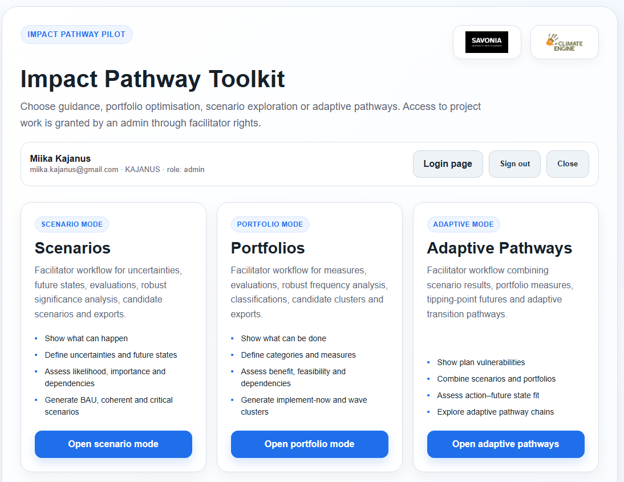
Figure 1. Overview of the Impact Pathway process. The application interface is available in English.
In the scenario analysis, participants first identify key uncertainties and their alternative future states. These states may represent threats, opportunities, or desired target states. Each state is assessed in terms of likelihood (1–5), strategic significance as a threat or opportunity (−3 to +3), and dependencies with other states (−3 to +3). Positive dependencies indicate mutually reinforcing developments, whereas negative dependencies represent conflicting or incompatible states.
In the portfolio analysis, potential actions and their expected impacts are first formulated as action-impact statements. Participants then assess the benefit and feasibility of these action-impact chains (1–5) as well as dependencies between actions (−3 to +3). Positive dependencies indicate synergies, while negative dependencies represent conflicts or overlaps.
The adaptive analysis combines scenario and portfolio analyses (Haasnoot et al. 2013). Future states are assessed for goal alignment (1–5), and the influence of actions on future states is evaluated (−3 to +3). This makes it possible to examine how actions support preparedness for, or achievement of, different futures.
At all analytical levels, dependency assessment is based on pairwise comparisons. Assessors first identify the causal mechanism linking two elements and then evaluate the direction and strength of the relationship. Brief justifications are recommended to improve transparency. Participants are encouraged to assess only the most strategically important relationships.
Based on these assessments, the application generates scenario candidates and action portfolios. Scenario candidates may represent likely development paths, critical uncertainties, or threat scenarios. Portfolio analysis identifies action clusters, synergies, enabling actions, and potential conflicts.
The robustness of results is evaluated using Robust Frequency (RF) analysis. The principle is to run the analysis under multiple assumption sets and examine how often a future state, action, or adaptive pathway appears among the best-performing alternatives. The more frequently an element is selected, the more robust it is considered. RF analysis builds on the principles of robust decision making (Lempert et al. 2003) and robust portfolio analysis (Liesiö et al. 2007). In the adaptive analysis, these principles are applied to dynamic pathways in the spirit of the Dynamic Adaptive Policy Pathways (DAPP) framework (Haasnoot et al. 2013).
In scenario and portfolio analyses, RF is based on the values assigned to individual elements and on the additional value or penalty created by their interdependencies. The calculations vary assumptions regarding assessment uncertainty, dependency weight (β), and the size of the selected set. In scenario analysis, RF reflects the robust significance of future states, whereas in portfolio analysis it reflects the robust usefulness of actions.
In the adaptive analysis, RF is applied to pathways consisting of a first-wave action, a realized threat (trigger), a response action, and a future endpoint state (endpoint) representing the desired outcome. The application selects the eight most promising first-wave actions, the eight most severe trigger threats, the twelve most suitable response actions, and the eight most desirable endpoint states. These elements generate 6,144 potential pathways (8 × 8 × 12 × 8).
Pathway evaluation considers factors such as goal alignment, the support provided by actions to the endpoint, the ability of actions to mitigate triggers, trigger pressure, and adaptive gain. Endpoint alignment and supporting factors increase pathway value, whereas the significance of realized threats and their reinforcing factors decrease it. A pathway effectively collapses when the threat component becomes stronger than the goal component.
For optimization purposes, the application automatically evaluates dependencies between pathways on a scale from −3 to +3 based on pathway structure and underlying scenario and portfolio assessments. Pathway dependencies indicate whether pathways are mutually reinforcing (sharing goals, resources, or supportive effects), parallel preparedness options (neutral), or competing alternatives (competing for the same actions, pursuing different endpoint states, or weakening each other’s trigger and endpoint management capabilities). The resulting RF value indicates how well a pathway maintains its position across varying assumptions and scenario conditions.
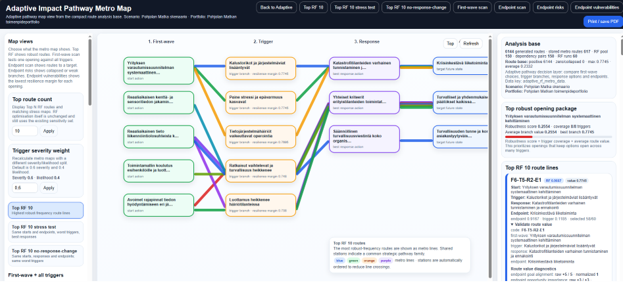
The Metro Map views support adaptive analysis. The Top RF Map displays the strongest pathways, the Stress Test examines performance under adverse conditions, and Endpoint Analyses help identify opportunities and vulnerabilities associated with target states.
Network View visualizations complement interpretation. In scenario analysis, they illustrate dependencies among future states, coherent clusters, and critical branching points. In portfolio analysis, they reveal synergies, enabling actions, and conflicts. In adaptive analysis, network interpretation becomes pathway interpretation, focusing on strong pathways, switching points, and vulnerabilities within plans.
Impact Pathway does not replace expert judgment; rather, it makes assessments transparent, comparable, and open to discussion. The value of the method lies in enabling participants to see how assessments, dependencies, and assumptions influence scenarios, portfolios, and adaptive pathways.
2.2 Tool Development
The methodology described above has been implemented as a facilitator-oriented toolkit designed for participatory workshops, where analyses are conducted interactively with participants and results emerge as part of the decision-making process.
The first version of the tool was developed as an Excel-based system consisting of separate Scenario and Portfolio modules. Data collection was conducted using KoBoToolbox forms, visualizations were created in Kumu, and optimization relied on the OpenSolver Advanced add-in. Although this setup enabled practical testing of the methodology, the use of multiple separate applications increased the complexity of data transfer and maintenance.
During the research process, the tool was redeveloped as a web-based application, integrating previously separate workflow stages into a single user interface. In the web version, scenario and portfolio analyses were redesigned so that user inputs are stored in a centralized database and analyses can be performed directly within the application without separate data-transfer steps. At the same time, the optimization model was redesigned. The nonlinear integer optimization used in the Excel version was linearized, enabling more efficient optimization algorithms and substantially faster computation, particularly for large networks.
The web version also introduced a new Adaptive module, extending the methodology from static scenario and portfolio analyses to adaptive planning. The module generates alternative pathways composed of actions, threats, responses, and target states and evaluates their robustness across changing futures. This enables both initial actions and subsequent adaptation points to be examined within the same analytical framework.
Software development followed an iterative AI-assisted development process (AI pair programming), in which artificial intelligence supported code drafting, testing, and debugging. Development was supported by OpenAI’s ChatGPT service (GPT-4o and later GPT-5.5 models). The process followed a recurring cycle of specification, implementation, testing, correction, and documentation. Final solutions were always approved through functional testing and researcher-led quality assurance.
Source code version control was managed through GitHub, enabling change management, documentation, and development tracking. Supabase serves as the system’s data repository, handling user management, projects, assessments, analysis results, and database services. The web application itself is hosted on Render, which manages deployment, server operations, and continuous updates from the GitHub repository. This architecture enables centralized maintenance, automated software updates, and use of the tool without local installation.
Using the web version requires only a web browser and user account. All analyses, visualizations, and optimization calculations are executed in the server environment, reducing technical requirements for users and enabling application of the method in large-scale participatory processes.
3. Case Example: Pohjolan Matka Ltd
3.1 Case Description and Workshop Process
Pohjolan Matka Ltd. is a Finnish travel and transportation company operating more than 200 buses that collectively travel over 8 million kilometers annually under highly variable weather conditions. Safety is the company’s highest priority.
In autumn 2025, Pohjolan Matka participated in a rapid series of three workshops aimed at improving preparedness for extreme weather events. The first workshop focused on developing a shared situational understanding, the second on generating and evaluating potential measures, and the third on assessing action portfolios. The workshops were organized as part of the Climate Engine project and involved experts from the Centre for Economic Development, Transport and the Environment of North Savo (ELY Centre), the Finnish Road Safety Council (Liikenneturva), Humak University of Applied Sciences, and Savonia University of Applied Sciences.
The situational assessment highlighted two key needs: improved anticipatory information and strengthened psychological resilience among drivers. Numerous complementary measures were identified for both themes, including technical solutions, operational practices, and communication-related actions. Evaluation of the measures helped identify the combination of actions that produced the highest overall benefit when interactions between measures were considered.
At the time of implementation, only the portfolio-analysis component of the Impact Pathway tool was available and used in the workshops. During spring 2026, the project team revisited the same dataset and additionally conducted scenario and adaptive analyses using the completed web-based version of the tool.
3.2 Scenarioanalysis
Based on the results of the 2025 situational assessment workshop, a scenario analysis was conducted to identify future developments that could significantly affect Pohjolan Matka’s operating environment. A future-state matrix was developed for this purpose.
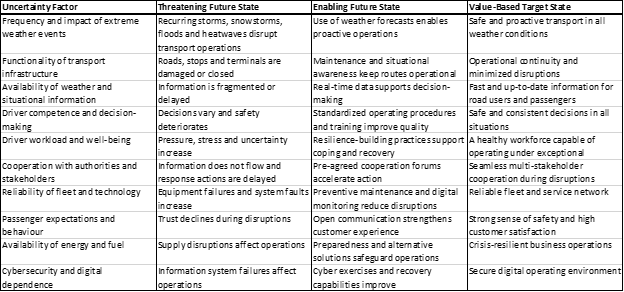
Table 1. Future-state matrix constructed from the situational assessment workshop results.
Future states were evaluated based on their likelihood, strategic significance, and interdependencies.
The most important uncertainties were found to be the increasing frequency of extreme weather events and the vulnerability of the transportation system to disruptions. At the same time, several desirable future states were identified, including crisis-resilient business operations, safe and consistent operating procedures, high customer satisfaction, and proactive safety leadership.
The web application’s network visualizations help users understand relationships among future states and develop a shared understanding of the environmental changes to which the company should prepare.
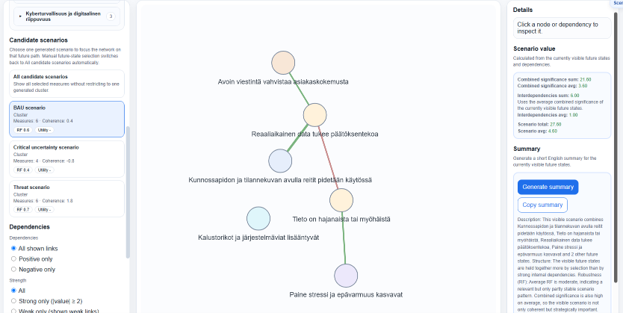
Figure 2. Scenario Network View showing the Business-as-Usual scenario.
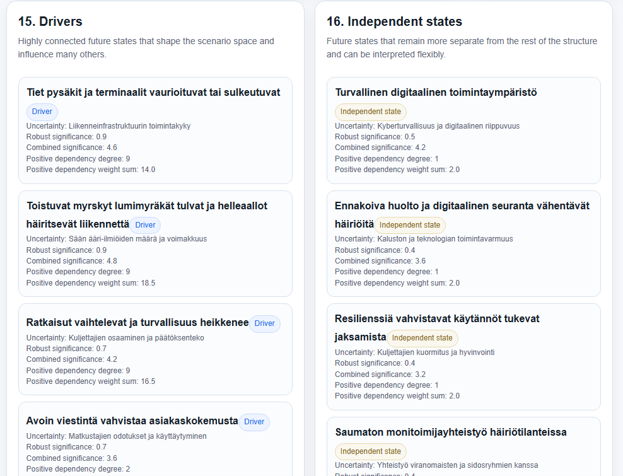
Figure 3. Results of the scenario analysis, highlighting key drivers and relatively independent future states identified by the analysis.
3.3 Portfolioanalysis
The portfolio analysis evaluated the benefits, feasibility, and interdependencies of potential actions.
The most important actions identified were the systematic development of the company’s preparedness plan, the use of real-time traffic and weather information, open information-sharing solutions, monitoring of driver safety, and staff training.
The results demonstrated that the greatest value emerges from combinations of actions rather than from individual measures. Robust Frequency analysis further identified actions that remained important under varying assumptions and together formed the core portfolio for improving safety and resilience.
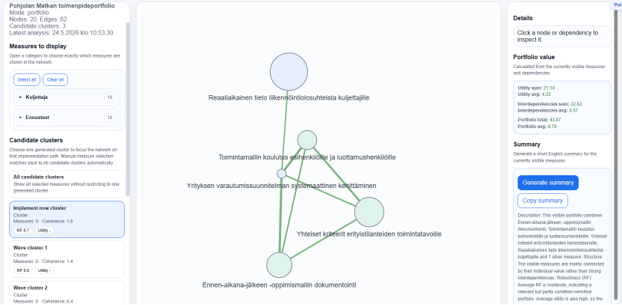
Figure 4. Portfolio Network View showing the action cluster recommended for immediate implementation.
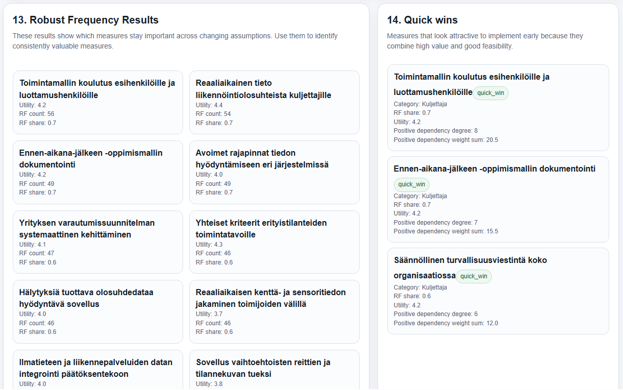
Figure 5. Prioritized action list based on Robust Frequency results, highlighting quick wins—actions that are both highly beneficial and relatively easy to implement.
3.4 Adaptive analysis
The adaptive analysis examined the performance of actions under changing conditions by combining eight first-wave actions, eight trigger threats, twelve response actions, and eight target future states into 6,144 possible pathways (8 × 8 × 12 × 8).
The results showed that the systematic development of the company’s preparedness plan most frequently served as the starting point of robust adaptive pathways. The most critical trigger threats were recurring storms, transportation system disruptions, infrastructure damage, and information system failures. The strongest response measures included early detection of crisis situations, shared operating criteria for exceptional circumstances, and regular safety communication.
The Metro Map analysis revealed both the strongest pathways and their vulnerabilities. It also identified situations in which the original plan would need to be modified and highlighted which responses best support the achievement of strategic objectives under different disruption scenarios.
Figure 6. Adaptive Metro Map showing the ten strongest pathways identified by the analysis. These pathways remain robust across changing assumptions and conditions. Additional views allow users to test alternative trigger threats, examine available response options, and assess the severity of threats when responses cannot be implemented in time.
3.5 Summary of Results
The Pohjolan Matka case illustrates how the three analytical levels of Impact Pathway complement one another. Scenario analysis identifies changes in the operating environment, portfolio analysis identifies the most effective combinations of actions, and adaptive analysis evaluates their robustness under disruptions and alternative future conditions.
The results indicate that improving safety and resilience depends on mutually reinforcing sets of actions rather than isolated measures. Adaptive analysis also makes visible situations in which the original plan is insufficient without predefined response options.
From the company’s perspective, the main benefits were the creation of a shared situational understanding, improved prioritization of decisions, and the development of a concrete action programme. The case demonstrates that scenarios, portfolios, and adaptive planning can be integrated into a single analytical framework in a lightweight and transparent manner.
The company’s CEO summarized the experience as follows: “The workshops were pleasantly concise, yet surprisingly rich in content. They produced concrete benefits and a practical action plan that improves safety. The process clarified priorities and introduced new perspectives, such as before–during–after learning through the use of action cards. The importance of safety became much clearer: it can also be a differentiating factor and a competitive advantage when a company documents its operating procedures, invests in proactive safety management, and communicates its values consistently. From the company’s perspective, participation was straightforward and required only modest resources.” – Johanna Lehtonen, CEO, Pohjolan Matka Ltd.
4. Results
4.1 AI-Assisted Development of the Tool
The development of Impact Pathway progressed from an Excel-based prototype to a web application during 2025–2026. The first version combined scenario and portfolio analysis within a single workshop process and was tested in the Climate Engine project, the Pohjolan Matka case study, and the CO-FOREST scenario project (see: https://www.co-forest.site/post/future-scenarios-different-forest-futures-across-europe ).
User feedback indicated that the main limitations of the Excel-based solution were the need to use multiple software applications, data-transfer steps, and separate optimization procedures. Consequently, development shifted toward a browser-based web application in which the entire analytical workflow could be performed within a single interface.
In spring 2026, scenario and portfolio analyses were migrated to the web environment. At the same time, the optimization model was reformulated into a linearized form, resulting in faster calculations, improved scalability, and support for interactive visualizations. During development, a new Adaptive module was also created, integrating first-wave actions, realized threats, response measures, and target states into adaptive pathways.
The first pilot version of the web application was completed in June 2026. The resulting prototype combines scenario analysis, portfolio analysis, and adaptive planning within a single environment. Assessments, calculations, visualizations, and result exploration are conducted through one integrated user interface.
Development was carried out using an AI-assisted approach in which artificial intelligence supported code generation, testing, debugging, and documentation. Final solutions were always validated through testing and expert review.
The web application architecture is based on GitHub for version control, Supabase for data storage and user management, and Render as the hosting and server environment. Deployment requires only a web browser and user credentials.
The results demonstrate that AI-assisted development is well suited for prototyping research-based decision-support methods, enabling rapid development while maintaining transparency and researcher control over the resulting solutions.
4.2 Results of the Pohjolan Matka Case Study
The results are based on a series of three workshops conducted in autumn 2025. The process began with building a shared situational understanding, followed by the generation and evaluation of potential actions, and concluded with an assessment of action portfolios. In the portfolio analysis, the most significant measures were the systematic development of a preparedness plan, the use of real-time traffic and weather information, open information-sharing solutions, safety training, and strengthening driver resilience. The results particularly emphasized the importance of interactions and synergies among actions.
In addition, the project team conducted illustrative scenario and adaptive analyses using the same case material. The scenario analysis identified recurring storms and snowstorms, transportation infrastructure damage, supply disruptions, and information system failures as the most significant threat factors. Desired future states included crisis-resilient business operations, safe operating practices, a strong sense of safety, and high customer satisfaction. The results help identify key preparedness needs.
In the adaptive analysis, the development of the preparedness plan most frequently emerged as the starting point of the strongest pathways. The most important response measures included early identification of crisis situations, shared operating criteria for exceptional circumstances, and regular safety communication. Stress tests and endpoint-risk analyses showed that the success of the overall plan depends particularly on the ability to manage large-scale weather-related and infrastructure disruptions.
This illustrative case demonstrates that Impact Pathway can integrate the analysis of future uncertainties, action prioritization, and adaptive planning within a single analytical framework. The approach enables focused workshops that generate new insights, justified prioritization, and concrete action plans with relatively modest resources. At the same time, it provides a practical foundation for improving organizational safety, preparedness, and resilience.
5. Discussion and Future Development
The results indicate that the primary objective of the Impact Pathway project was achieved. The study resulted in a functional web-based prototype that integrates scenario analysis, portfolio analysis, and adaptive pathway analysis into a single decision-support framework. The method was successfully applied in practical workshop settings to build a shared situational understanding, compare alternatives, prioritize actions, and account for uncertainty.
A key finding of the study is that scenarios, portfolios, and adaptive planning form a natural continuum. Scenarios help decision-makers understand what may happen, portfolio analysis identifies the most impactful actions, and adaptive analysis evaluates how well selected solutions perform across different futures and when adjustments may be required. Integrating these perspectives within a single analytical framework represents the study’s most significant contribution.
A major strength of the approach is its ability to make systemic interdependencies visible. Assessing future states, actions, and their relationships generates information that often remains hidden in methods focused on individual solutions. At the same time, visualizations facilitate the interpretation of complex systems and analytical results.
The findings also suggest that the Robust Frequency (RF) approach is well suited to participatory decision-making processes. Rather than identifying a single optimal solution under one set of assumptions, RF highlights options that remain relevant across multiple assumptions and future conditions. This is particularly valuable in addressing climate change, safety, security of supply, and other complex societal challenges.
The development of the web application significantly improved usability. While the earlier Excel-based solution demonstrated the feasibility of the method, the web application integrates assessments, calculations, visualizations, and result exploration within a single interface. This lowers the barrier to adoption and enables the method to be used in larger and more diverse participatory processes.
The study also identified several areas for further development. More experience is needed regarding the management of the entire process and the level of effort required from participants. Additional evidence is also needed concerning the quality and reliability of assessments. Because the method relies on expert judgment, result quality depends on participant expertise and the effectiveness of the assessment process. Future research should examine differences between evaluators, the sensitivity of results to assessment assumptions, and opportunities to incorporate external data sources into the evaluation process.
A second development direction concerns adaptive analysis. The Metro Map approach developed in this study demonstrated its ability to identify robust pathways, stress situations, and vulnerabilities. A particularly promising avenue for future research is the incorporation of a temporal dimension into adaptive pathways, enabling the analysis of action timing, decision points, and transition moments.
A third area of development relates to the use of artificial intelligence. In this study, AI was primarily used to support software development and assessment processes. In the future, AI could be applied more extensively to pre-populate assessments, draft scenario narratives, and generate alternative policy and development pathways.
More broadly, the study demonstrates that participatory evaluation methods can be used to build practical decision-support systems for addressing complex challenges. Although Impact Pathway remains a prototype, the results show that scenarios, portfolios, and adaptive planning can be integrated into a single transparent analytical framework. The approach enables focused workshops that generate new insights, justified prioritization, and concrete action plans with relatively modest resources.
In conclusion, the study’s most important contribution is not a specific software application or calculation model, but a methodological framework that integrates future-oriented thinking, action prioritization, and adaptive decision-making into a single process for supporting shared understanding. The results suggest that the approach has considerable potential to support decision-making in both public and private organizations operating under conditions of high uncertainty where decisions must nevertheless be made.
References
Belton, V. & Stewart, T.J. 2002. Multiple Criteria Decision Analysis: An Integrated Approach. Springer/Kluwer.
Haasnoot, M., Kwakkel, J.H., Walker, W.E. & ter Maat, J. 2013. Dynamic Adaptive Policy Pathways: A Method for Crafting Robust Decisions for a Deeply Uncertain World. Global Environmental Change 23(2), 485–498.
Heikkinen Anne 2025. Vastuullista vaikuttavuutta näkyväksi – näin Savonia arvioi vaikuttavuuttaan. Savonia Pro artikkeli 2025. https://www.savonia.fi/vaikuttavuus/vastuullista-vaikuttavuutta-nakyvaksi-nain-savonia-arvioi-vaikuttavuuttaan/
Kajanus, M., Iire, A., Eskelinen, T., Heinonen, M. & Hansen, E. 2014: Business model design: new tools for business systems innovation, Scandinavian Journal of Forest Research
Kuntaliitto. 2022. Ilmasto-ohjelman rakennemalli. Julkaisu. Viitattu 15.3.2026.
Kurttila, M., Pesonen, M., Kangas, J., Kajanus, M. 2000. Utilizing the analytic hierarchy process (AHP) in SWOT analysis—a hybrid method and its application to a forest-certification case. Forest policy and economics 1 (1), 41-52
Lempert, R., Popper, S. & Bankes, S. 2003. Shaping the Next One Hundred Years: New Methods for Quantitative, Long-Term Policy Analysis. RAND Corporation.
Leskinen, L., Leskinen, P., Kurttila, M., Kangas, J., Kajanus, M. 2006. Adapting modern strategic decision support tools in the participatory strategy process—a case study of a forest research station. Forest Policy and Economics 8 (2006) 267– 278
Liesiö, J., Mild, P. & Salo, A. 2007. Robust portfolio modeling with incomplete cost and benefit information. European Journal of Operational Research, 180(1), 358–372.
Lukmine, D., Mizaras, S., Gulbinas, A., Kajanus, M. 2025. Testing the Prospective Rapid Impact Assessment Approach for Stakeholders Engagement in Municipality Action Planning: The Case of Tauragė. Sustainability. 2025-03-18. DOI: 10.3390/su17062684
Mustajoki, J., Liesiö, J., Kajanus, M., Eskelinen, T., Karkulahti, S., Kee, T., Kesänen, A., Kettunen, T., Wuorisalo, J., Marttunen, M. 2024. A portfolio decision analysis approach for selecting a subset of interdependent actions: The case of a regional climate roadmap in Finland. Science of The Total Environment. Volume 912, 20 February 2024.
Paldanius, K. ja Kajanus, M. 2021. Future divercities-project (e)valuation report. Savonia University of Applied Sciences Serie 2/2021
Puurunen, A., Ikäheimo, T-M., Nissen, M., Huotarinen, A., Jyrkkänen H-K., Huttunen, J., Koivisto, T., Kajanus, M., von und zu Fraunberg, M. 2020. Neuromodulation nurses, teamwork, and the establishment of a multi-disciplinary pain center are key success factors in neuromodulation: a hybrid SWOT analysis of the neuromodulation process for chronic pain. British Journal of Neuroscience Nursing. Vol. 16, No. 2.
Rittel, H.W.J. & Webber, M.M. 1973. Dilemmas in a General Theory of Planning. Policy Sciences 4(2), 155–169. (avoimesti saatava PDF-arkisto).
Sitra. 2021a. Viheliäinen ongelma (tulevaisuussanasto) sekä Kohti viheliäisten ongelmien ratkaisemista – ongelman monipuolinen ymmärrys ja yhteinen suunta monialaisissa tiimeissä. Verkkosivu ja selvitys.
Sitra. 2021b. Marttila, P. Taksonomia tulee: Kestävyyden luokittelu vaikuttaa rahoituksen hintaan. Blogi.
Unruh, G.C. 2000. Understanding carbon lock-in. Energy Policy 28(12), 817–830
Links
The tool: https://impact-pathway-web-pilot.onrender.com
User and development community: https://teams.microsoft.com/l/team/19%3Akl7gJrgfO4eoFwi3IwXU8l6ek1vpHq8nIMbD01uz4201%40thread.tacv2/conversations?groupId=480dacea-3c81-4ee0-82ac-469cdb884f74&tenantId=b6d5681b-4a40-4d3a-8e7b-03a70d3991b6
Authors
Miika Kajanus, retired, Savonia University of Applied Sciences
Antti Kotimaa, RDI Expert, Savonia University of Applied Sciences
Minna Luoto, RDI Expert, Savonia University of Applied Sciences
Lauri Kerman, Senior Specialist, Savonia University of Applied Sciences
Hannu Autti, Lecturer, Savonia University of Applied Sciences
Seppo Koponen, Lecturer Savonia University of Applied Sciences
Timo Dunkel, IT Systems Designer, Savonia University of Applied Sciences
Kaija Vilman, RD Manager, Savonia University of Applied Sciences
Jukka Kähkönen, RDI Expert, Savonia University of Applied Sciences
Tuomo Eskelinen, Research Manager, Savonia University of Applied Sciences
Jyri Wuorisalo, RDI Expert, Savonia University of Applied Sciences
Anni Kesänen, Lecturer, Savonia University of Applied Sciences
This article was prepared with the help of AI.