
Savonia Article Pro: Learning to Use AI Wisely: Insights from a Practical University Students’ Workshop
Savonia Article Pro is a collection of multidisciplinary Savonia expertise on various topics.
This work is licensed under CC BY-SA 4.0


Artificial intelligence (AI) is rapidly becoming embedded in students’ everyday learning practices. In higher education, students increasingly use AI tools to summarise materials, clarify concepts, improve language accuracy, and generate ideas. While these tools can support learning in meaningful ways, many students still lack practical guidance on how to use AI critically, ethically, and in ways that genuinely enhance learning rather than replace it.
This project explored how first-year international Savonia UAS students currently use AI and examined whether a short, practical workshop could strengthen students’ understanding of responsible, learning-focused AI use. An interactive 90-minute workshop was delivered to 45 first-year students of IoT and Mechanical Engineering in November 2025, as part of their orientation to university studies. Rather than focusing only on policies or technical instructions, the sessions were designed with an emphasis on hands-on learning, discussion, and critical reflection.
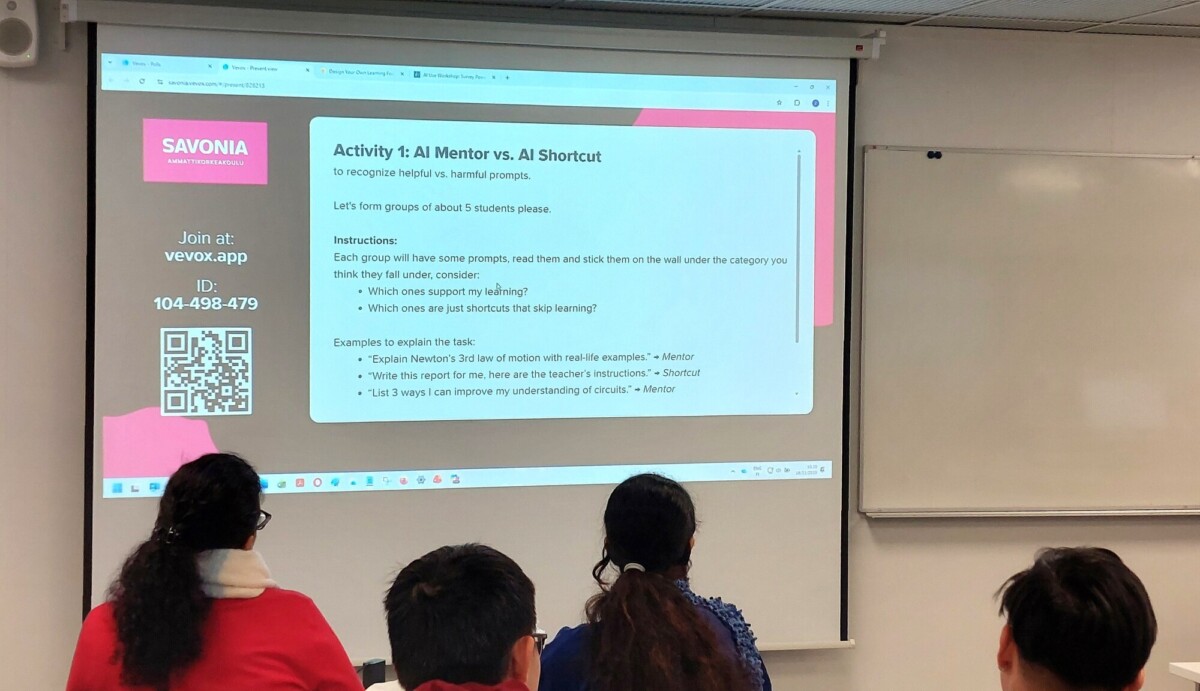
Students actively tested AI tools, evaluated AI-generated outputs, identified inaccuracies, and practised designing prompts that supported understanding as a “mentor”, instead of bypassing learning as a “shortcut”. The workshops aimed to help students recognise both the possibilities and the limitations of AI within authentic learning contexts.
Students are already using AI – but often without critical evaluation
Workshop discussions, polls, and activities showed that most students already use AI regularly in their studies. Common uses included:
- summarising study materials
- checking understanding of difficult concepts
- language support, including translation and grammar correction
- generating ideas and examples
Students described AI as particularly useful for simplifying complex topics, offering alternative explanations, and saving time during study tasks. Many students also valued AI for helping them structure their thinking and improve clarity in written work.
While some students were generally aware that AI can produce errors, this awareness was often superficial. During the workshops, concerns such as inaccurate information, misleading responses, and over-reliance became more explicit through guided activities and discussion. Most students had tended to place a high level of trust in AI outputs, rather than consistently engaging in critical evaluation.
Practical activities revealed gaps in AI literacy
The workshops centred on collaborative, hands-on group activities designed to move beyond abstract discussions about “ethical AI use.”
Students worked in small groups to:
- distinguish between prompts that support learning as a “mentor” and prompts that bypass learning as a “shortcut”
- identify factual and logical errors in AI-generated text
- create learning-focused prompts connected to their own coursework and assignments.
The activities revealed that many students struggled to detect inaccuracies in AI-generated content, particularly when the errors appeared subtle or plausible. In several cases, mistakes were only identified after extended discussion and collaborative analysis.
Students also demonstrated uncertainty regarding acceptable and unacceptable AI use. Questions frequently emerged around situations such as summarising lecture slides, rewriting text, improving assignments, or generating content for coursework. These discussions highlighted that many students operate within unclear “grey areas” where institutional guidelines alone do not provide enough practical clarity.
The findings suggest that students may understand general ideas about responsible AI use while still lacking the practical judgement needed to apply these principles in real academic situations.
The workshops appeared to strengthen confidence and awareness
Following the workshops, more than 70% of students reported increased confidence in using AI responsibly. While this indicates a positive shift, these post-workshop self-reported responses should be interpreted with some caution, as they may partly reflect students’ perceptions of expected behaviours rather than fully developed practices.
Students reported that they were more likely to:
- check AI-generated outputs carefully
- question information rather than accepting it immediately
- avoid relying on AI for complete answers
- use AI to support understanding rather than replace independent thinking.
The workshops also created an open environment where students could discuss uncertainties, compare experiences, and reflect on their own habits without fear of judgement. This reflective and discussion-based approach appeared to strengthen students’ awareness of both ethical boundaries and learning-related risks.
The workshop activities were designed to activate students and to be adaptable and relevant to their learning practices. This allowed it to reveal that students’ AI literacy cannot be assumed even among technically oriented engineering students.
Why practical AI guidance matters
The findings demonstrate that AI literacy requires more than institutional policies or technical instructions. Although many higher education institutions encourage students to use AI “responsibly” or “ethically,” these expectations often remain too abstract to guide students in concrete learning situations.
This showed that even short, structured workshops can help students:
- recognise the limitations and risks of AI systems
- develop critical evaluation skills
- understand ethical boundaries more clearly
- use AI as a learning support tool rather than a shortcut.
The results also reinforce growing research suggesting that AI literacy should include critical thinking, reflection, ethical awareness, and practical decision-making, not only technical competence.
Practical implications for teaching
Several practical approaches emerged from the project that could support the development of AI literacy across higher education.
1. Integrate small AI literacy activities into existing courses
Short activities such as analysing AI-generated answers, improving prompts, or identifying inaccuracies can be integrated into teaching without major curriculum redesign.
2. Use realistic examples and authentic study situations
Concrete examples help students better understand what responsible AI use looks like in practice and make institutional expectations more visible and meaningful.
3. Teach students to critically evaluate AI outputs
Students benefit from guided opportunities to question AI-generated information, verify claims, and identify potential errors instead of accepting outputs at face value.
4. Address ethical uncertainty directly
Providing examples of acceptable and non-acceptable AI use can help students navigate unclear situations related to assignments, rewriting, authorship, copyright, and confidentiality.
5. Create space for discussion and reflection
Open discussions allow students to share experiences, explore uncertainties, and develop confidence in their own decision-making regarding AI use. Without casting blame or a sense of mistrust towards the students.
From AI use to AI literacy: key lessons from the workshop
AI is already deeply integrated into students’ learning practices, particularly in areas such as explanation, language support, summarisation, and idea generation. However, this project demonstrated that students need structured support to use these tools critically, ethically, and effectively.
The same Savonia UAS students continued with a guided AI-related learning session during the communication skills course in April 2026. This later session focused particularly on the use of AI in the report-writing process, with emphasis on transparency in AI use and confidentiality issues related to sharing texts with ChatGPT or similar tools. This learning was reflected in the course exam through a question on the ethical use of AI tools in studies and reporting. In many student responses, the ideas of the “shortcut” and the “mentor” resurfaced, even though the workshop had taken place half a year earlier. This suggests that the workshop had a somewhat lasting impact on student learning and that the concepts provided a useful way of understanding its central message.
All this shows that even brief, practice-oriented interventions can help strengthen students’ confidence, critical awareness, and understanding of responsible AI use. Most importantly, the findings highlight that AI literacy develops through guided practice, discussion, reflection, and concrete examples — not through policies and guidelines alone.
As AI continues to reshape higher education, helping students become thoughtful, critical, and ethically aware users of AI will be increasingly important for maintaining meaningful learning and academic integrity.
Authors
Zainab Elgundi, International Relations Planner, Savonia University of Applied Sciences
Irene Hyrkstedt, Senior Lecturer, Savonia University of Applied Sciences
References
Barrett, A., & Pack, A. (2023). Not quite eye to A.I.: Student and teacher perspectives on the use of generative artificial intelligence in the writing process. International Journal of Educational Technology in Higher Education, 20, 59. https://doi.org/10.1186/s41239-023-00427-0
Cukurova, M., & Miao, F. (2024). AI competency framework for teachers. UNESCO Publishing. https://doi.org/10.54675/ZJTE2084
Grassini, S. (2023). Shaping the future of education: Exploring the potential and consequences of AI and ChatGPT in educational settings. Education Sciences, 13(7), 692. https://doi.org/10.3390/educsci13070692
Holmes, W., Bialik, M., & Fadel, C. (2019). Artificial intelligence in education: Promises and implications for teaching and learning. Center for Curriculum Redesign.
Johri, A., Hingle, A., & Schleiss, J. (2024). Misconceptions, pragmatism, and value tensions: Evaluating students’ understanding and perception of generative AI for education. Proceedings of the IEEE Frontiers in Education Conference. https://arxiv.org/abs/2410.22289
Mazaheriyan, A., & Nourbakhsh, E. (2025). Beyond the hype: Critical analysis of student motivations and ethical boundaries in educational AI use in higher education. arXiv. https://doi.org/10.48550/arXiv.2511.11369
Zawacki-Richter, O., Marín, V. I., Bond, M., & Gouverneur, F. (2019). Systematic review of research on artificial intelligence applications in higher education—Where are the educators? International Journal of Educational Technology in Higher Education, 16, 39. https://doi.org/10.1186/s41239-019-0171-0