Savonia Article Pro: Quality assurance of robot-welded assemblies – Collaboration between Savonia and Stera Technologies
Savonia Article Pro is a collection of multidisciplinary Savonia expertise on various topics.
This work is licensed under CC BY-SA 4.0


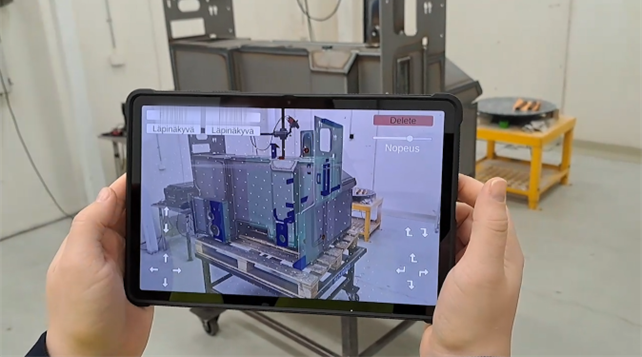
At Stera Technologies’ Kaavi factory, an Augmented Reality (AR) application was developed as a pilot implementation for quality assurance of robot-welded assemblies (Picture 1). The application enables verification that the manufactured assembly includes all required parts in the correct positions, that shapes and holes are processed correctly, and that the dimensions match the 3D design. These features allow for faster quality assurance compared to traditional methods.
The application displays the CAD 3D design model on a tablet or smartphone screen, and through the device’s camera, the model can be aligned with the finished assembly for comparison. The 3D model’s dimensions can be scaled to match the actual assembly. The AR application also allows inspection of internal components, provided there is an opening to view inside the assembly. Alternatively, the application can be used during manufacturing before internal parts become hidden. The solution supports quality assurance for any assembly or product that has a 3D design model.
Implementation Method
In this pilot, a technical demonstration of the application was created using the Unity game engine, leveraging built-in AR features such as plane detection. In simple terms, the application uses the mobile device’s camera to detect surfaces—such as floors—onto which the digital twin (3D model of the part to be inspected) can be freely placed at correct dimensions. The 3D model can be moved and rotated so that the real-world part and the 3D model align (Video 1).
The mobile application currently runs on Android and has been tested only on newer Android versions (Android 13–15, API level 33–36). In future development, it may be more practical to use markers (image, QR code, or similar) as part of the real-world component to speed up alignment significantly.
Video 1. Demonstration video of the application’s operating principle.
The AR application was developed at Savonia University of Applied Sciences’ XR Center and tested in a real production environment at Stera Technologies’ Kaavi factory. For demonstration purposes, the test was conducted using a sample component.
Experiences and Development Ideas
During the project, a test version of the application was produced to illustrate the potential of AR technology for this use case. A mechanical engineering student at Savonia University of Applied Sciences is designing a 3D-printable assembly suitable for demonstration purposes. In addition to demonstrations, the model assembly can later be used to develop the AR application’s functionality with additional programming.
The application’s source code is available at Savonia University of Applied Sciences for use in programming projects, where new features can be added incrementally. Useful features could include on-screen measurement of objects, similar to what is possible in Apple’s iOS. However, achieving millimeter-level accuracy may be challenging.
Project: A90789 VIREO Research Project (1.9.2023 – 31.10.2025)
Funded by: South Savo Centre for Economic Development, Transport and the Environment
Authors:
Asmo Jakorinne, Kimmo Pakarinen, Ville Heiskanen – Savonia University of Applied Sciences
Jarno Vehviläinen – Stera Technologies




Article has been previously published at https://www.savonia.fi/artikkelit-pro/robottihitsatun-kokoonpanon-laadunvarmistus-savonian-ja-stera-technologiesin-yhteistyo/