Savonia Article Pro: Reimagining innovation and entrepreneurial learning: Insights from a staff exchange in Graz strengthening EU4Dual collaboration
Savonia Article Pro is a collection of multidisciplinary Savonia expertise on various topics.
This work is licensed under CC BY-SA 4.0


Innovation and entrepreneurial education are undergoing a transformation across Europe. As work-life expectations evolve and artificial intelligence through accessible large language models reshapes how knowledge is produced, assessed and utilized, higher education institutions are increasingly challenged to provide learning that extends far beyond theoretical instruction. Today’s students need experiences that develop resilience, critical judgement when evaluating information and the ability to operate under uncertainty, capabilities that emerge when navigating authentic entrepreneurial environments and real-world problems, not simulated scenarios.
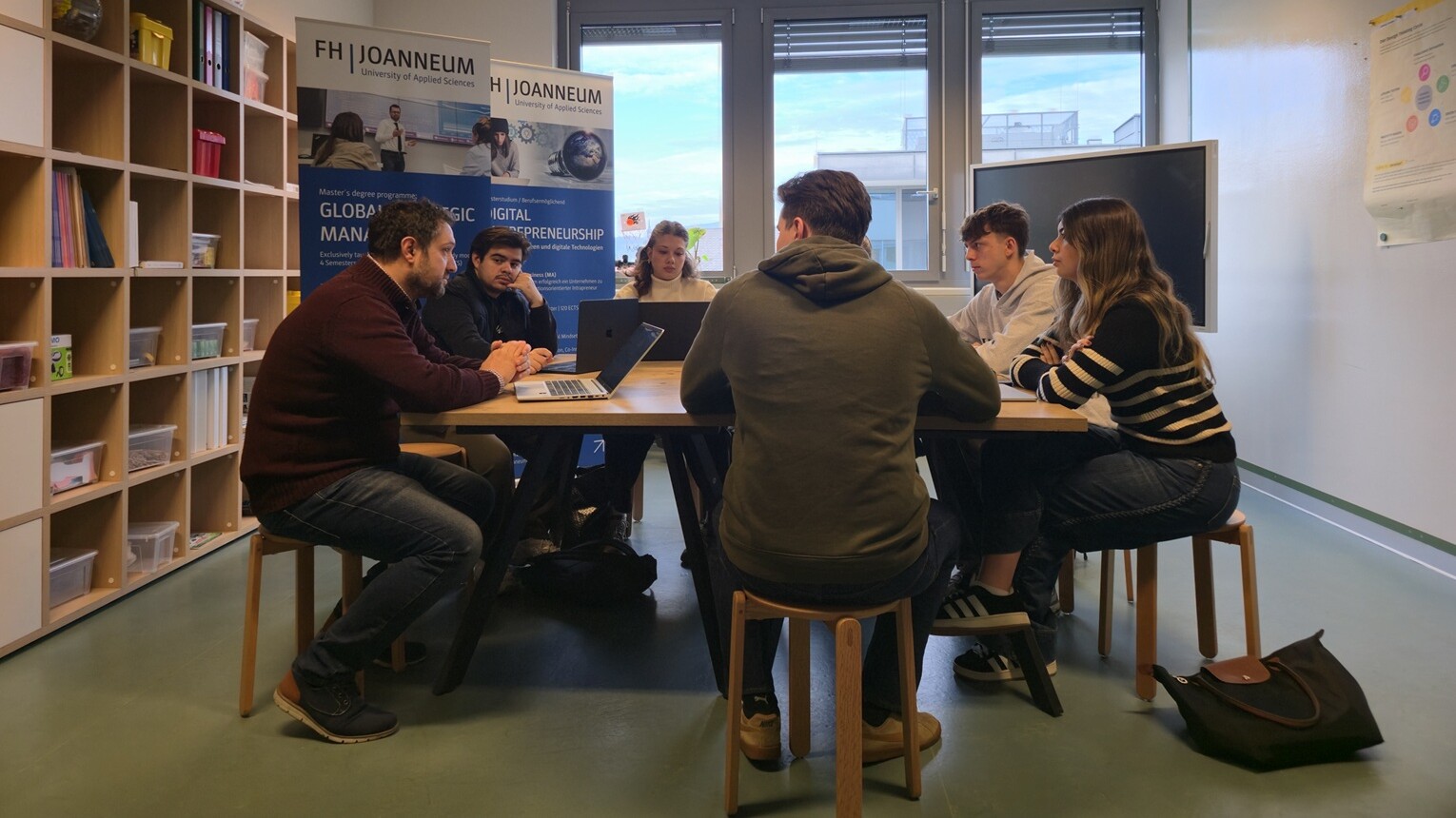
Students participating in the international case challenge and entrepreneurial and cross-cultural competences course, engaging in direct coaching and feedback discussions at FH JOANNEUM
This transition to entrepreneurial learning was clearly visible during a staff exchange period held in October 2025 at FH JOANNEUM University of Applied Sciences in Graz, where innovation and entrepreneurship education were deeply embedded into practice-based learning. The exchange coincided with the Entrepreneurial and Cross-Cultural Competences Case Challenge 2025 course, a development sprint in which national and international students collaborated intensively in multidisciplinary teams to solve challenges defined by industry partners. The business cases were provided by the Digital Entrepreneurship & Innovation Master (DEM) programme at FH JOANNEUM and by RESET: Adaptive Mountain Bike Solutions. The challenges required students to apply analytical, creative, and strategic thinking in an environment shaped by ambiguity, time pressure, and accountability.
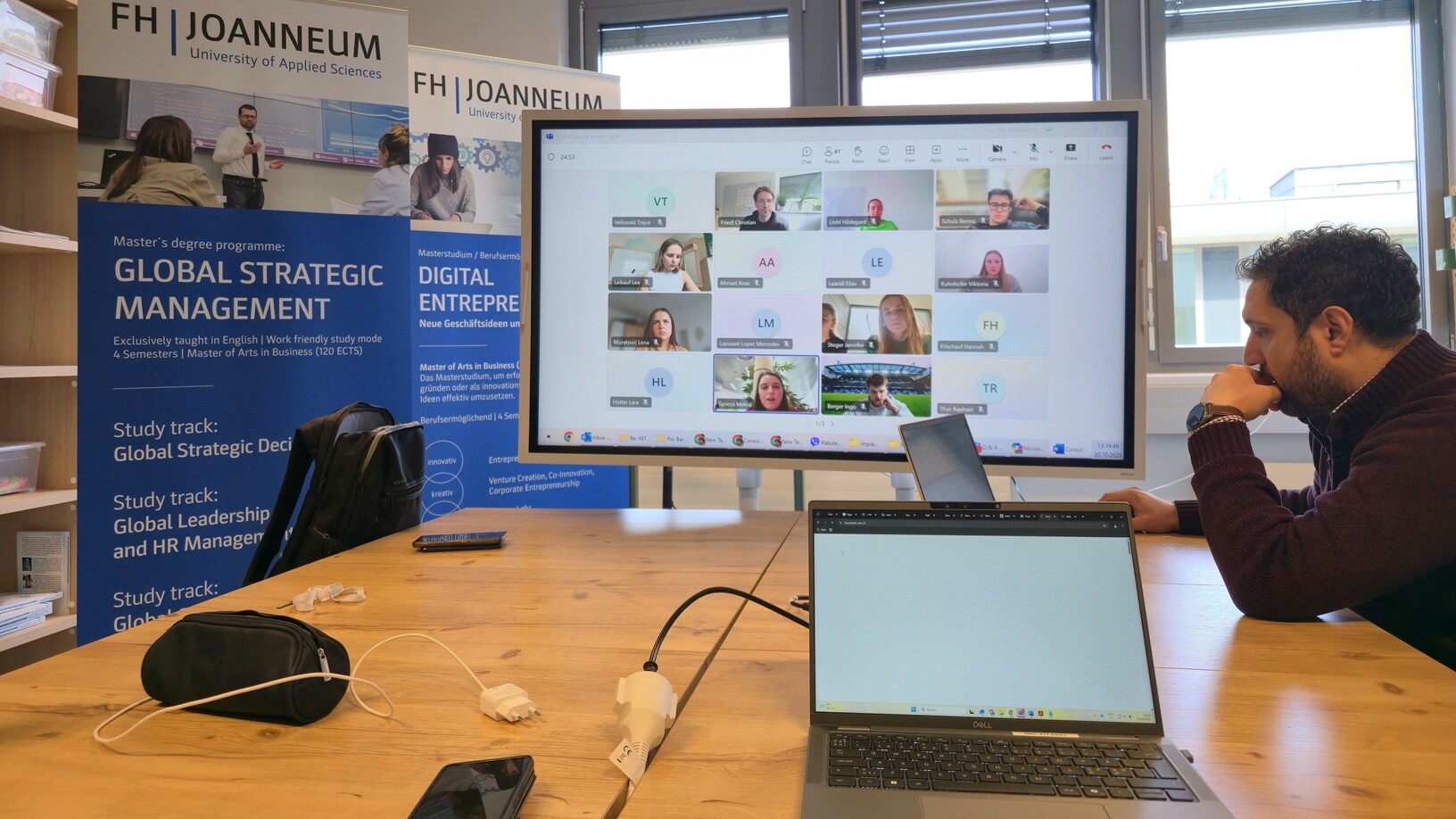
Case Challenge teamwork taking place in a hybrid learning setup, demonstrating collaboration across locations, supported by academic and industry experts. In picture, the Assistant professor Trajce Velkovskin
The dynamic nature of the case challenges demonstrated how rapidly capability develops when learners are pushed beyond abstract exercises. In one instance, a team confronted with a last-minute disruption reorganised responsibilities and reconstructed their narrative within hours, ultimately delivering a compelling presentation under pressure. Their experience highlighted entrepreneurial behaviour in its most authentic form: the ability to regroup, adapt, and execute when circumstances shift unexpectedly.
Strengthening entrepreneurial education through staff exchange
The staff exchange in Graz served as a platform for deepening collaboration within the EU4Dual alliance, examining emerging pedagogical models in innovation and entrepreneurial education, and exploring the role of international mobility as a catalyst for applied learning. Rather than relying on lecture-based knowledge transfer, the approach observed at FH JOANNEUM integrated real companies, professional mentoring, innovation laboratory settings, and incubation structures directly into the course, creating conditions that mirror early-stage entrepreneurial reality.
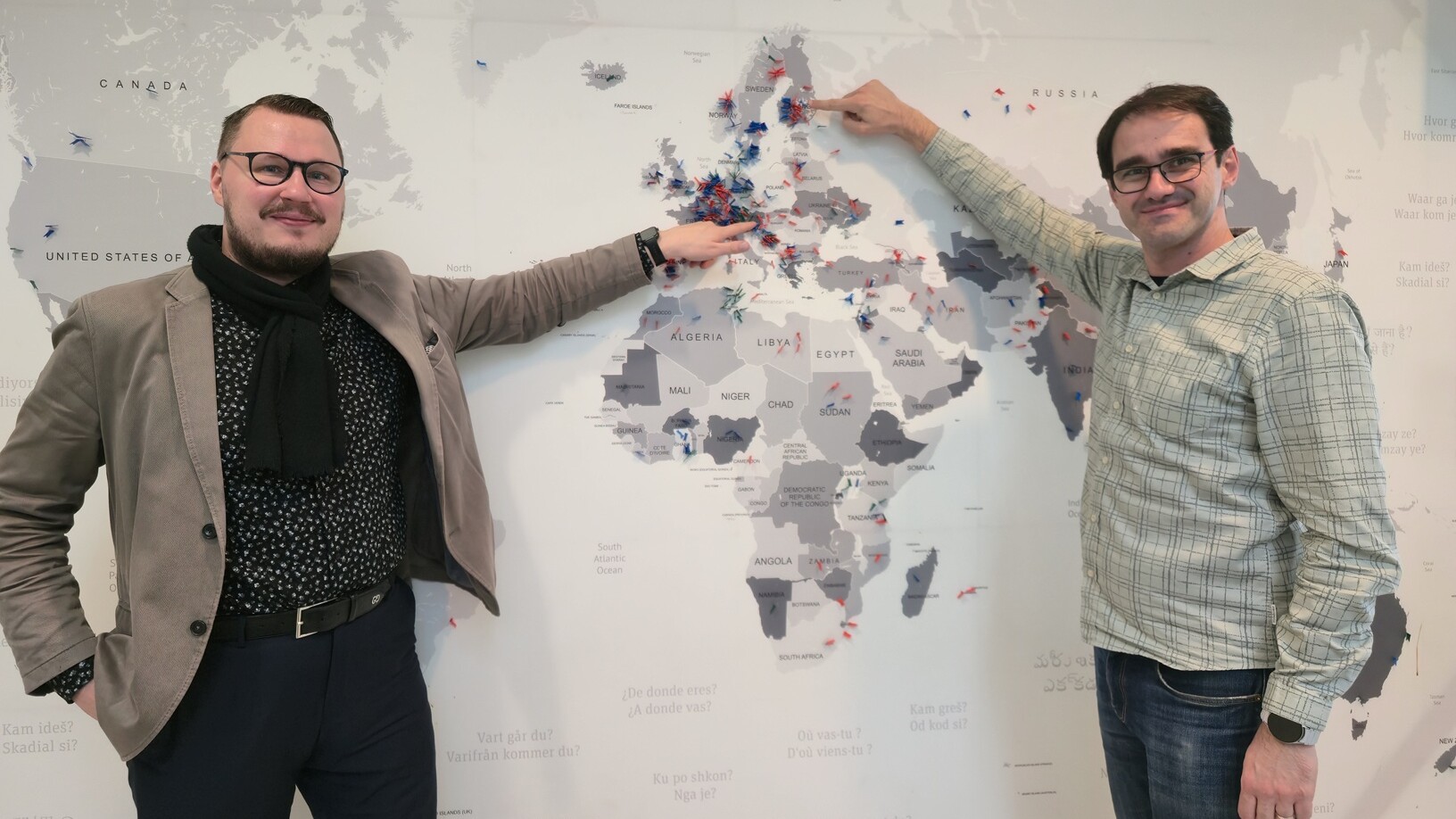
Author, Matti Laitinen and Bojan Jovanovski (Start up Hub, FH JOANNEUM) highlighting the geographical reach of mobility-based learning and collaborative innovation within the EU4Dual Alliance.
The surrounding ecosystem forms a critical component of this learning model. Startup Hub FH JOANNEUM, Startup Labs and Science Park Graz with ESA BIC Austria constitute an interconnected innovation environment in which academic studies and entrepreneurial development coexist. Students gain access to expert mentoring, market-feedback processes, prototyping paths and real-time evaluation while advancing their coursework. This structure lowers barriers to experimentation and enables ideas to develop rapidly from concept to implementation.
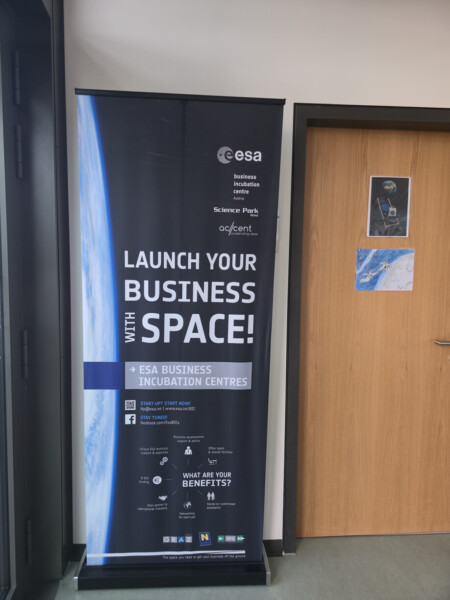
Entrance to the ESA Business Incubation Centre at Science Park Graz, illustrating the connection between academic learning environments and high-tech entrepreneurial ecosystems.
The incubation model at Science Park Graz, providing development support, with a strong emphasis on accessibility and confidence in new initiatives, exemplifies how entrepreneurial learning becomes more relevant when universities act as active contributors to regional innovation systems rather than isolated educational institutions. When students engage directly with real stakeholders, real constraints and accountability, learning deepens as it is embedded in ecosystem-based learning processes, and capability development becomes more durable than through traditional classroom-based methods alone.
Key Insight: Innovative case challenges as learning modules
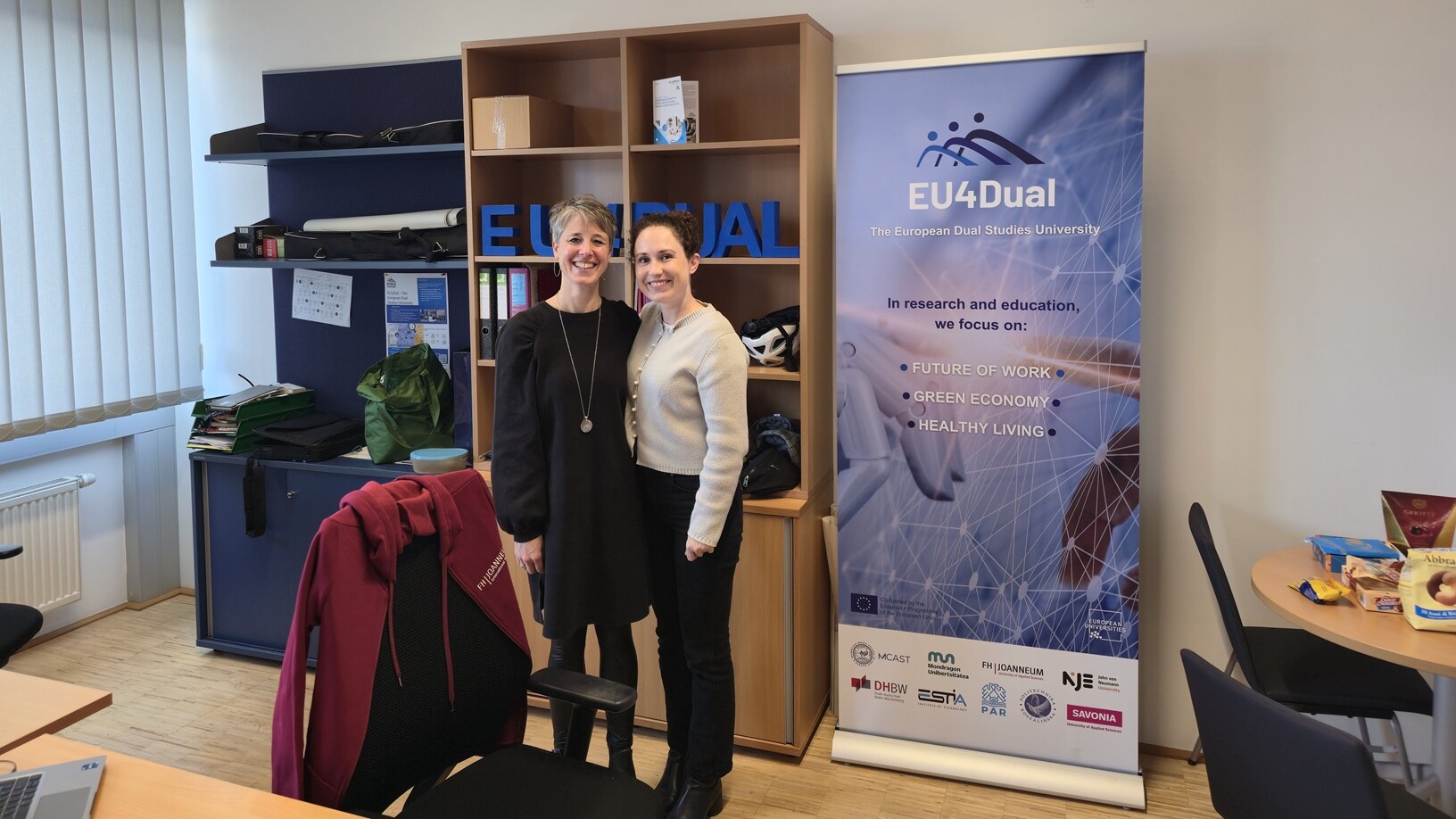
Members of the EU4Dual project team at FH JOANNEUM, supporting dual education, mobility development and innovation-focused collaboration across European partner institutions. In picture Ines Kipperer and Ingerid Dommersnes
The experience in Graz reveals how dual, work-based learning models gain strength when authentic industry challenges, international teamwork and active mentoring converge. In such settings, academic knowledge and entrepreneurial practice reinforce one another rather than remaining separate. A central insight emerging from the exchange is that entrepreneurial capability develops through decision-making and reflective learning, not passive observation. Feedback from industry professionals, jury members and peers played a key role in accelerating learning; students learned to operate with incomplete information, negotiate uncertainty, communicate across cultures and defend decisions before expert evaluators. In a time when language-based AI systems can automate many analytical tasks, the importance of human-centered competencies: collaboration, empathy toward customer needs, creative concept development, resilience and situational judgement becomes increasingly critical for learning how to act innovatively.
Recent European policy perspectives reinforce this direction. The EU startup and scaleup strategy emphasise the importance of entrepreneurial skills, talent mobility and ecosystem-level cooperation in enabling Europe to grow new ventures and scale innovation more effectively. The educational shift observed in Graz in this course aligns with this strategic orientation: innovation capacity is not built through theory alone but through exposure to real entrepreneurial conditions, market-level thinking and cross-regional collaboration.
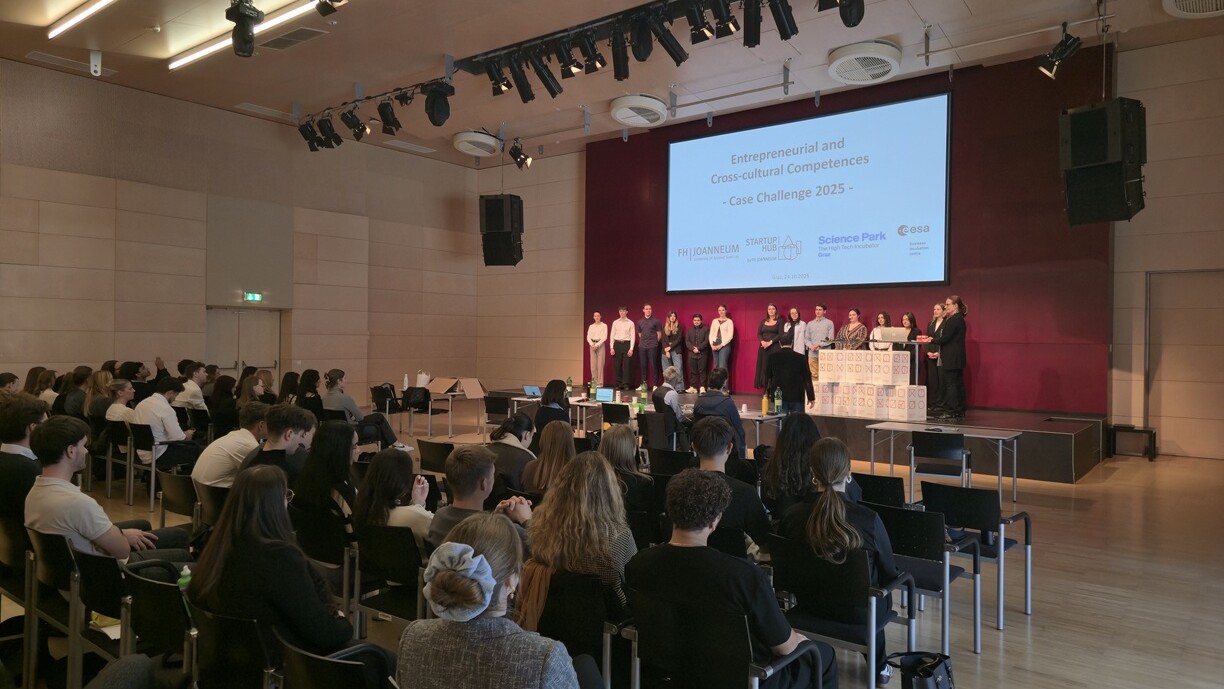
Student teams presenting their final solutions to a panel of academic experts and industry representatives during the concluding event of the entrepreneurial and cross-cultural competences case challenge 2025.
Future collaboration and opportunity
Based on the observations and discussions with partners, several concrete development pathways emerged for collaboration within the EU4Dual alliance in innovation and entrepreneurial education. Joint development initiatives are underway, including future Spring Schools, shared mentoring, co-created entrepreneurship and innovation course content for winter school and expanded student and staff mobility opportunities; all embedded in innovation ecosystems. The shared objective is not merely to teach innovative methods or intra-entrepreneurship, but to build environments where innovation and entrepreneurial learning occur naturally and collaboratively.
The Case challenge in Graz demonstrated the potential of an education model in which universities, companies, incubators and European partners co-create learning experiences. When these elements align, education becomes not only more relevant but fundamentally transformative, equipping future professionals with the capability to navigate complexity and create meaningful value in a European context. Experiences such as this reinforce EU4Dual’s vision of a European university that integrates academic excellence with work-based learning, strengthening innovation capacity across borders.
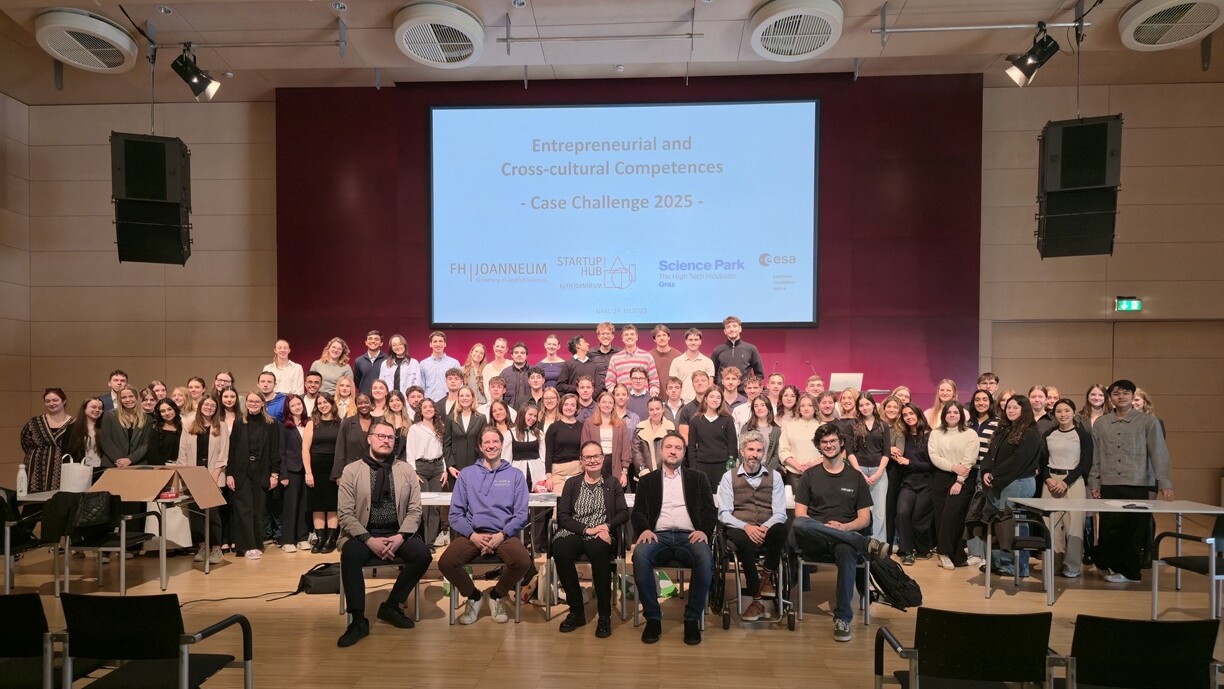
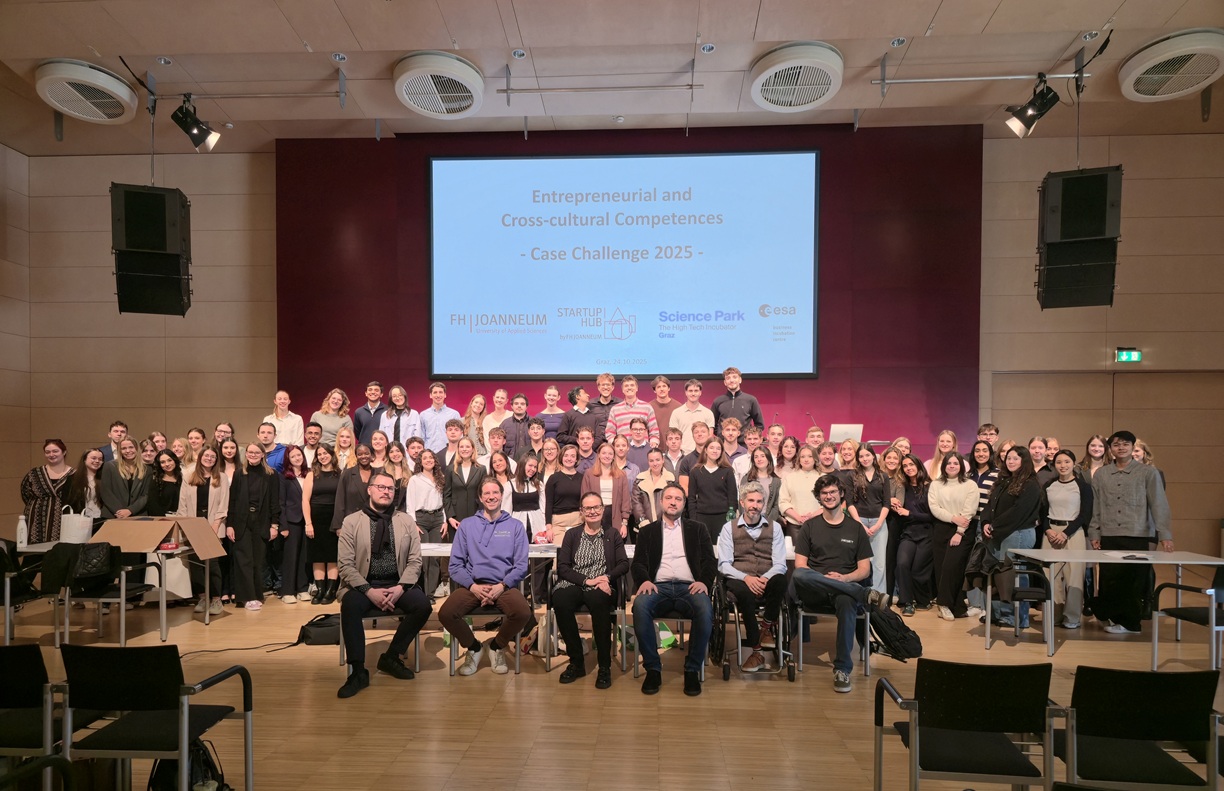
Group photo of the international case challenge and entrepreneurial and cross-cultural competences course participants, mentors, jury members and partner organisations, representing a diverse pan-European learning community
Author:
Matti Laitinen, Innovation Advisor, Savonia University of Applied Sciences / Business Center North-Savo
+358 44 785 6333 | matti.laitinen@savonia.fi | https://www.linkedin.com/in/mattislaitinen/
Erasmus+ Staff Exchange, FH JOANNEUM Graz, Austria, October 19–25, 2025
Key stakeholders:
FH JOANNEUM
Hildegard Liebl, Trajce Velkovski, Bojan Jovanovski, Doris Kiendl, Ingerid Dommersnes, Ines Kipperer, Sofia de Oliveira, Christian Friedl
Science Park Graz
Jeremija Hranjec, Dijana Janevska
RESET – Adaptive Mountain Bike Solutions
Simon Walch, Thomas Mayr
References & Contextual Sources:
FH JOANNEUM (2025). International Case Challenge & Entrepreneurial and Cross-Cultural Competences.
https://www.fh-joanneum.at/en/news/entrepreneurial-and-cross-cultural-competences/
Savonia UAS (2025). Unlocking Entrepreneurial Potential Across Borders.
Science Park Graz & ESA BIC Austria. Incubation ecosystem and support models.
Savonia University of Applied Sciences. Entrepreneurial mobility and EU4Dual initiatives.
Business Center North-Savo (2025).
European Commission (2025). EU Startup and Scaleup Strategy: Choose Europe to start and scale.