
Savonia Article Pro: Sustainable Manufacturing Decisions with Simulation: Part 1
Savonia Article Pro is a collection of multidisciplinary Savonia expertise on various topics.
This work is licensed under CC BY-SA 4.0


Introduction
Sustainability is a wide and increasingly important subject in the modern industrial environment. The pressure from institutions such as the European Union has required companies to adopt climate and sustainability policies to promote transparency in emissions reporting and carbon-reduction efforts. Therefore, most companies aim to document and monitor their CO₂ footprint since environmental responsibility has become both a strategic and regulatory priority. These efforts on monitoring CO₂ footprint make the environmental impact quantifiable, comparable, and manageable, changing the sustainability from a general objective into a concrete, data-driven parameter that supports informed decision-making and continuous improvement.
CO₂ Emissions in Machining Systems
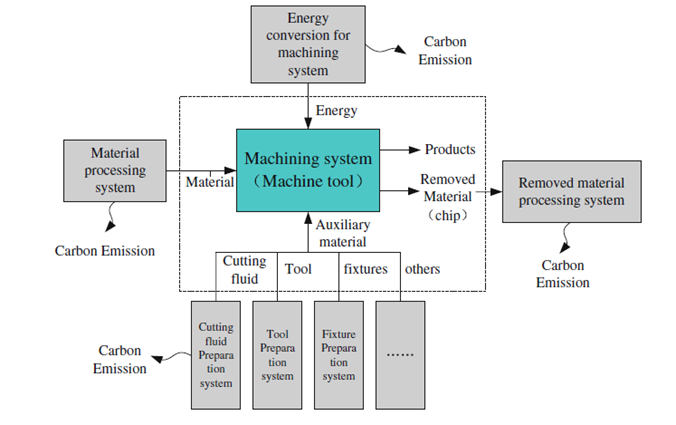
It is important to focus on a quantifiable scope to make sustainability actionable, so this study aims to develop a product-specific carbon footprint model within factory boundaries to illustrate how emissions are generated and identify where design or process decisions can have an impact. Figure 1 shows the machining system from a carbon footprint perspective. To initiate, the central element shows the machining system (machine tool), which receives material from the material processing system and energy from the energy conversion system. During operation, auxiliary inputs such as cutting fluid, tools, fixtures, and other supporting elements are also required, each linked to its own preparation system. The machining system produces finished products and removed material (chips), which are sent to a removed material processing system. Carbon emissions are generated at multiple stages, including energy conversion, material preparation, auxiliary material preparation, and chip processing, showing that environmental impact is distributed across the entire production chain rather than limited to the machine tool itself.
Uncertainty in Carbon Footprint Data
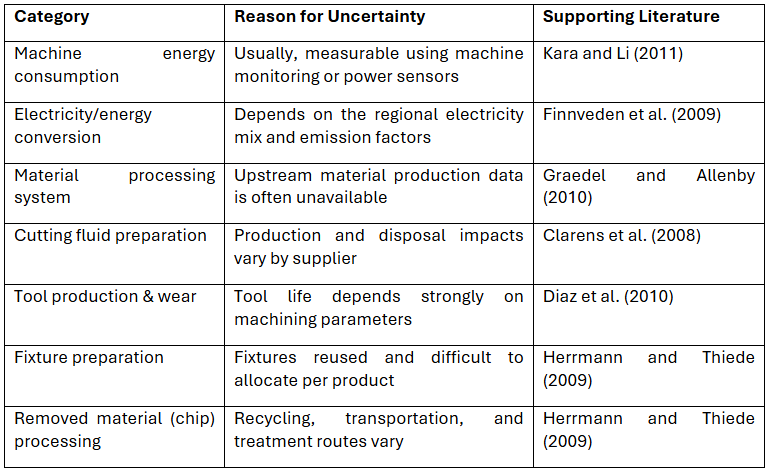
Research on the life cycle assessment of machining processes shows that data availability varies significantly between process inputs. Machine electricity consumption can usually be measured directly and therefore has relatively low uncertainty (Kara and Li, 2011). Whereas processes such as cutting tool production, cutting fluid manufacturing, and material processing often rely on supplier information or assumptions, which lead to greater uncertainty (Finnveden et al., 2009; Diaz et al., 2010; Graedel and Allenby, 2010). Table 1 shows each system category and its uncertainty reason.
It is notable that in reality, manufacturing machinery operates differently based on factors such as cutting parameters, load conditions, tool wear, and standby or idle times. Energy consumption and emissions can be different between industrial machines. Moreover, upstream systems (material preparation, energy conversion) and downstream processes (chip handling and recycling) also contribute to the total footprint. If these factors are ignored, the model will risk oversimplifying reality and underestimating environmental impact. Therefore, establishing broader system boundaries and considering machine-specific differences are important for improving the validity of model results.
Analyzing such a model required data including material types and quantities, energy consumption, process information, and machine emission factors. In addition, if the calculation is expanded beyond factory scope, the origin and processing of raw materials need to be taken into consideration. Key optimization variables that can be adjusted and simulated include material selection, manufacturing energy use, welding processes, working time, and defect rates, all of which affect total emissions.
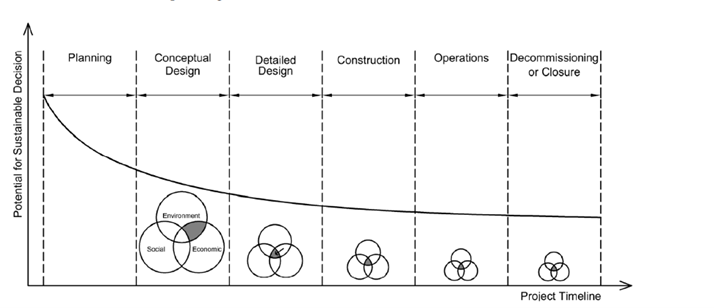
This complexity requires looking at the concept a bit differently. To explain, Figure 2 illustrates how the potential to influence sustainability outcomes changes across the project lifecycle. During the early stages, particularly planning and conceptual design, decision-makers have the highest flexibility in changing environmental, economic, and social outcomes. At this stage, key design choices, such as material selection, manufacturing processes, and system configuration, can significantly affect the product’s overall carbon footprint and cost. As the project progresses toward detailed design and operational phases, the ability to modify these decisions decreases because technical specifications, investments, and production commitments have already been established. Consequently, sustainability improvements become more difficult and costly to implement in later stages. Therefore, decision-support methods that allow sustainability, cost, and manufacturing constraints to be evaluated at the early design stage assist designers in making more informed and balanced decisions.
Application of Multi-Criteria Decision-Making (MADM)
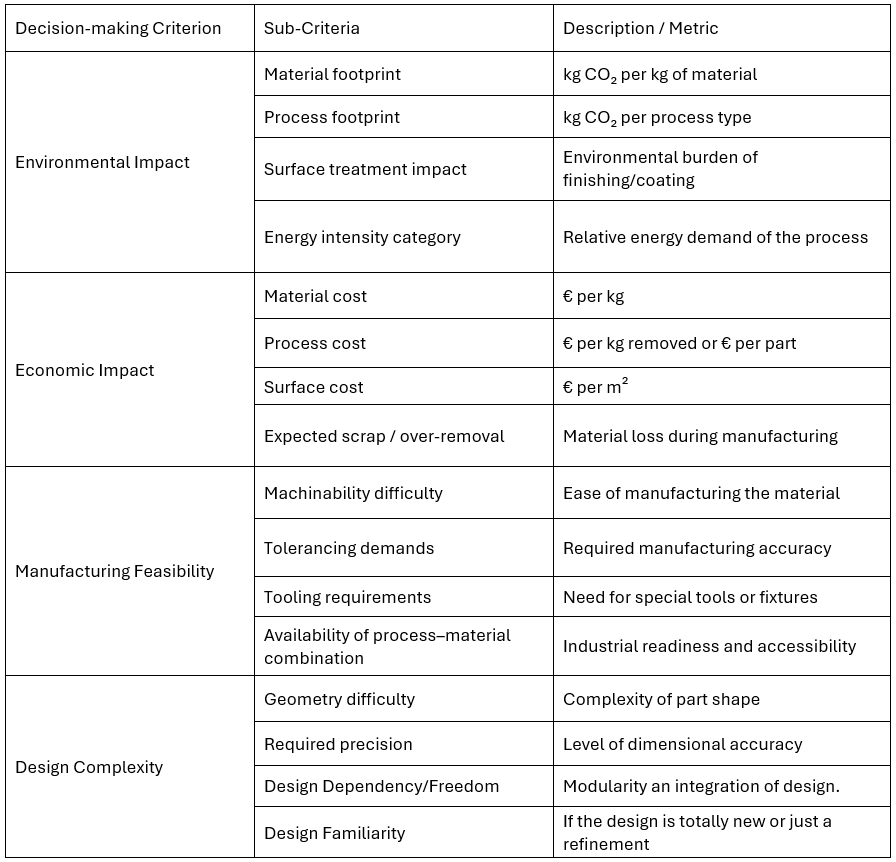
To continue with the early-stage evaluation concept, this study introduces a structured decision-making model that allows multiple factors to be assessed simultaneously. The decision-making model is structured around four main criteria: Environmental Impact, Economic Impact, Manufacturing Feasibility, and Design Complexity. In addition, each of these criteria contains four sub-criteria, which ensures a more detailed and well-balanced structure.
Starting with the Environmental Impact criterion, which includes material footprint (kg CO₂ per kg of material), process footprint (kg CO₂ per process type), surface treatment impact (e.g., coating), and energy intensity category (relative energy demand of the process). These indicators make environmental performance measurable and comparable, allowing CO₂ emissions and resource use to be integrated directly into early-stage decision-making.
Secondly, the Economic Impact criterion focuses on cost-related aspects. This criterion considers material cost (€ per kg), process cost (€ per kg removed), surface cost (€ per m²), and expected scrap or over-removal, which reflects material loss during manufacturing. The goal for this criterion is to consider financial feasibility.
Next, the Manufacturing Feasibility criterion addresses production practicality. It includes machinability difficulty (ease of manufacturing the material), tolerancing demands (required manufacturing accuracy), tooling requirements (need for special tools or fixtures), and availability of the process–material combination (industrial readiness and accessibility). These factors determine whether a technically optimal option can be implemented in practice.
Finally, the Design Complexity criterion captures how product design influences manufacturability and sustainability outcomes. It includes geometry difficulty (complexity of part shape), required precision (level of dimensional accuracy), design dependency or freedom (modularity and integration level), and design familiarity (whether the design is new or a refinement of an existing concept). By incorporating these aspects, the model recognizes that early design decisions strongly influence cost, emissions, and production efficiency across the product lifecycle.
This article is made as part of the Simulation models in industrial processes project. You can read more about the project from here: https://sitepro.savonia.fi
The second part of the article can be accessed here: https://www.savonia.fi/en/articles-pro/sustainable-manufacturing-decisions-with-simulation-part-2/
Author
Sorayya Amirahmadi, Project Specialist, Savonia University of Applied Sciences
References
Gozzi, V. and Guante Henriquez, L. (2025) ‘Integrating Sustainability Indicators in Conceptual Design of Footbridges: A Decision-Support Framework for Environmental, Economic, and Structural Performance’, Sustainability, 17(10), 4562. Available at: https://doi.org/10.3390/su17104562 (Accessed: 4 March 2026).
Clarens, A.F., Zimmerman, J.B. and Keoleian, G.A. (2008) ‘Environmental impacts of metalworking fluid use in machining processes’, Environmental Science & Technology, 42(12), pp. 4564–4570.
Diaz, N., Helu, M. and Dornfeld, D. (2010) ‘Environmental analysis of milling machine tool use phase’, Journal of Manufacturing Science and Engineering, 132(3), pp. 031005.
Finnveden, B., Hauschild, M.Z., Ekvall, T., Guinée, J., Heijungs, R., Hellweg, S., Koehler, A., Pennington, D. and Suh, S. (2009) ‘Recent developments in life cycle assessment’, Journal of Environmental Management, 91(1), pp. 1–21.
Graedel, T.E. and Allenby, B.R. (2010) Industrial Ecology and Sustainable Engineering. Upper Saddle River, NJ: Prentice Hall.
Graedel, T.E., Allwood, J., Birat, J.P., Reck, B.K., Sibley, S.F., Sonnemann, G., Buchert, M. and Hagelüken, C. (2011) ‘What do we know about metal recycling rates?’, Journal of Industrial Ecology, 15(3), pp. 355–366.
Herrmann, C. and Thiede, S. (2009) ‘Process chain simulation to foster energy efficiency in manufacturing’, CIRP Journal of Manufacturing Science and Technology, 1(4), pp. 221–229.
Kara, S. and Li, W. (2011) ‘Unit process energy consumption models for material removal processes’, Journal of Cleaner Production, 19(17–18), pp. 1923–1932.