Savonia Article Pro: Utilizing mixed reality in product testing – Collaboration between Savonia and Lapp Connecto
Savonia Article Pro is a collection of multidisciplinary Savonia expertise on various topics.
This work is licensed under CC BY-SA 4.0


At Lapp Connecto’s factory in Vieremä, electrical and electronic components are manufactured for industrial use. As part of the VIREO research project, a pilot Mixed Reality (MR) application was implemented to test and ensure the quality control of wiring harnesses used in heavy machinery.
Lapp Connecto uses a custom-developed test bench for wiring harnesses. All connectors used in production are arranged in a matrix and connected to the actual testing system. Testing a completed harness involves connecting multiple connectors, which vary depending on the application. The wide variety and number of connections require precision and care from the tester. Instructions can be complex, demanding familiarity and experience for efficient setup.
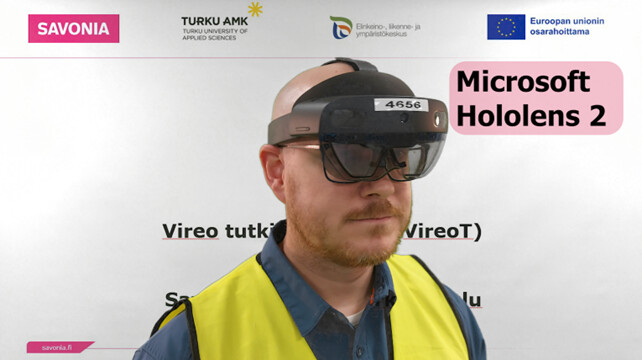
In the pilot, Microsoft HoloLens 2 MR glasses were used (Picture 1). The goal was to bring PDF-format connection instructions—usually printed or displayed on a screen—directly into the tester’s field of view, freeing both hands for work. The guidance progresses step-by-step, showing the required connector and its location on the test bench.
Implementation and Practical Insights
The MR application used Microsoft Dynamics 365 Guides. Content was created at Savonia University of Applied Sciences’ XR Center, and testing was conducted in a real factory environment by Lapp Connecto employees. A demonstration video was produced to illustrate the user experience (Video 1).
Lapp Connecto’s pilot team was trained to create new content in the MS 365 Guides environment, enabling broader use of the MR system for both existing and future instructions. Benefits included visual, language-independent instructions and hands-free work.
From a data security perspective, it’s important to note that MS HoloLens software is designed to utilize Microsoft Azure cloud services. A company’s IT policy may limit the use of HoloLens’s features. To manage sensitive data, companies should establish their own Azure cloud environment.
Using the device requires changes in work practices and regular use to improve testing speed. Testers noted that prolonged use of HoloLens can cause eye strain and other physical effects. The battery lasts about 4 hours before needing a recharge. Rotating multiple HoloLens devices could support full-day use or shift work. Charging breaks can also help mitigate physical strain. However, the biggest obstacle is that Microsoft has discontinued support and production of HoloLens. HoloLens 2 will receive security updates until the end of 2027.
Video 1. Video from the HoloLens application’s user perspective during the test execution.
Future of XR Technologies and Pilot Summary
New XR technologies are emerging to address current limitations. Apple has launched Vision Pro glasses, and Apple Smart Glasses are expected around 2027. Finnish company Varjo is developing professional-grade VR glasses for simulators and military use.
This pilot confirmed the applicability of new technology in real work environments. Real-world testing provides valuable insights for product development and increases awareness of XR possibilities. As more usable devices enter the market, the threshold for adoption becomes lower.
We look forward to seeing what the development of XR technology will bring.
Project: A90789 VIREO Research Project (1.9.2023 – 31.10.2025)
Funded by: South Savo Centre for Economic Development, Transport and the Environment
Authors:
Asmo Jakorinne, Kimmo Pakarinen, Ville Heiskanen – Savonia University of Applied Sciences
Ari Reinikainen, Jukka Kekkonen, Ivan Makarihinen – Lapp Connecto
References:
HoloLens 2 | Microsoft
https://learn.microsoft.com/en-us/hololens/hololens2-hardware




Article has been previously published at https://www.savonia.fi/artikkelit-pro/mixed-realityn-hyodyntaminen-tuotetestauksessa-savonian-ja-lapp-connecton-yhteistyo/