Savonia-artikkeli: Can play help solve regional challenges? Lessons from cooperation across borders
This work is licensed under CC BY-SA 4.0


What if play could help young people see a future for themselves in their own region? This question has been at the heart of our work in InnoGS, where partners across Northern Europe explore how gamified approaches can support participation, skills development and regional vitality. As the project approaches its midpoint, it is a good moment to pause and reflect on what has already taken shape across the partnership, what we have learned, and what kind of value this cooperation is already creating.
Gamification is often misunderstood
One of the most important lessons for me has been related to gamification itself. Before InnoGS, I also understood it too narrowly. I associated it mainly with entertainment or small tricks used to make activities more enjoyable. Working with this partnership has changed that view. I have seen much more clearly how game thinking can help people enter discussions, explore different perspectives, imagine alternatives and build solutions together.
This matters especially in sparsely populated areas, where many communities face familiar challenges. Young people move away. Talent can be difficult to attract and retain. Access to services, networks and digital opportunities is not always equal. At the same time, these areas have strong communities, local knowledge and a great deal of underused potential. InnoGS has shown that the point is not to copy one ready-made model everywhere, but to develop approaches that make sense in each local context.
What cooperation across borders makes possible
That diversity has become one of the project’s strengths. InnoGS brings together organisations of different sizes and types, with expertise ranging from education and research to regional development, innovation work, community building and gamified methods.
Creative Crowd, a game industry company, described this well. As CEO Johan Linder put it “InnoGS has shown us the value of learning across borders. Working with partners from different countries has enabled us to compare approaches, challenge our assumptions, and co-create solutions that respond to shared societal challenges.” This captures something essential. Cooperation across borders is not only about wider networks. It improves the quality of the work itself by creating space to compare, test and rethink.
From abstract ideas to practical experiments
There are already several concrete examples of this in InnoGS. In Finland, youth-oriented activities such as the game camp have shown how game-related formats can create meaningful, low-threshold ways for young people to participate, connect and build skills. Digital youth communities have opened further possibilities for participation in environments that are already relevant to young people’s everyday lives. In Sweden and Ireland, ecosystem-building work has highlighted how shared physical spaces can support creativity, collaboration and local vitality.
Project coordinator Rebekka Mannelqvist from Region Västerbotten summed up an important shift well: “InnoGS is helping us move the discussion from abstract potential to practical use cases, especially connected to youth engagement, skills development, and place-based innovation.” This has been one of the most valuable things to see so far. Gamified methods are often discussed in broad terms, but their value becomes visible when they are tested with real stakeholders and concrete regional needs.
Rebekka Mannelqvist also highlighted another key lesson: “We have learned the importance of designing initiatives with youth and stakeholders, not for them, especially in rural and sparsely populated areas. Accessibility, trust, and relevance are important for engagement.” This is an important reminder. Even the most creative method will not work if people do not feel included in the process.
Role-play as a tool for dialogue
One of the clearest examples so far has been the use of role-playing as a method in regional development. During the Interreg NPA 25th anniversary event in Bodø, we organised a parallel session where participants took on different stakeholder roles and worked together on a regional challenge: how to create conditions that would encourage a young person to stay in the region. The format was simple, but the discussions were lively and productive. The exercise quickly opened up different viewpoints and helped participants move from general concerns to practical ideas.
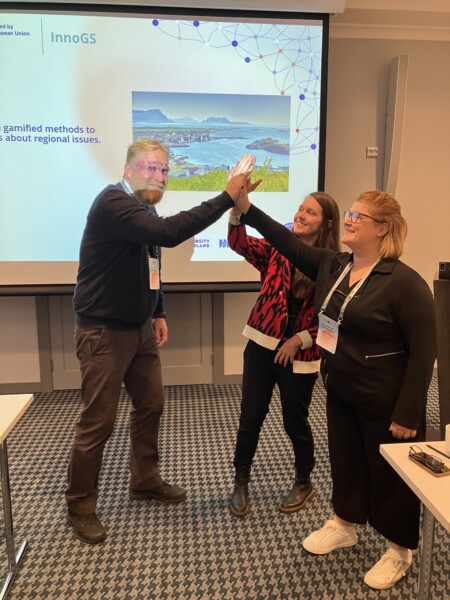
In one group, the young person’s dream was to become a rock star, but they wanted to move away because they felt there were no real opportunities to pursue music in their home community. Through the discussion, the parent, municipal representative and youth worker identified practical ways to support that ambition locally: a basement rehearsal space, stronger support for music activities, and encouragement through youth work. In the end, the young person decided they could imagine staying, because their dream no longer seemed possible only somewhere else.
For me, that was a good reminder of what these methods can do. Role-play does not make complex issues disappear, but it can make them easier to approach together. It can help people understand each other’s perspectives and find solutions that feel more concrete and shared.
Creative Crowd’s reflection points in the same direction: “For Creative Crowd, the project has reinforced the potential of gamified methods to connect communities, inspire participation, and support sustainable regional development.” The value of these methods does not lie in novelty alone. Their value lies in how they can strengthen participation, support local initiative and connect people around common goals.
What comes next
Another thing that stands out when looking back is the role of people. Projects move forward because people bring their expertise, curiosity and willingness to work together. One of the most encouraging aspects of InnoGS so far has been seeing what becomes possible when committed people from different countries, sectors and organisational contexts are brought together around a shared theme.
As the project moves into its second half, the work will continue by deepening pilots, strengthening cooperation and exploring new applications for game thinking in regional development. One emerging direction is to examine how games and gamified approaches can support diplomacy-related skills among young people, linking these questions to community skills, rural development and wider geopolitical themes in the Arctic context. This direction has also been shaped by the interests and needs expressed by our target groups.
At this point, InnoGS has already shown that gamified approaches can support inclusion, shared learning and regional innovation in practical ways. Just as importantly, it has shown that when different kinds of organisations work together across borders, they can create something more meaningful than any of them could have achieved alone.
This article has been made possible by the Innovation through Gamified Solutions (InnoGS) project, co-funded by the European Union through Interreg NPA.
Links
– When games and regional development met – InnoGS project partners’ visit to Finland – article: https://www.interreg-npa.eu/projects/innogs/home/news-events/new-article-when-games-and-regional-development-met-innogs-project-partners-visit-to-finland/
– “Bring Something Here for Us, Too!” – Young people’s wishes and participation barriers in remote areas – article: https://www.interreg-npa.eu/projects/innogs/home/news-events/new-article-bring-something-here-for-us-too-young-people-s-wishes-and-participation-barriers-in-remote-areas/
Authors
Mariia Hämäläinen, RDI Specialist, InnoGS Project Manager, Savonia University of Applied Sciences
This article was prepared with the help of AI.