The Degree Programme in International Business is a 3.5-year, 210 cr programme which leads to a BBA degree. The skills and expertise gained through this programme are in compliance with the requirements of the EU in view of the level of higher education enabling free movement of labour and experts.
BBA graduates are prepared to face continuous change in the global business field and are sensitive to the requirements set by international partners. BBAs are especially skilled in the practicalities of the internationalisation process, thus in a good position to assist eg SMEs in starting international trade. They operate fluently within multicultural teams and are able to guide the team towards set goals. BBAs have an open mind towards developing new ways in not only business but also in well-being at work as well as their own expertise in the field. BBAs will work, among other things, in import-export, international sales and customer care, logistics and other international activities.
Competence Standards
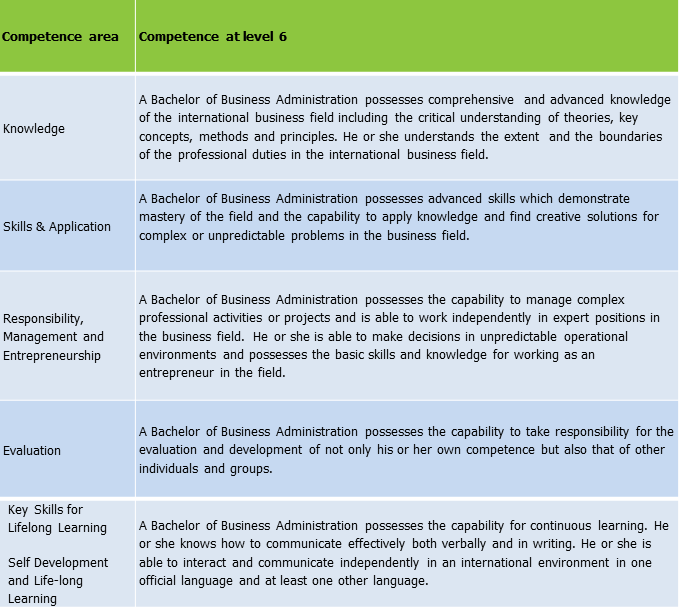
The qualification of a Bachelor of Business Adminitration is at the European and Finnish level 6. (The national framework of qualifications and other learning).
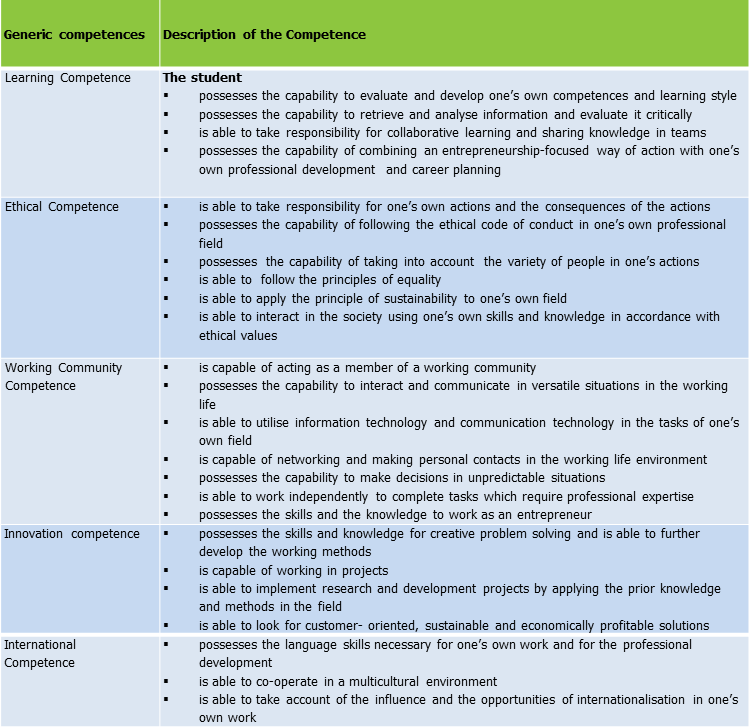
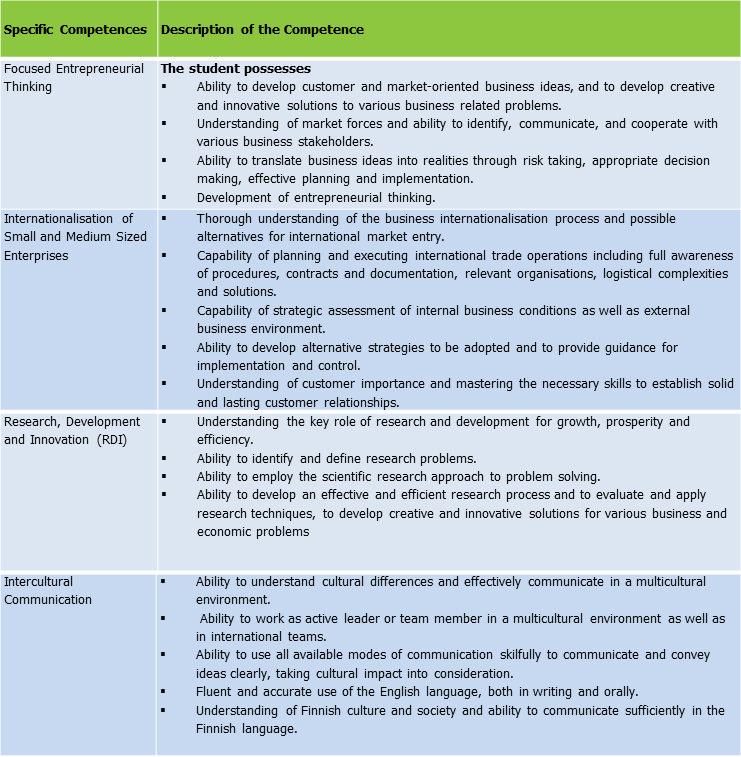
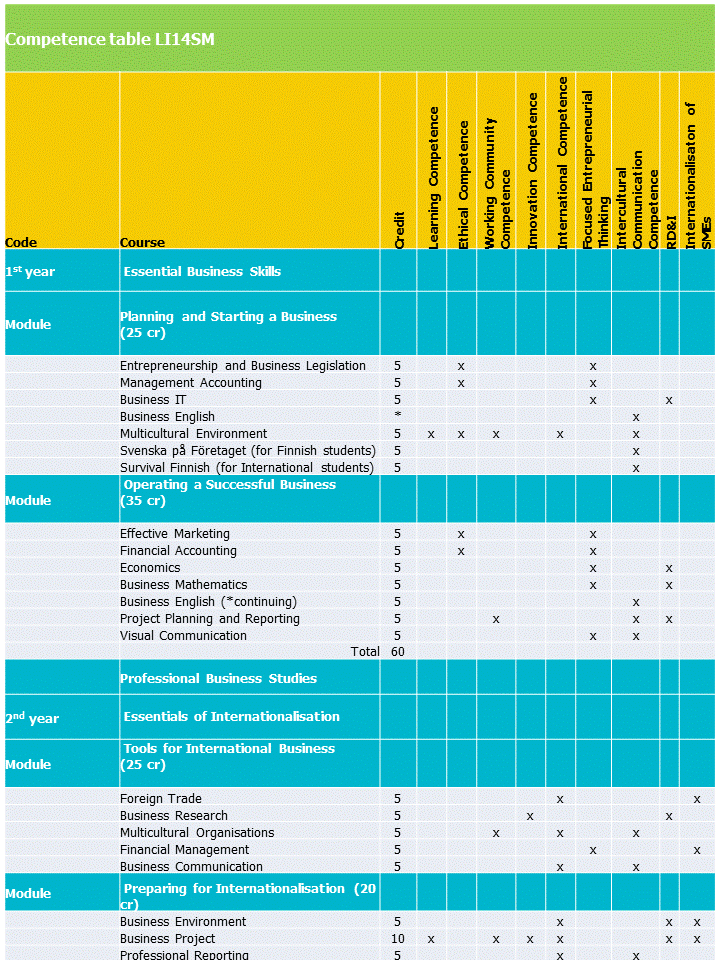
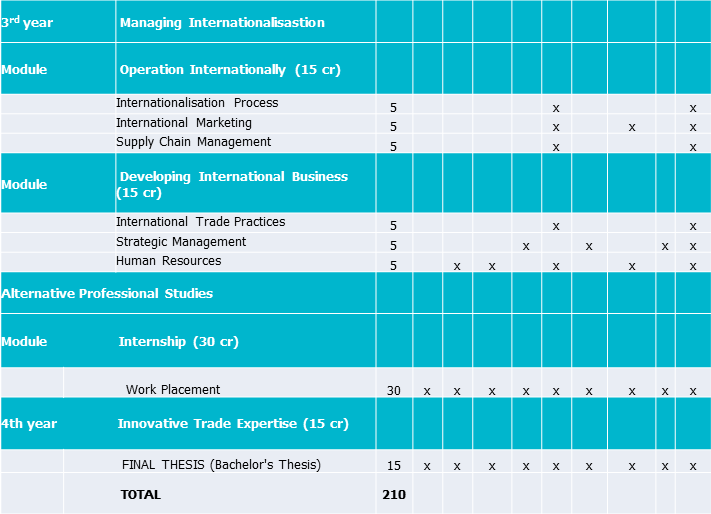
The professional profile of a Bachelor of Business Administration consists of generic and specific competences.
Structure of Studies
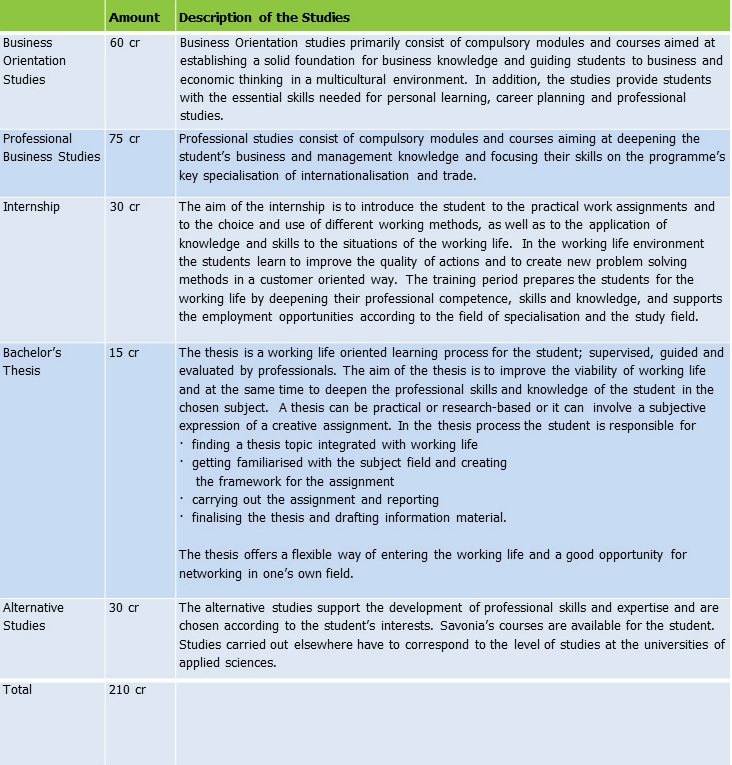
The studies for a Bachelor’s Degree in Business Administration comprise 210 credits. According to the curriculum one academic year corresponds to 60 credits, which is equivalent to 1600 hours of a student’s work load. The studies consist, among others, of lessons in class, distance learning and independent studies as well as web-based learning and practical training (internship). The studies include working life oriented research and development activities.
Development of Expertise
In Savonia’s curriculum the study modules form extensive study entities. Thus they are not separate but support the development of the student’s professional expertise and the student’s development as a whole. This also enables the combination of teaching with the research and development activities of the working life. The Bachelor of Business Administration curriculum has been planned so that the - the degree programme provides the student with the knowledge, skills and competence required in the working life - the studies ensure the development of the student’s professional expertise.
The student - drafts an individual study plan to support his or her studies. - takes responsibility for the progress of his or her studies.
Savonia’s teachers and other personnel guide and support the student in defining and achieving the personal goals.
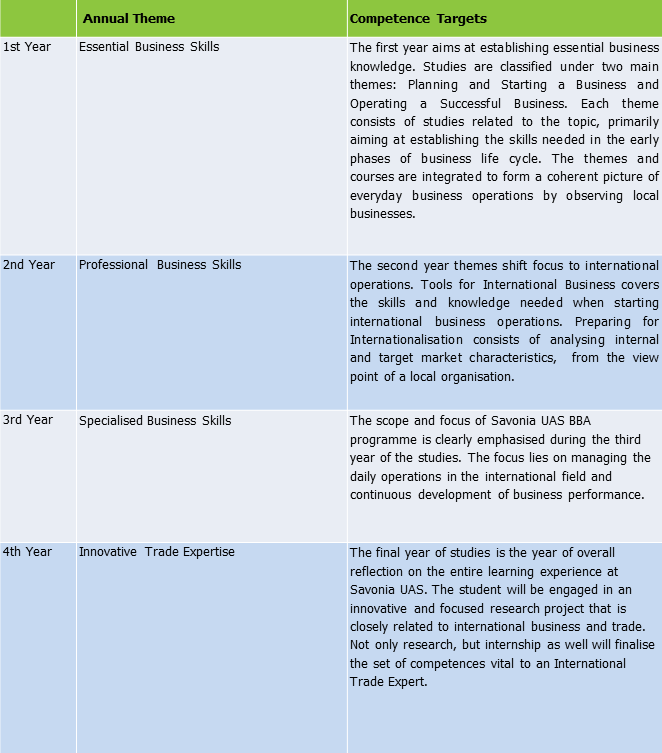
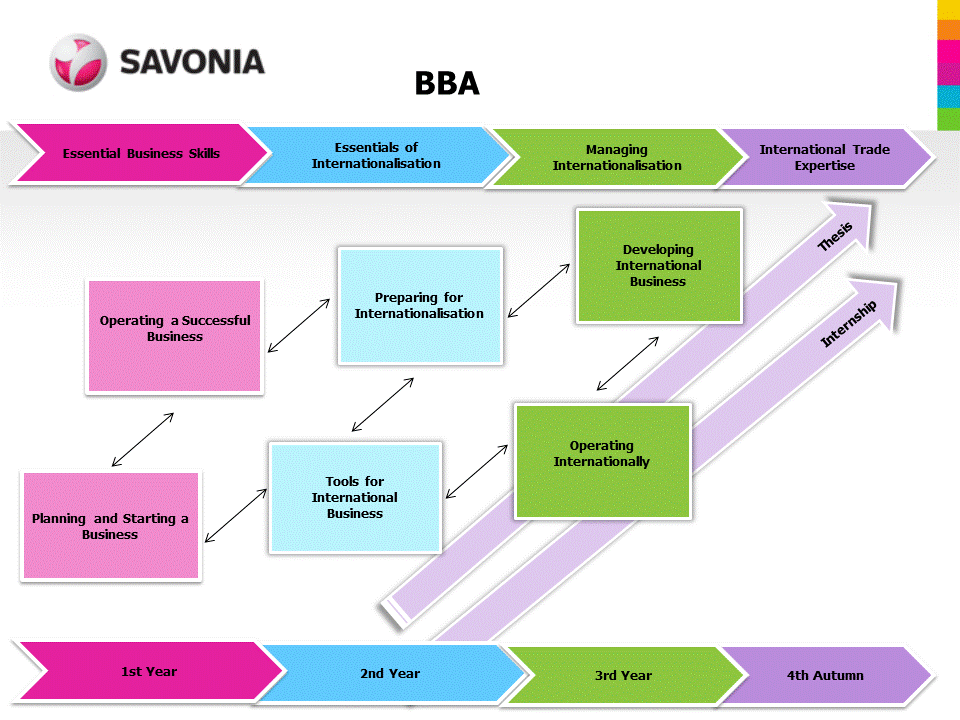
The BBA Degree Programme in International Business at Savonia UAS aims at developing focused expertise in foreign trade. To reach this goal, the curriculum is designed to encourage students to develop knowledge gradually, along their study path, from the wide scope of business to the focused knowledge of trade expertise.
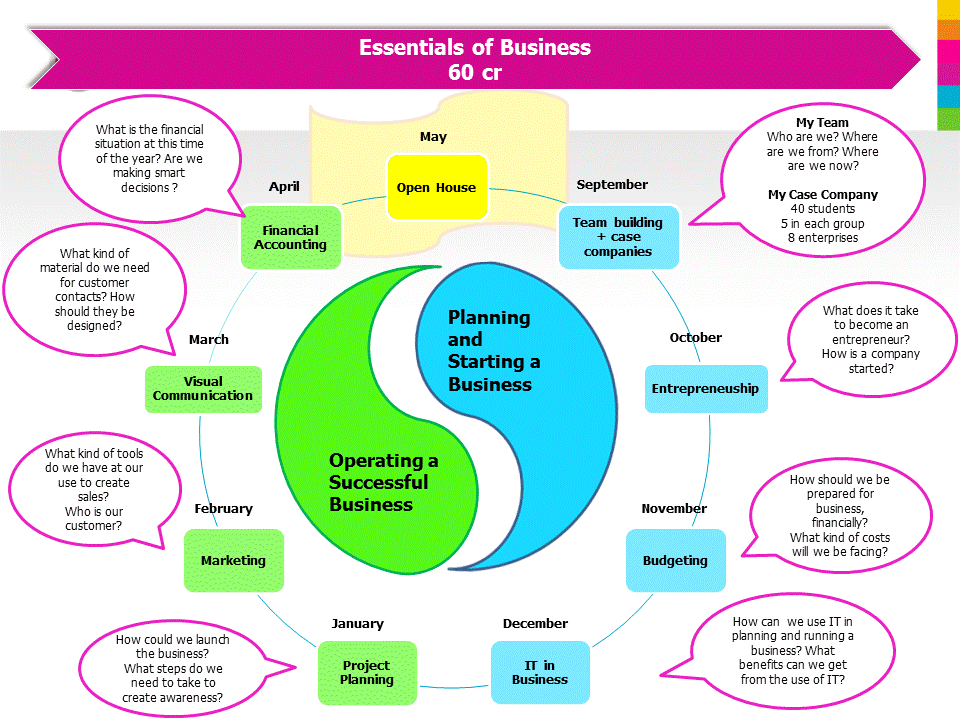
Each year has two assigned themes. During the first term of studies the students will cover issues concerning planning and starting a business. This is done by working in cooperation with a partner organisation from the surrounding environment. The students will form teams around SMEs in cooperation with Savonia, and start getting to know the various phases needed for establishing a business.
The second term continues to operating a successful business. The students gain a profound insight into the successful implementation of daily operations of the partner organisation. They will go through team building phases and become familiar with multicultural working teams and methods. The students are also expected to apply business knowledge to practice within the partner organisation and to be able to share their understanding to fellow students. At the end of the year, the students will have a comprehensive understanding of the everyday business operations as a foundation to develop their international trade expertise.
During the second year studies the students will focus on the essential internationalisation skills. First, the students will learn how to use the tools, such as business research, and will understand the functions of international economics. Second, the students will put these skills and understanding into use, again together with local organisations, within the theme of preparing for internationalisation. A real life business internationalisation project dominates the term, supported by studies in business analysis and communication.
The third-year students will focus on adapting business operations to international environment, and on the challenges organisations face due to differences in conducting business. As skills and understanding grow, the students perceive the evaluation and development of international business professionally. By this stage the students' management and leadership skills will grow to meet the demands of international trade expertise.
Methods and implementation
Savonia provides education which is guided by OIS-thinking. The objective is to combine high-quality learning and teaching with the working life oriented research and development assignments. OIS is short for the words Open Innovation Space. The student is an active doer and he or she studies in various studying environments in different teams, communities and eLearning environments. The students of different study fields, the teachers, the partners working in research and development tasks and the representatives of the working life carry out diverse practice-based assignments in close cooperation. In this way the theory and the practical assignments are combined with the studies.
The working life oriented education at Savonia is strengthened by the active networking of its teaching staff. The continuous development of substance expertise is also guaranteed by cooperation within the business field. The personnel provides the learning opportunities and supports the student’s learning. The Student Services Office, the Library and Information Services, the International Co-operation Services and other supportive services help the students in their studies. The studies are based on the principles of inclusive education and sustainable development.
4 LIG7220 Entrepreneurship and Business Legislation
Credits
5 cr
Credits in Foreign Language
5 cr
Objectives
The student forms a basic understanding of business and its role in the society: the meaning of entrepreneurship and the key characteristics of an entrepreneur. The student also understands the importance of a business plan and is familiar with its structure. The student is aware of the common business functions, and their importance for business success. Further, the student is familiar with the legal aspects of business and able to distinguish between the different legal forms of business. The student is able to identify legal problems in businesses and know the principal areas of law relevant to the operation of a business. The student understands how contracts are used as proactive law tools and is familiar with the most important commercial contractual terms.
Content
business and the society, business functions, entrepreneurship and business plan, business and tourism laws, forms of business, contracts and the functions of contracting, sale of goods and services, intellectual property rights and licensing agreements, forbidden competition restrictions and cooperation, responsible business (sustainable business), black economy.
Grading Scale
0 - 5
Course material
Mariotti, S. & Glackin, C. 2010. Entrepreneurship, 2/E or newer. Prentice Hall.
Ray A. August -Don Mayer - Michael Bixby. 2013. International Business Law: International Edition, 6/E . Pearsons.
Other material will be provided by instructors.
Contact
Hannoura Abdelazim, Komulainen Riitta-Liisa
4 LIA5132 Management Accounting
Credits
5 cr
Credits in Foreign Language
5 cr
Objectives
The student can prepare a CVP income statement and calculate the ratios based on that (contribution margin percentage, break-even point and margin of safety). In addition, the student can set the price for a product according to the wanted contribution margin and is also able to consider the VAT in pricing. The student can prepare a budgeted income statement, cash budget and estimated balance sheet according to given information. He or she can simulate the calculations when the initial data is changed.
Horngren, C.T., Bhimani, A., Datar, S.M. & Foster, G. Management And Cost Accounting (to the appropriate extent). Harlow: Pearson Education. Electronic book or text book.
Contact
4 LIA8130 Business IT
Credits
5 cr
Credits in Foreign Language
5 cr
Objectives
The student learns how to use computers and basic software. After completing this course the student is able to create and modify text documents, create business calculations with spreadsheet and create a slide show with presentation graphics program.
Content
Formatting text documents according to document models. Creating and modifying long documents with styles, page numbering and a table of contents. Using spreadsheet formulas and basic functions in business calculations. Designing presentations and modifying themes of a presentation graphics program.
Requirements
CDL-exams Word processing, Spreadsheet and Presentation Graphics
Grading Scale
0 - 5
Course material
Ornanet e-book collection. Related Office tutorials.
Contact
Suomela Leo
4 LICE050 Business English
Credits
5 cr
Credits in Foreign Language
5 cr
Objectives
The student acquires a good command of business vocabulary and an ability to understand professional business texts. The student develops his or her oral and written communication skills in business and social life so that he or she is able to present himself or herself in a professional manner.
Content
Extensive business vocabulary: terms and concepts of the specialised language in the field-specific contexts. Standard written business messages. Introduction to academic writing. Telephoning, job interviews and other oral communication situations.
Requirements
Final examination, written and oral tests and assignments.
Grading Scale
0 - 5
Course material
MacKenzie, I. 2010. English for Business Studies. 3rd edition. Cambridge: Cambridge University Press.
Other material provided by the lecturer.
Contact
4 LIF5235 Multicultural Environment
Credits
5 cr
Credits in Foreign Language
5 cr
Objectives
The student will increase his or her intercultural awareness and understanding of cultural diversity and the impact of culture on human behaviour and interaction.
Content
The concept of culture, intercultural learning, values, perception, communication, stereotyping, culture shock, concept of time.
Requirements
An assessed journal and assignments based on the lectures, exercises and reading material.
Grading Scale
0 - 5
Course material
Lewis, Richard D. 2006. When Cultures Collide. Leading Across Cultures. 3rd edition. Nicholas Brealey Publishing.
Other material provided by the teacher.
Contact
4 LLCR230 Svenska på företaget
Laajuus
5 op
Osaamistavoitteet
Opiskelija osaa kertoa itsestään ja esitellä omaa ammatillista profiiliaan. Opiskelija selviytyy työelämän tyypillisimmissä viestintätilanteissa ruotsin kielellä, hallitsee liiketalouden alan keskeisimmän sanaston sekä kykenee viestimään vuorovaikutustilanteeseen sopivalla tavalla. Opiskelija osaa tuottaa tavallisimpia liike-elämän tekstejä sekä esitellä yritystä tai organisaatiota ja sen palveluja, tuotteita ja toimintaa. Opiskelija osaa hyödyntää talouselämän julkaisujen ja muiden tietolähteiden tarjontaa.
Keskeiset sisällöt
Koulutukseen ja työhön liittyvä sanasto sekä liiketalouden alan perussanasto: kirjalliset viestintätilanteet (mm. työnhaun asiakirjat, sähköpostiviestintä, liikekirje): suulliset viestintätilanteet (mm. puhelinkieli, tuote-esittely, yritysesittely, asiakaspalvelutilanteet, työpaikkahaastattelu).
Suoritustavat
Luennot ja ohjatut harjoitukset.
Arviointiasteikko
0 - 5
Materiaali
Tolkki, J. & Öhman, M. 2009. Perspektiv på affärssvenska. WSOY sekä materiaalipaketti.
Muuta huomioitavaa
Opintojaksolla arvioidaan erikseen opiskelijan kirjallinen (3 op) ja suullinen kielitaito (2 op), joiden painotetun keskiarvon perusteella opintojaksoarvosana muodostuu. Suorittamalla ruotsin kielen pakollisen opintojakson hyväksytysti opiskelija osoittaa hallitsevansa valtion virkamiehiltä vaadittavan suullisen ja kirjallisen ruotsin kielen taidon (julkisyhteisöjen henkilöstöltä vaadittavasta kielitaidosta annettu laki 424/2003, 6§).
Yhteyshenkilö
Suhonen Inka-Mari
5 LLCR230A Svenska på företaget / Suullinen
Laajuus
2 op
Arviointiasteikko
0 - 5
Yhteyshenkilö
5 LLCR230B Svenska på företaget / Kirjallinen
Laajuus
3 op
Arviointiasteikko
0 - 5
Yhteyshenkilö
4 LICO350 Survival Finnish
Credits
5 cr
Credits in Foreign Language
5 cr
Objectives
The aim is to help the foreign student to adapt to the Finnish environment at the beginning of studies. The student will learn easy words and phrases needed in everyday situations. He or she will increase the awareness of characteristics of the Finnish way of life, culture and society.
Content
Words and phrases: introductions, greetings, filling in forms with personal information, general signs and notices, places around, asking directions, grocery shopping etc. Basic structures.
Requirements
Written and/or oral examination, assignment(s)
Grading Scale
0 - 5
Course material
Provided by the teacher
Prerequisites
-
Contact
Leskinen Hanna
4 LIF5230 Effective Marketing
Credits
5 cr
Credits in Foreign Language
5 cr
Objectives
The student will learn the role of marketing within businesses and the influence operating environments have on marketing decisions. The student will study the history and development of marketing to be able to understand the current mind-set of marketing. The student will comprehend the entity of marketing and the variety of tools at use as well as acquire customer oriented attitude towards business. Furthermore, the student will learn the foundations of CRM and service marketing, as well as the basis for eMarketing activities.
Content
Role of marketing within business, marketing thinking development, marketing environments, marketing tools, customer orientation, purchase behavior, CRM, service marketing, eMarketing.
Grading Scale
0 - 5
Course material
Armstrong, G & Kotler, P. 2013. Marketing : an introduction. Harlow, Essex. Pearson.
Contact
4 LIA5340 Financial Accounting
Credits
5 cr
Credits in Foreign Language
5 cr
Objectives
The student can analyse and record typical business transactions and is able to close the entries to the income statement and balance sheet. In addition, the student understands the basis for value added tax and is able to define how VAT affects financial statements. The student is able to evaluate a company's financial situation based on the most common ratios.
Content
Accounts and financial statements, basis of value added taxation, basic financial ratios in profitability, liquidity and solvency.
Grading Scale
0 - 5
Course material
Weygandt, Jerry J., Kieso, Donald E. & Kimmel, Paul D. Accounting Principles VOL I. New York: John Wiley.
Contact
4 LIA5160 Economics
Credits
5 cr
Credits in Foreign Language
5 cr
Objectives
The student understands the economic rationale of business and is familiar with the essential economic tools for analysis and the major branches of economics. The student understands the economic backgrounds of markets' interaction, and the economic logic of output and price. Further, the student is familiar with major macroeconomic variables and understands the role of macroeconomic policies to stabilise these variables.
Content
Economic problem, demand and supply, cost structure and supply decision, markets structures, macroeconomic variables (inflation, unemployment, interest rate, GDP, economic cycles), macroeconomic policies (fiscal and monetary), macroeconomic analysis (AD/AS).
Grading Scale
0 - 5
Course material
Hubbard, P. O'Brien. Economics 3/E, or newer. Prentice Hall. (Selected chapters)
Contact
4 LIA6150 Business Mathematics
Credits
5 cr
Credits in Foreign Language
5 cr
Objectives
The student can use mathematics in solving problems on percentage, simple interest, and compound interest. The student can use basic statistical measures in practical applications. The student can use Excel in problem solving.
Content
Revision of percentage calculation. Calculations concerning value-added tax and personal taxation. Cost and revenue function. Basics of contribution margin calculation and pricing. Indices and the value of money. Simple and compound interest including applications. Basics on numerical measures of numerical data. Basics of correlation and regression. Basics of investment calculations. Use of Excel in aplications.
Requirements
Weekly exercises and exams (two midterm exams or final exam).
Grading Scale
0 - 5
Course material
Pulkkinen, P., Holopainen, M. & Keinänen, K. 2011. Business mathematics (The 3rd edition of Business Mathematics published by CS Care & Share, Kuopio, in 2011, translation of the 4-7th revised edition of Talous- ja rahoitusmatematiikka written by Pekka Pulkkinen and Martti Holopainen and published by WSOY pro Oy, Helsinki, in 2010. Kuopio: CS Care & Share. Lecture notes.
Prerequisites
Business IT
Contact
Muuruvirta Petteri
4 LIF9116 Project Planning and Reporting
Credits
5 cr
Credits in Foreign Language
5 cr
Objectives
The student will understand the unique nature and characteristics of projects and become familiar with and aware of the tools necessary for project planning and management. He or she will be able to define the scope of projects and break down work into tasks. He or she will also be able to estimate workload and assign resources to tasks as well as schedule and monitor the process. In addition, the student will be able to produce professional documents during the lifetime of a project to various recipients.
Content
Meaning of project and project work. Project planning tools. Task analysis. Scheduling of tasks. Project documentation. Use of English language in projects.
Grading Scale
0 - 5
Contact
4 LIF9200 Visual Communication
Credits
5 cr
Credits in Foreign Language
5 cr
Objectives
The student will understand the importance of visual aspects in communication and recognises the visual methods with which the resulting image and interpretation of communication are influenced. The student can analyse and categorise images and associations and can evaluate the methods critically.
The student knows how to use visual elements and styles when improving the understandability and attractiveness of communication and when creating the desired image and associations. The student can implement visual methods in various communication duties and materials.
Content
Points of view to analysing visual material, eg. references in pictures, the design, colour and context of visual communication. The objectives and responsibilities of visual aspects in communication. Visual elements in various modes of communication and material (corporate design, publicity, advertising, the internet).
Grading Scale
0 - 5
Course material
Hagen, R. & Golombisky, K. 2013. White space is not your enemy : a beginner's guide to communicating visually through graphic, web & multimedia design.Burlington, MA. Focal Press.
Contact
4 LIF9160 International Economics
Credits
5 cr
Credits in Foreign Language
5 cr
Objectives
The student will become familiar with the economic backgrounds of foreign trade and most common trade theories. He or she is able to use and apply economic analytical tools in international trade. He or she will also become familiar with the role of governments and international organisations which distort trade between nations, and the economic consequences of trade barriers. Furthermore, the students will become familiar with the balance of payment and its significance, as well as the foreign exchange market and exchange rate mechanism.
Content
trade theories (mercantilism, absolute advantage, comparative advantage, factors endowment), PPF and opportunity cost, consumer and producer surplus, trade barriers, balance of payment and balance of trade, exchange rate systems and exchange rate determinants.
Grading Scale
0 - 5
Course material
Hubbard, O´Brien. Economics 3/E, or newer.
Parkin. Economics 10/E or newer. Prentice Hall. (only Selected chapters).
Other material and web sources will be provided by instructor.
Prerequisites
1st year studies, specifically Economics, Business Math, Management Accoungting and Financial Accounting.
Contact
4 LIF6125 Business Research
Credits
5 cr
Credits in Foreign Language
5 cr
Objectives
The student will gain the ability to plan and conduct a research or development project. He or she can evaluate the applicability of a variety of research and development methods as well as gather, analyse, and interpret qualitative and quantitative data. In addition, the student can evaluate the reliability of a research or development process. He or she can follow ethical research principles.
Content
The process and goals of research and development projects. Planning and conducting research and development projects. Data acquisition in research and development projects. Gathering, analysing and interpreting qualitative and quantitative data. Use of statistical programs (Webropol and partly Excel). Ethics in research.
Grading Scale
0 - 5
Course material
Buckingham, A and Saunders, P. 2009. The survey methods workbook: from design to analysis. Cambridge: Polity.
Eriksson, P.& Kovalainen, A. 2008. Qualitative Methods in Business Research. London: Sage.
Kananen, J. 2011. Rafting Through the Thesis Process. Step by Step Guide to Thesis Process. Jyväskylä: JAMK University of Applied Sciences.
Silverman, D. 2010. Doing Qualitative Research. A Practical Handbook. Sage: London.
Articles and lecture notes provided by the teachers.
Prerequisites
1st year studies, specifically Business Mathematics, Economics and Business IT.
Contact
4 LIF5245 Multicultural Sales and Organisations
Credits
5 cr
Credits in Foreign Language
5 cr
Objectives
The student can explain the importance of management in the creation of organisational culture. He or she also realises the impact of organisational culture and values on the working environment. The student is able to recognise perception and values influencing personality, work, motivation, communication and team work. He or she is also able to understand the impact of his or her communication on the co-workers or team. The student will focus on the impact of culture on business and the importance of intercultural communication skills at work.
Content
The leader's role in the creation of culture. Dimensions of organisational activities. Recognition of the internal environment, differences and assumptions as well as the embedding mechanisms of an organisation.
The impact of culture on business and the importance of intercultural communications skills at work. Cultural Types (the Lewis Model), Hofstede's dimensions, The Seven Dimensions of Culture by Fons Trompenaars & Charles Hampden-Turner, multicultural management. Co-operational skills in a multicultural environment. Working in a multicultural team.
Grading Scale
0 - 5
Course material
Schein, E. 2010 Organizational Culture and Leadership. The Jossey-Bass Business & Management Series.
Hofstede, G., Hofstede G. J. & Minkov M. 2010.Cultures and organizations: software of the mind : intercultural cooperation and its importance for survival. New York: McGrawHill
Other material provided by the lecturer(s).
Prerequisites
1st year studies, specifically Multicultural Environment.
Contact
4 LIB5225 Business Environment
Credits
5 cr
Credits in Foreign Language
5 cr
Objectives
The student will learn how to observe and analyse both internal and external business environment internationally. In addition, the student is able to discuss how the changes in the business environment affect companies' decisions. The student will become familiar with the selection process of the target country and the factors influencing market selection.The student will learn some business environment analysis tools (e.g. PESTEL). He or she will become familiar with the means of assessing the competences and skills of the companies that are planning internationalisation or are developing their business in the international markets.
Content
Analysing the external and internal business environment. The selection process of the target country and the factors influencing market selection. The role of market research in the internationalisation process. Reviewing a company's international readiness.
Grading Scale
0 - 5
Course material
Daniels, J.D., Radebaugh, L. Sullivan, D. 2007. International business: environments and operations. Upper Saddle River (NJ) : Pearson Education International.
Rugman, A. & Collinson, S. 2009. International business. Harlow : Pearson Education.
Morrison, J. 2009. International Business: challenges in a changing world. New York : Palgrave Macmillan.
Wall, S., Minocha, S. & Rees, B. 2010. International business [E-book]. Harlow Pearson.
Prerequisites
1st-year studies, International Economics and Business Research.
Contact
Tarvainen Minna, Göker Özerk
4 LLCE230 Business Communication
Laajuus
5 op
Osaamistavoitteet
The student develops his or her skills in professional writing and is able to write effective business letters and other business documents using the proper layout and style. He or she learns how to give well-structured oral presentations. He or she also acquires the communication skills needed when organising and attending meetings and negotiations in a multicultural environment.
Keskeiset sisällöt
Written business messages required in international operations such as foreign trade. Business presentations. Meeting and negotiation skills.
Arviointiasteikko
0 - 5
Materiaali
To be announced later.
Edeltävät opinnot
1st ear studies, specifically Business English and Multicultural Environment.
Yhteyshenkilö
4 LIA5345 Financial Management
Credits
5 cr
Credits in Foreign Language
5 cr
Objectives
The student understands the key role and tasks of a financial manager. The student will be familiar with the financial market, its key players, and major financial assets and will be able to analyse and assess the financial performance of the firm. The student will be familiar with vital financial decision making tools and techniques, and will be able to evaluate financial investments.
Content
Financial market, financial assets and instruments, financial ratios and analysis, financial mathematics, capital budgeting, financial assets valuation, capital structure and cost of capital.
Grading Scale
0 - 5
Course material
Ross S. A., Westerfield, R. W. & Jordan, D. B. 2003. Fundamentals of Corporate Finance. Boston, Mass.: McGraw Hill.
Adelman, P. J. & Marks, A. M. 2009. Entrepreneurial finance. New York: Prentice Hall.
Prerequisites
1st year studies, specifically Management Accounting, Financial Accounting and Business Mathematics.
Contact
4 LIB9120 Business Project
Credits
10 cr
Credits in Foreign Language
10 cr
Objectives
The key learning objective is to gain a real life experience in planning and executing a real business-related project. The student gains basic skills in using project management software. The student also takes an active project group member role at least in the following roles:
- planning and organising a given project work to achieve the goals
- working proactively and contributing to the project success by having his or her own responsibility area and independent tasks during the execution phase
- communicating within the project organisation and group as well as to the external client
- contributing to the end reporting of the project in a professional manner.
Content
Project phases, life cycle, roles, resources and risks. Project documentation and the use of project management software. Communication with stakeholders, customers and internally within the team. Cooperative development of knowledge and skills.
Requirements
Assignment(s).
Grading Scale
0 - 5
Course material
Lecture material provided by tutoring teachers.
Prerequisites
1st-year studies, specifically Project Planning. Business Research and Business Communication.
Contact
Tarvainen Minna
4 LIF9117 Professional Reporting
Credits
5 cr
Credits in Foreign Language
5 cr
Objectives
The student will refine and sharpen his or her professional writing and self-editing skills. He or she is able to organize text contents effectively in order to write long, comprehensive messages such as a thesis.
Content
Characteristics of powerful, professional and reader-friendly messages. Reporting. Academic English. Writing a thesis.
Grading Scale
0 - 5
Course material
To be announced later.
Prerequisites
1st year studies, Business Communication
Contact
4 LIB5115 Internationalisation Process
Credits
5 cr
Credits in Foreign Language
5 cr
Objectives
The student understands the internationalisation process of a company and possible alternatives for international market entry. He or she gains knowledge of the various operation methods in the international markets. He or she is able to find, analyse and utilise versatile information when choosing proper internationalisation methods for a company.
Content
A company's internationalisation strategies: challenges, problems and risks related to a company's internationalisation: information sources and support organisations: international business operation methods.
Grading Scale
0 - 5
Course material
Welch L.S. at al. 2007. Foreign Operation Methods. Cheltenham, UK : Edward Elgar : Northampton, MA, USA
Cavusgil S.T. et al. 2013. International business. The new realities. Boston : Pearson Education. ebook.
Other material announced later by the lecturer.
Prerequisites
1st and 2nd year studies, specifically International Economics, Business Research and Business Environment.
Contact
4 LIF5228 International Marketing
Credits
5 cr
Credits in Foreign Language
5 cr
Objectives
The student will learn the influence of the international environment on marketing decisions based on environmental analysis. The student will adopt a deeper orientation to customer relationship management and the adaptation needs of international customers in operations. The planning process of international marketing will deepen the student's knowledge and skills regarding marketing objectives, strategies, tools and building relationships internationally.
Content
Planning process of international marketing, levels of integration/standardisation, marketing objectives, strategies and tools in international operations, CRM.
Grading Scale
0 - 5
Course material
Czinkota, M. R. & Ronkainen, I.A. 2013. International marketing. (International edition). Mason, OH : Thomson/South-Western.
Usunier, J-C. & Lee, J.A. 2013. Marketing across cultures. Harlow, England : New York : Pearson.
Prerequisites
1st and 2nd year studies, specifically International Economics and Business Environment.
Contact
4 LIF5117 Supply Chain Management
Credits
5 cr
Credits in Foreign Language
5 cr
Objectives
The student understands the critical role of logistics for business and is able to identify different logistics tools and supply chain related strategies. He or she is also able to use purchasing and warehousing models to optimise business operations.
Content
Concepts of supply chain and logistics, logistics tools and modes of transportation, supply chain strategies, purchasing and ordering decisions, planning and controlling inventory.
Grading Scale
0 - 5
Course material
For courses arranged 2017 and later:
Murphy, P. & Wood, D. 2014. Contemporary Logistics. Upper Saddle River (NJ) : Pearson Education.
or
Waters, D. 2003. Logistics. An Introduction to Supply Chain Management. New York : Palgrave Macmillan.
For courses arranged before 2017:
Coyley, J. ,Bardi, E. & Langley, J. 2002. The Management of Business Logistics: a supply chain perspective. Mason, OH: South Western.
Prerequisites
1st and 2nd-year studies, specifically International Economics and Business Environment.
Contact
4 LIF9165 International Trade Practices
Credits
5 cr
Credits in Foreign Language
5 cr
Objectives
The student will gain practical experience in the trade process, in the import/export process of international trade, especially exporting from order to delivery process including forwarding and customs clearance, eBusiness applications related to international business practices, VAT regulations and procedures as well as international trade law regulations. He or she will be familiar with the practical aspects related to import/export documents and procedures.
Content
The import/export process, import/export documents, eBusiness applications (e.g. TYVI eGovernment services), VAT, international trade law.
Grading Scale
0 - 5
Course material
ICC Guide to Export-Import basics 3/e.
Drafting and Negotiating International Commercial Contracts - A Practical Guide, ICC Incoterms® 2010.
Grafers H.W. et al. 2006. Strategic Export Management,
Weiss K.D. 2002. Building an Import/Export business.
Material provided by lecturer
Prerequisites
1st and 2nd year studies, SCM and Internationalisation Process.
Contact
4 LIF5122 Strategic Management
Credits
5 cr
Credits in Foreign Language
5 cr
Objectives
The student understands the strategic management planning process, and develops the skill of strategic thinking. He or she understands the vital importance of devising a business vision and mission statement, understands and is able to apply SWOT analysis to develop an effective business strategy. The student is also able to use assessment tools to evaluate business performance and to take corrective strategic decisions.
Content
The strategic management concept and the strategic planning process, business vision and mission, SWOT analysis for internal and external factors, strategic assessment for marketing, HRM, finance, R&D, operations performances.
Grading Scale
0 - 5
Course material
To be announced.
Prerequisites
1st and 2nd year studies.
Contact
4 LIF5116 Human Resources
Credits
5 cr
Credits in Foreign Language
5 cr
Objectives
The student understands the importance of maintenance and development work with human resources both from the company's and personnel's points of view. He or she identifies the different elements of human resource management and is able to understand the practical HRM procedures in the company. The student understands the principles of empowering leadership of the individuals and teams including motivation and interaction at the work place as well as teamwork principles. The student will learn how to work as a team and workplace member and team leader.
Content
HRP, recruitment and orientation, HRD, redundancies, knowledge management, well-being at work, interaction and motivation at work, empowering and team leadership.
Grading Scale
0 - 5
Course material
Organisational Behaviour, International Human Resource Management, Intelligent Leadership (diff. authors).
Other material provided by the lecturer
Prerequisites
1st and 2nd year studies, Internationalisation Process and SCM.
Contact
4 LIF5250 Digital Marketing Communication Project
Credits
5 cr
Credits in Foreign Language
5 cr
Objectives
The student knows the basics of digital marketing communication and current trends of digital marketing and social media. The student is capable of implementing digital marketing campaigns with applicable tools.
Content
Digital marketing and social media strategy, planning, and content marketing. Measuring the results. Image processing and graphic design software. Online marketing channels and advertising. Using blogs and social media in Business. Basics of search engine optimization.
Requirements
Learning diary, project work, self and peer evaluation, presentation of project work in seminar.
Grading Scale
0 - 5
Course material
Material informed by the teachers at the beginning and during the course.
Contact
Järvenpää Titta
4 LIF5300 Strategic Branding and Marketing Communication
Credits
5 cr
Credits in Foreign Language
5 cr
Objectives
The students will understand the meaning of strategic brands in the success of an organisation. The connection between branding and the overall management of the organisation will become clearer. The student will also learn the process of methodical brand building and the tools and methods of implementation.
Content
- Meaning of brands in regards to purchase behavior
- Meaning of brands in regards to organizational achievement
- Brand strategies and branding as a strategic issue
- Brand building elements, concepts and process
- Brand equity and benefits
Requirements
Presentation on assignment, exam.
Grading Scale
0 - 5
Course material
Aaker, D: Building Strong Brands.
Keller, K: Strategic Brand Management, 2008.
Fournier, Breazeale & Fetscherin, edited: Consumer-brand relationships, 2012.
Other material provided by teacher.
Prerequisites
Effective Marketing or similar.
Contact
Oksanen Virpi
4 LIH8130 Personal Creativity in Business
Credits
5 cr
Credits in Foreign Language
5 cr
Objectives
The student understands the main responsibilities of a subordinate and a superior. He/she recognises issues which enable a person to motivate to develop him/herself and his/her creativity. The student identifies means that an organisation or a superior can apply to increase motivation and flow at work. The student identifies his/her potential for creativity and creative problem solving. The student gains insight into enhancing creativity analytically with the help of a concrete creativity method.
Content
Psychological contract, motivation, well-being, flow at work, enhancement of creativity, creative problem solving, creativity tools.
Requirements
Written assignments and analysis.
Grading Scale
0 - 5
Contact
Willman Salla
4 LIF8135 Business Intelligence
Credits
5 cr
Credits in Foreign Language
5 cr
Objectives
Students get basic understanding of Business Intelligence and methods related to this area. Students become familiar with personal computing tools applied to practical business decisions.
Content
Spreadsheet functions and BI-tools of Office- programs. Time series and regression analysis. Introduction of optimization-based management science techniques. Formulation decision problems as optimization models and using Excel Solver to formulate, solve and interpret various management optimization problems.
Requirements
Assignments.
Grading Scale
0 - 5
Course material
Wayne L. Winston: Microsoft Excel 2013: Data Analysis and Business Modeling.
Winston, W.L. & Albright, S.C. 2005. Spreadsheet Modeling and Applications: Essentials of Practical Management.
Prerequisites
Basic spreadsheet skills, Business Mathematics.
Contact
Suomela Leo
4 LIA5350 Advanced Finance
Credits
5 cr
Credits in Foreign Language
5 cr
Objectives
The student becomes familiar with advanced concepts and tools in finance. Students learn how to measure financial assets’ returns and associated risks, how to estimate necessary parameters and further to optimize efficient portfolio of assets. Students are also familiar with more advanced bonds and derivatives concepts and tools such as bond duration, options pricing, and SWAPs.
Content
Risk and return relationship in finance. Portfolio theory, financial assets allocation, and optimization. Advanced bonds features, and bond duration. Black-Scholes Model for options pricing. Currency and Interest rate SWAPs.
Requirements
Assignments.
Grading Scale
0 - 5
Course material
To be announced later.
Prerequisites
Management Accounting, Financial Accounting.
Contact
Hannoura Abdelazim
4 LIF8130 eBusiness
Credits
5 cr
Credits in Foreign Language
5 cr
Objectives
Students will familiarize with the key concepts, opportunities, and effects of electronic and mobile business as well as learn about the influences of the digital society into the organizations and lives of the consumers. Students will recognize the internet's role in business and understand internet-related business models and technologies. The main focus is on strategic planning of e-business, social business, and digital marketing.
Content
Business models in the internet and mobile environment, strategic e-business planning process, e-commerce, digital marketing, and social business channels.
Grading Scale
0 - 5
Course material
Informed by the teacher during the course
Contact
Oksanen Virpi, Aho Markus
4 LICO400 Everyday Finnish
Credits
5 cr
Credits in Foreign Language
5 cr
Objectives
The student can communicate in a simple way in familiar situations related to studying and social life. He/She is able to tell about his/her studies and interests. He/She can make a short phone call and write a simple email message to a friend or teacher. The student will be able to describe his/her health problems to a school nurse/doctor.
Content
Vocabulary related to studies, school environment, freetime activities and health problems. Some basics of language structures.
Requirements
Assignments and an oral and/or or written test.
Grading Scale
0 - 5
Course material
To be announced later.
Prerequisites
Survival Finnish.
Contact
Leskinen Hanna
4 LICO450 Working Life Finnish
Credits
5 cr
Credits in Foreign Language
5 cr
Objectives
The students learn to communicate in basic situations at workplace and in job application process. They can describe their studies and work experience, express ideas and thoughts, and tell about their plans for future.
Content
Vocabulary, phrases and language structures related to CV, job application, job interview, and simple working life situations.
Requirements
Written and/or oral examination, assignment(s)
Grading Scale
0 - 5
Course material
Provided by teacher
Prerequisites
LICO350 Survival Finnish and LICO400 Everyday Finnish
Contact
Leskinen Hanna
4 LICQ120 Elementary Business Russian
Credits
5 cr
Credits in Foreign Language
5 cr
Objectives
The student learns Russian pronunciation and intonation. He/she learns the basic structures and vocabulary to manage in everyday communication situations
Content
Pronunciation and intonation, Cyrillic alphabet (both handwriting and typing), basic vocabulary and structures, basic communication skills.
Requirements
Written and/or oral examination(s), assignment(s), active participation (75% attendance required).
Grading Scale
0 - 5
Course material
To be announced later.
Prerequisites
None.
Contact
Ruotsalainen Olga
4 LICF120 Elementary Business French
Credits
5 cr
Credits in Foreign Language
5 cr
Objectives
The student learns French pronunciation and intonation. He/she learns the basic structures and vocabulary to manage in everyday communication situations.
Content
Pronunciation and intonation, basic vocabulary and structures, basic communication skills.
Requirements
Written and/or oral examination(s), assignment(s), active participation (75% attendance required).
Grading Scale
0 - 5
Course material
To be announced later.
Other considerations
This course is for those students who have no previous studies in French.
Contact
Mylläri Anu
4 LICF130 Advanced Business French
Credits
5 cr
Credits in Foreign Language
5 cr
Objectives
The student learns French structures and vocabulary to manage in basic business communication situations.
Content
Vocabulary related to working life, studies and free time. Basic communication situations at workplace.
Requirements
Written and/or oral examination(s), assignment(s), active participation (75% attendance required).
Grading Scale
0 - 5
Course material
To be announced later.
Prerequisites
LICF120 Elementary Business French.
Contact
Mylläri Anu
4 LICS260 Elementary Business German
Credits
5 cr
Credits in Foreign Language
5 cr
Objectives
The student learns German pronunciation and intonation. He/she learns the basic structures and vocabulary to manage in everyday communication situations.
Content
Pronunciation and intonation, basic vocabulary and structures, basic communication skills.
Requirements
Written and/or oral examination(s), assignment(s), active participation (75% attendance required).
Grading Scale
0 - 5
Course material
To be announced later.
Other considerations
This course is for those students who have no previous studies in German.
Contact
Niskanen Terttu
4 SAVONT1 Opinnäytetyö
Laajuus
15 op
Osaamistavoitteet
Opiskelija osaa
- valita oman alan ja oman ammatillisen kehittymisen kannalta sopivan opinnäytetyöaiheen sekä perustella valintaansa eri näkökulmista.
- suunnitella ja toteuttaa työelämäläheinen tutkimus- ja kehittämistyön, joka perustuu käyttäjän/tilaajan tarpeisiin.
- soveltaa tieteellistä ja näyttöön perustuvaa tietoa opinnäytetyöprosessissa ja oman asiantuntijuutensa kehittämisessä.
- käyttää tarkoituksenmukaisesti omalle ammattialalle ja opinnäytetyön aiheeseen soveltuvia tutkimus- ja kehittämistyön tai taiteellisia menetelmiä.
- laatia opinnäytetyöstään selkeästi rajatun, loogisen ja ammattialalle soveltuvan raportin.
- arvioida opinnäytetyönsä keskeisiä sisältöjä, tuloksia tai tuotoksia ja perustella niiden merkitystä oman alan, tilaajan/käyttäjän tarpeen sekä oman asiantuntijuuden kehittymisen näkökulmasta.
- arvioida opinnäytetyöprosessiaan, sen luotettavuutta ja eettisyyttä sekä työn aikana tapahtunutta ammatillista kasvuaan ja oppimistaan.
- toimia joustavasti yhteistyössä opinnäytetyöprosessissa mukana olevien toimijoiden kanssa ja osoittaa asiantuntijuuttaan.
- kirjoittaa omasta opinnäytetyöstään kypsyysnäytteen.
Keskeiset sisällöt
SAVONT1 Opinnäytetyö 15 op
ONT10: Opinnäytetyön suunnittelu (5 op)
- opinnäytetyöhön ja sen tekemiseen orientoituminen
- aiheen valitseminen ja rajaaminen
- opinnäytetyön suunnitelman laatiminen ja taustamateriaalin kokoaminen
ONT20 Opinnäytetyön toteutus (5 op)
- opinnäytetyön tekeminen
- opinnäytetyön tulokset/tuotos
ONT30 Opinnäytetyön viimeistely (5 op)
- opinnäytetyön raportointi ja julkaiseminen
ONT40 Kypsyysnäyte
Suoritustavat
Opinnäytetyö on aina työelämäläheinen. Suoritustapa voi olla:
a) Kehittämistyö, jonka opiskelija tai opiskelijaryhmä suunnittelee ja toteuttaa käyttäjän tai tilaajan tarpeisiin. Kehittämisen kohteena voi olla esim. tuote, palvelu, prosessi, työmenetelmä, oppi- tai ohjemateriaali, digitaalinen aineisto tai ohjattu toiminta. Opiskelija esittää kehittämistyönsä suunnittelun, toteutuksen sekä arvioinnin tuotoksesta ja sen jatkokehittämistarpeista ammattialalle soveltuvassa raportointimuodossa.
b) Tutkimuksellinen opinnäyte, jossa opiskelija tai opiskelijaryhmä lähestyy oman alan käytännön ongelmaa tai kehittämiskohdetta tarkoituksenmukaisin tutkimuksen menetelmin. Opiskelija laatii työnsä suunnittelusta, toteutuksesta, tuloksista ja niiden tulkinnasta raportin.
c) Produktio, jossa opiskelija tai opiskelijaryhmä osoittaa osaamistaan asiantuntijana tai taiteilijana suunnittelemalla ja toteuttamalla esim. tapahtuman, seminaarin tai taiteellisen esityksen. Opiskelija esittää työnsä suunnittelun, toteutuksen sekä arvioinnin tuotoksesta ammattialalle soveltuvassa raportointimuodossa.
d) Koostettu opinnäytetyö, jossa opintojen aikana toteutetaan ja raportoidaan opinnäytetyöksi suunnitellut osat (esim. projektit). Opinnäytetyöhön kuuluvassa kokoavassa kirjallisessa synteesissä, artikkelissa tai muussa julkaisussa opiskelija esittää työn osien keskeiset tulokset/tuotokset ammattialalle soveltuvassa muodossa.
Opiskelija valitsee opinnäytetyön suoritustavaksi joko SAVONT1 tai SAVONT2
Arviointiasteikko
0 - 5
Materiaali
Opiskelija hankkii itse opinnäytetyössä tarvittavan materiaalin.
Savonian opinnäytetyön raportointiohje.
Opiskelija voi työstää opinnäytetyö -opintojaksoa työnsä kannalta tarkoituksenmukaisella aikataululla.
Yhteyshenkilö
Linden Jari
5 LIONT10 Thesis Planning
Credits
5 cr
Credits in Foreign Language
5 cr
Objectives
The student can
- choose a topic that is relevant for the development of both the field of study and his/her own expertise
- motivate his/her topic choice from various viewpoints
- create a thesis topic description and complete it into a thesis plan (=work plan)
- work flexibly with other people and parties involved in the thesis process
- present his /her knowledge and skills.
Content
- selecting a thesis topic and narrowing it down
- writing a thesis topic description
- signing an agreement on thesis project and supervision
- finding a thesis supervisor
- information retrieval
- writing a thesis plan (= work plan) and finding source material
Requirements
Participation in thesis info sessions, writing a thesis topic description, independent work, information retrieval, presenting a thesis plan (=work plan) in a thesis seminar.
Grading Scale
Passed - 0
Course material
The student acquires the material required in the thesis process independently.
Savonia Reporting Instructions.
Prerequisites
Research methodology studies of the degree programme.
Other considerations
The student can create an individual yet appropriate timetable for the thesis process.
Contact
Mäkelä Pentti
5 LIONT20 Thesis Implementation
Credits
5 cr
Credits in Foreign Language
5 cr
Objectives
The student can
- implement a working-life-oriented research and development project, which meets the needs of a user/client
- apply scientific and evidence-based knowledge to the thesis process in order to increase and develop his/her expertise
- create a report that is concise and logical and meets the professional standards of his/her field of study.
- assess the main contents, results and outcomes of the thesis and discuss their relevance to the field, the needs of a user/the client and the development of his/her expertise
- work flexibly with other people and parties involved in the process and demonstrate his/her expertise
Content
- working independently on the thesis
- guidance related to the various phases of the thesis
- the results/outcome of the thesis
- presentation of the thesis in a seminar
Requirements
Independent studies and information retrieval.
Grading Scale
Passed - 0
Prerequisites
Research methodology studies of the degree programme.
Thesis Planning -course (5 cr).
Other considerations
The student may set an individual yet appropriate timetable for his/her thesis process.
Contact
Mäkelä Pentti
5 LIONT30 Thesis Finalisation
Credits
5 cr
Credits in Foreign Language
5 cr
Objectives
The student can
- create a report that is concise and logical and meets the professional standards of his/her field of study
- assess the main contents, results and outcomes of the thesis and discuss their relevance to the field, the needs of a user/the client and the development of his/her expertise
- assess the thesis process, its reliability and ethicalness as well as his/her professional growth and development
- work flexibly with other people and parties involved in the process and demonstrate his/her expertise
- write a maturity test essay on the thesis process.
Content
- finalizing the thesis as well as writing and editing the report based on the feedback received in the thesis seminar and from the thesis supervisor
- detection of plagiarism
- submitting the thesis for assessment
Requirements
Independent studies and information retrieval.
Grading Scale
Passed - 0
Course material
The student acquires any material needed in the thesis process independently.
Savonia Reporting instructions.
Prerequisites
Research methodology studies of the degree programme.
Thesis Planning -course (5 cr).
Thesis Implementation -course (5 cr).
Other considerations
The student may set an individual yet appropriate timetable for the thesis process.
Contact
Mäkelä Pentti
5 LIONT40 Maturity Test
Objectives
The student can
- write the maturity test showing expertise in the field of his/her studies and proficiency in communication and language skills
- discuss the maturity test assignment in a logical manner, showing professional competence and with relevance to the assignmnet questions
- summarise his/her thesis and focus on the essential concepts, facts and findings
- write a professional text in the appropriate style and without grammar mistakes.
Content
Enrolling to and writing the maturity test.
Requirements
The student enrols to the maturity test after his/her thesis has been submitted for assessment.
The student in an international degree programme who has completed his/her school education in Finnish or Swedish writes the maturity test in Finnish or Swedish. The student who has completed his/her school education abroad or in a language other than Finnish or Swedish writes the maturity test in the language of instruction of the degree programme in question.
The thesis supervisor prepares maturity test questions on the student's thesis content. The student answers the question(s) of his/her choice. The student is not allowed to bring any material to the examination room. The maturity test comprises about four pages of text written by the student or 400-600 word. The student can spend up to three hours (3x60 min) on the test.
Grading Scale
Passed - 0
Course material
The student receives the maturity test assignment after entering the examination classroom.
Prerequisites
Completion of SAVONT1 Thesis (15 cr) or SAVONT2 Thesis (15 cr).
Other considerations
Information on the student's maturity test is given on the degree certificate.
Contact
Mäkelä Pentti
4 SAVONT2 Opinnäytetyö
Laajuus
15 op
Osaamistavoitteet
Opiskelija osaa
- valita oman alan ja oman ammatillisen kehittymisen kannalta innovatiivisen opinnäytetyöaiheen sekä perustella valintaansa eri näkökulmista.
- suunnitella ja toteuttaa työelämäläheinen tutkimus- ja kehittämistyön, joka perustuu käyttäjän/tilaajan tarpeisiin.
- soveltaa tieteellistä ja näyttöön perustuvaa tietoa opinnäytetyöprosessissa ja oman asiantuntijuutensa kehittämisessä.
- käyttää tarkoituksenmukaisesti omalle ammattialalle ja opinnäytetyön aiheeseen soveltuvia tutkimus- ja kehittämistyön tai taiteellisia menetelmiä.
- laatia opinnäytetyöstään selkeästi rajatun, loogisen ja ammattialalle soveltuvan raportin.
- arvioida opinnäytetyönsä keskeisiä sisältöjä, tuloksia tai tuotoksia ja perustella niiden merkitystä oman alan, tilaajan/käyttäjän tarpeen sekä oman asiantuntijuuden kehittymisen näkökulmasta.
- arvioida opinnäytetyöprosessiaan, sen luotettavuutta ja eettisyyttä sekä työn aikana tapahtunutta ammatillista kasvuaan ja oppimistaan.
- toimia joustavasti yhteistyössä opinnäytetyöprosessissa mukana olevien toimijoiden kanssa ja osoittaa asiantuntijuuttaan.
- kirjoittaa omasta opinnäytetyöstään kypsyysnäytteen.
Keskeiset sisällöt
SAVONT2 Opinnäytetyö 15 op
ONT50 Opinnäytetyö, projekti 1 (5 op)
ONT60 Opinnäytetyö, projekti 2 (5 op)
ONT70 Opinnäytetyöprojektien synteesi ja julkistaminen (5 op)
ONT80 Kypsyysnäyte
Suoritustavat
Opinnäytetyö on aina työelämäläheinen. Suoritustapa voi olla:
a) Kehittämistyö, jonka opiskelija tai opiskelijaryhmä suunnittelee ja toteuttaa käyttäjän tai tilaajan tarpeisiin. Kehittämisen kohteena voi olla esim. tuote, palvelu, prosessi, työmenetelmä, oppi- tai ohjemateriaali, digitaalinen aineisto tai ohjattu toiminta. Opiskelija esittää kehittämistyönsä suunnittelun, toteutuksen sekä arvioinnin tuotoksesta ja sen jatkokehittämistarpeista ammattialalle soveltuvassa raportointimuodossa.
b) Tutkimuksellinen opinnäyte, jossa opiskelija tai opiskelijaryhmä lähestyy oman alan käytännön ongelmaa tai kehittämiskohdetta tarkoituksenmukaisin tutkimuksen menetelmin. Opiskelija laatii työnsä suunnittelusta, toteutuksesta, tuloksista ja niiden tulkinnasta raportin.
c) Produktio, jossa opiskelija tai opiskelijaryhmä osoittaa osaamistaan asiantuntijana tai taiteilijana suunnittelemalla ja toteuttamalla esim. tapahtuman, seminaarin tai taiteellisen esityksen. Opiskelija esittää työnsä suunnittelun, toteutuksen sekä arvioinnin tuotoksesta ammattialalle soveltuvassa raportointimuodossa.
d) Koostettu opinnäytetyö, jossa opintojen aikana toteutetaan ja raportoidaan opinnäytetyöksi suunnitellut osat (esim. projektit). Opinnäytetyöhön kuuluvassa kokoavassa kirjallisessa synteesissä, artikkelissa tai muussa julkaisussa opiskelija esittää työn osien keskeiset tulokset/tuotokset ammattialalle soveltuvassa muodossa.
Opiskelija valitsee opinnäytetyön suoritustavaksi joko SAVONT1 tai SAVONT2
Arviointiasteikko
0 - 5
Materiaali
Opiskelija hankkii itse opinnäytetyössä tarvittavan materiaalin.
Savonian opinnäytetyön raportointiohje.
Opiskelija voi työstää opinnäytetyö -opintojaksoa työnsä kannalta tarkoituksenmukaisella aikataululla.
Yhteyshenkilö
Linden Jari
5 LIONT50 Thesis Project 1
Credits
5 cr
Credits in Foreign Language
5 cr
Objectives
The student can
- implement a working-life-oriented research and development project, which meets the needs of a user/client
- apply scientific and evidence-based or artistic methods to the thesis process in order to increase and develop his/her expertise
- work flexibly with other people and parties involved in the process and demonstrate his/her expertise
Content
Planning, implementation and reporting on a project.
Requirements
Presenting the project plan. Approval of the the project plan. Independent studies and information retrieval. Implementation of the project. Reporting on the project.
Grading Scale
Passed - 0
Course material
The student acquires any material needed in the thesis project independently.
Savonia Reporting instructions.
Prerequisites
Research methodology studies of the degree programme.
Contact
Mäkelä Pentti
5 LIONT60 Thesis Project 2
Credits
5 cr
Credits in Foreign Language
5 cr
Objectives
The student can
- implement a working-life-oriented research and development project, which meets the needs of a user/client
- apply scientific and evidence-based or artistic methods to the thesis process in order to increase and develop his/her expertise
- work flexibly with other people and parties involved in the process and demonstrate his/her expertise
Content
Planning, implementation and reporting on a project.
Requirements
Presenting the project plan. Approval of the the project plan. Independent studies and information retrieval. Implementation of the project. Reporting on the project.
Grading Scale
Passed - 0
Course material
The student acquires any material needed in the thesis project independently.
Savonia Reporting instructions.
Prerequisites
Research methodology studies of the degree programme.
Other considerations
The student may set an individual yet appropriate timetable for the thesis process.
Contact
Mäkelä Pentti
5 LIONT70 Finalising the Thesis Projects
Credits
5 cr
Credits in Foreign Language
5 cr
Objectives
The student can
- assess the main contents, results and outcomes of the thesis and discuss their relevance to the field, the needs of a user/the client and the development of his/her expertise
- assess the thesis process, its reliability and ethicalness as well as his/her professional growth and development
- create a report, article or other publication that is concise and logical and meets the professional standards of his/her field of study
Content
Creating a report, article or other publication that presents the main results/outcomes in a format that meets the professional standards of the field.
Presenting the thesis projects in a seminar.
Requirements
Reporting on the thesis projects.
Presentation of the thesis projects in a seminar.
Grading Scale
Passed - 0
Course material
The student acquires any material needed in the thesis process independently.
Savonia Reporting instructions.
Prerequisites
Research methodology studies of the degree programme.
LIONT50 Thesis Project 1.
LIONT60 Thesis Project 2.
Other considerations
The student may set an individual yet appropriate timetable for the thesis process.
Contact
Mäkelä Pentti
5 LIONT80 Maturity Test
Objectives
The student can
- write the maturity test showing expertise in the field of his/her studies and proficiency in communication and language skills
- discuss the maturity test assignment in a logical manner, showing professional competence and with relevance to the assignmnet questions
- summarise his/her thesis and focus on the essential concepts, facts and findings
- write a professional text in the appropriate style and without grammar mistakes.
Content
Enrolling to and writing the maturity test.
Requirements
The student enrols to the maturity test after his/her thesis has been submitted for assessment.
The student in an international degree programme who has completed his/her school education in Finnish or Swedish writes the maturity test in Finnish or Swedish. The student who has completed his/her school education abroad or in a language other than Finnish or Swedish writes the maturity test in the language of instruction of the degree programme in question.
The thesis supervisor prepares maturity test questions on the student's thesis content. The student answers the question(s) of his/her choice.
The student is not allowed to bring any material to the examination room. The maturity test comprises about four pages of text written by the student or 400-600 word. The student can spend up to three hours (3x60 min) on the test.
Grading Scale
Passed - 0
Course material
The student receives the maturity test assignment after entering the examination classroom.
Prerequisites
Completion of LIONT50 Thesis Project 1 and LIONT60 Thesis Project 2.
Other considerations
Information on the student's maturity test is given on the degree certificate.
Contact
Mäkelä Pentti
4 LIG9130 Internship 1
Credits
6 cr
Credits in Foreign Language
6 cr
Objectives
The objective of the work placement is to enable the student to become familiar with various professions, duties and tasks in business life while doing work that is relevant to the degree programme. The work placement enables the student to apply the knowledge learned to practice and also evaluate personal aptitude in view of the requirements of working life. At the same time the student gains experience of the qualifications required in various professions in business life in general and is able to evaluate his/her own knowledge and skills.
Content
Development of knowledge, the practical working skills within the specific field and personal competences.
Grading Scale
Passed - 0
Prerequisites
60 credits of studies.
Contact
Niskanen Terttu
4 LIG9140 Internship 2
Credits
6 cr
Credits in Foreign Language
6 cr
Objectives
The objective of the work placement is to enable the student to become familiar with various professions, duties and tasks in business life while doing work that is relevant to the degree programme. The work placement enables the student to apply the knowledge learned to practice and also evaluate personal aptitude in view of the requirements of working life. At the same time the student gains experience of the qualifications required in various professions in business life in general and is able to evaluate his/her own knowledge and skills.
Content
Development of knowledge, the practical working skills within the specific field and personal competences.
Grading Scale
Passed - 0
Prerequisites
60 credits of studies.
Contact
Niskanen Terttu
4 LIG9150 Internship 3
Credits
6 cr
Credits in Foreign Language
6 cr
Objectives
The objective of the work placement is to enable the student to become familiar with various professions, duties and tasks in business life while doing work that is relevant to the degree programme. The work placement enables the student to apply the knowledge learned to practice and also evaluate personal aptitude in view of the requirements of working life. At the same time the student gains experience of the qualifications required in various professions in business life in general and is able to evaluate his or her own knowledge and skills.
Content
Development of knowledge, the practical working skills within the specific field and personal competences.
Grading Scale
Passed - 0
Prerequisites
120 cr of studies
Contact
Niskanen Terttu
4 LIG9160 Internship 4
Credits
6 cr
Credits in Foreign Language
6 cr
Objectives
The objective of the work placement is to enable the student to become familiar with various professions, duties and tasks in business life while doing work that is relevant to the degree programme. The work placement enables the student to apply the knowledge learned to practice and also evaluate personal aptitude in view of the requirements of working life. At the same time the student gains experience of the qualifications required in various professions in business life in general and is able to evaluate his or her own knowledge and skills.
Content
Development of knowledge, the practical working skills within the specific field and personal competences.
Grading Scale
Passed - 0
Prerequisites
120 cr of studies
Contact
Niskanen Terttu
4 LIG9170 Internship 5
Credits
6 cr
Credits in Foreign Language
6 cr
Objectives
The objective of the work placement is to enable the student to become familiar with various professions, duties and tasks in business life while doing work that is relevant to the degree programme. The work placementl enables the student to apply the knowledge learned to practice and also evaluate personal aptitude in view of the requirements of working life. At the same time the student gains experience of the qualifications required in various professions in business life in general and is able to evaluate his or her own knowledge and skills.
Content
Development of knowledge, the practical working skills within the specific field and personal competences.
Grading Scale
Passed - 0
Prerequisites
120 cr of studies
Contact
Niskanen Terttu
Pidätämme oikeuden opetussuunnitelmien muutoksiin mm. opiskeltavien sisältöjen päivitystarpeiden takia.