EJYI18SY Master's Degree Programme in Environmental Engineering
Basis of Education
The Master’s Degree Programme in Environmental Engineering is a 60 ECTS programme which leads to a Master’s Degree in Engineering (M. Eng.). The skills and competence gained through this programme meet the requirements of the working life in view of extensive and profound knowledge and skills in environmental engineering. It also provides the required knowledge of the field-related theory to enable the graduates to work in challenging managerial positions in the field. University of applied sciences Master’ Degree is equivalent to a university Master’s Degree and the graduates are equally eligible for public posts. The name of qualification is Master of Engineering. (The government decree on polytechnics 352/2003)
The degree programme in environmental engineering is work-oriented education primarily targeted at Bachelors of Engineering (UAS). The students can complete the degree studies either alongside work or as full-time students; the studies take 1.5-2 years.
The content and aims of the programme are based on the identified competence needs in the environmental industry. In addition, the programme is focused on the scientific, technological and business key innovation and development projects which contribute to economic reform. These projects are included in the Northern Savo regional plan. The education promotes the ’biofuels and bio refining’ fields as well as enhances the development of a new field ’The locus of water processes and air technology’ in accordance with the regional plan.
The student gains excellent project work as well as research data collection and processing skills. He or she is able to apply this data to his or her own work and its development. The aim of the studies is to promote willingness for lifelong learning, innovation, internationality and wellbeing at work.
When studying alongside work, educationalization is used extensively. The skills and competence required for completing the degree are gained through development work which meets the employer’s needs. This work supports the working student’s professional development and graduation process as well as the employer’s business development needs. The Savonia UAS specialist staff supports the educationalization and development process actively in close cooperation with the student and employer.
Competence Standards
The qualification of a Master of Engineering is at the European and Finnish level 7 (The national framework of qualifications)
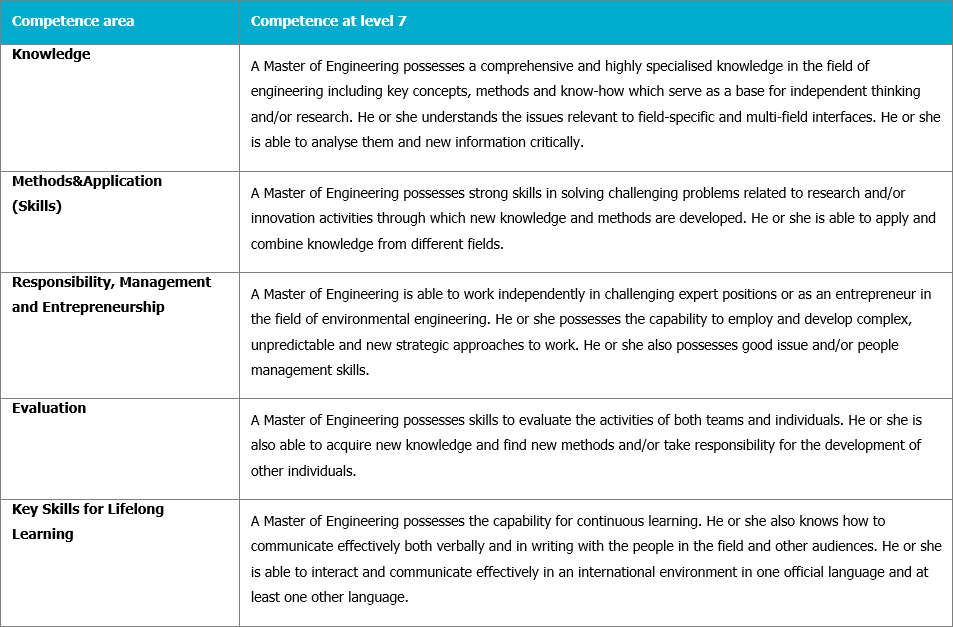
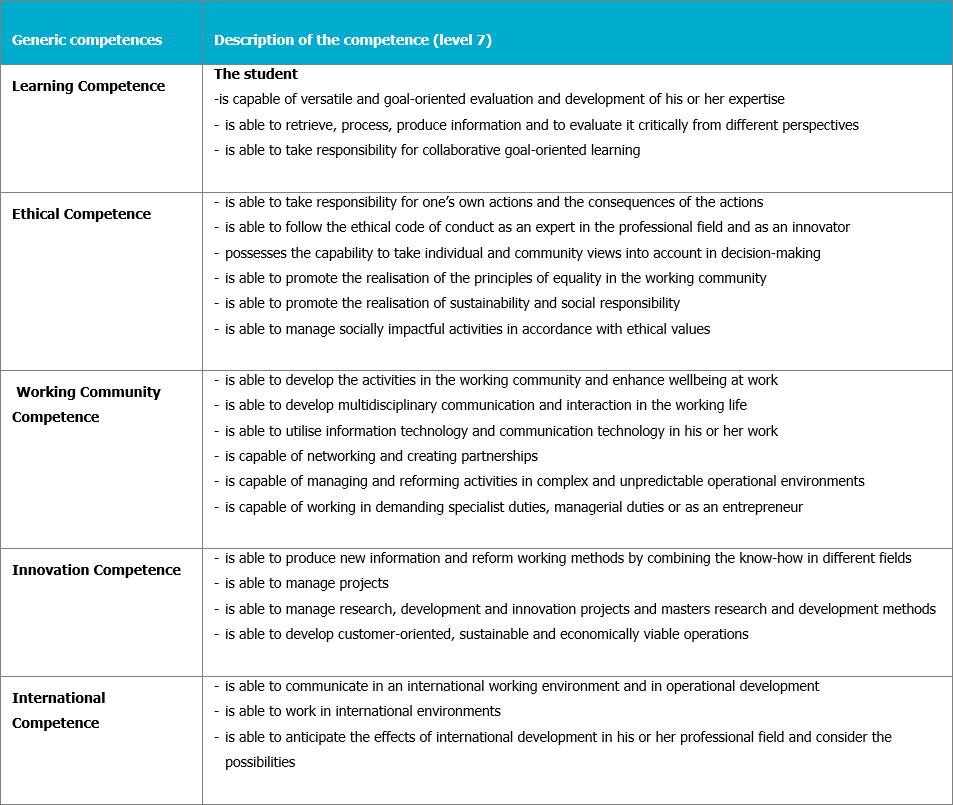
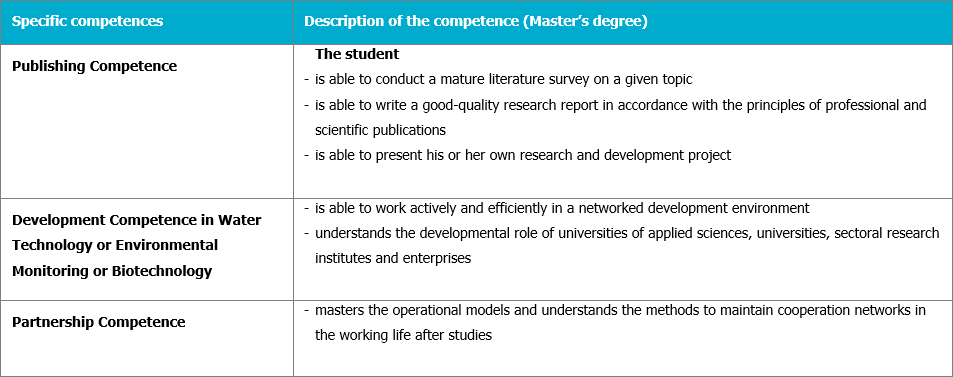
The competence profile of a Master of Engineering consists of generic and specific competences.
Structure of Studies
The Master’s Degree Programme in Environmental Engineering is 60 ECTS and the accomplishment takes 1.5-2 years. According to the curriculum one academic year of full-time studying corresponds to 60 ECTS, which is equivalent to 1600 hours of a student’s workload. The study time in the master’s programme may vary due to diverse educational backgrounds and work experience. Recognition of prior learning may shorten the study time.
The structure of the degree programme is presented in the following chart. The studies contain field-specific professional studies (20 ECTS), common studies at Savonia UAS (10 ECTS) and a thesis (30 ECTS). The student chooses at least 10 ECTS from the joint studies of the master’s programmes at Savonia UAS. They include entrepreneurship, research and development as well as management of expert organisations.

Chart 1. The Structure of Studies
The objectives, contents and methods of the courses are described in the curriculum course descriptions. The Savonia OIS project teaching methods (OIS-Open Innovation Space) guide the implementation of the studies. The studies are part of the research and development work of Savonia UAS, businesses and other partners. It is possible to use the Savilahti joint laboratory premises during the studies.
The student makes a work-oriented personal study plan for his or her studies in cooperation with the supervisor and, if needed, with the employer. In addition, the skills and learning gained earlier in the working life are recognised in accordance with the RPL system at Savonia UAS (RPL – recognition of prior learning).
The master’s thesis is an extensive, applied development or research project during which the student demonstrates his or her ability to apply research data and to produce new solutions as well as to reform work-life practices. The students start the thesis plans as early as at the beginning of the studies and the personal study plan is made to support the achievement of the goal. The course ’Inquiry Based Development’, thesis seminars and method clinics support the thesis work. One aim of the thesis work is to gain publishing competence which is an integral part of research and development work. Some of the courses are taught in the English language.
Development of Expertise
Contemporary employees move from one position to another within an organisation and between organisations. As the content of work changes, the employees’ versatile skills and reaction ability are emphasised. The multidisciplinary and international nature of work is emphasised in most fields. A successful employee needs service, business and technological skills as well as skills to promote wellbeing in the society and environment. Analytical reasoning and problem-solving skills, critical thinking and data management skills are required to be able to develop wellbeing and create innovations in the working life.
It is increasingly important to focus on a user driven and user experience approach. Lifelong learning is closely linked to an employee’s career development. The themes of competence at Savonia UAS describe the view of the competence required in the future working life. The curricula include four strategically selected common themes: lifelong learning, innovations, internationality and wellbeing at work. These themes run through the implementation plans and assessment criteria of the studies. They are in line with the national and field-specific competences which are described in the table below.
The curricula at Savonia UAS are composed of courses. They are not separate but support the development of a student’s expertise and his or her development as a whole. They also enable the combination of work-oriented research, development and innovation activities.
The Master’s Degree in Environmental Engineering is devised to
- produce the skills and competence required in the working life
- ensure the development of the student’s professional expertise
The student
- drafts his or her personal study plan to support the studies. Prior learning is recognised (includes at least 5 ECTS of studies in a foreign language)
- takes responsibility for the progress of his or her studies
The teachers and other members of staff at Savonia UAS guide and support the student in defining and achieving personal goals.
Methods and implementation
The master’s environmental engineering education is based on the competence and development demands of the working life. The students’ own working life experiences contribute to the learning. Competence goal-oriented expert knowledge and practice-oriented teaching methods are used to deepen the experiences. The methods emphasise reflective thinking and sharing knowledge and know-how. The student’s role is to be an active, responsible and critical doer. He or she is able to make choices related to his or her studies on the basis of his or her personal development challenges.
The education is implemented as multiform studies including contact lessons, independent studying, eLearning, practical work and assignments. The student can study alongside with work and link his or her assignment and thesis research to the development of his or her working place. The number of days for contact lessons is approx. 2 days/month, mainly on Fridays and Saturdays in Kuopio.
International competence is enhanced in many ways. Each student must have at least 5 ECTS of studies in a foreign language included in his or her personal study plan.
The accomplishment of the student’s study goals is guided and monitored through evaluation. The whole study and learning process is evaluated. The focus is on the achieved knowledge and skills as well as on the attitude and ability to assume responsibility required in the working life. Course evaluation is based on the criteria presented in the course description.
The environmental engineering students and staff at Savonia UAS are in close, daily contact with the working life representatives. The timeliness, competitiveness and quality of the education are ensured through continuous national and international cooperation with other educational institutes, sectorial research institutes and with the business sector.
Course Table
| Code | Name | 1 S | 1 K | 1 KS | 2 S | 2 K | 3 S | 3 K | |||
|---|---|---|---|---|---|---|---|---|---|---|---|
| Advanced Professional Studies | |||||||||||
| Specialised Professional Studies | |||||||||||
| 4 EJYI8000 | Applied Water Technology | 5 (NonStop) | |||||||||
| 4 EJYI8010 | Water Technology Development Project | 5 (NonStop) | |||||||||
| 4 EJYI8020 | Applied Environmental Monitoring | 5 (NonStop) | |||||||||
| 4 EJYI8030 | Environmental Monitoring Development Project | 5 (NonStop) | |||||||||
| 4 EJYI8040 | Applied Bioprocesses | 5 (NonStop) | |||||||||
| 4 EJYI8050 | Bioprocess Development Project | 5 (NonStop) | |||||||||
| 4 EJYI8060 | Occupational Health and Risk Assessment | 5 (NonStop) | |||||||||
| Elective Studies | |||||||||||
| Common Professional Studies | |||||||||||
| 4 X991008 | Working and Studying in International Environment | 5 (NonStop) | |||||||||
| 4 X991012 | Digitalised Working Environment | 5 (NonStop) | |||||||||
| 4 X991050 | Business in Digital Health | 5 (NonStop) | |||||||||
| 4 X991054 | Successful Organisation | 5 (NonStop) | |||||||||
| 4 X991056 | Innovation Knowledge | 5 (NonStop) | |||||||||
| 4 X991058 | Expertise and Supervisory Work | 5 (NonStop) | |||||||||
| 4 X991060 | Strategic Project Knowledge | 5 (NonStop) | |||||||||
| 4 X991062 | Strategic Thinking and Future Orientation | 5 (NonStop) | |||||||||
| 4 X991064 | Service Design | 5 | |||||||||
| Final Thesis | |||||||||||
| Thesis | |||||||||||
| 4 SAVMONT | Thesis | 30 | |||||||||
Opintojaksokuvaukset
4 EJYI8000 Applied Water Technology
Credits | 5 cr |
Credits in Foreign Language | 5 cr |
Objectives | The student is able to combine his or her skills in water and process technologies with e.g. mathematical-physical, chemical, biological or measurement technological skills. These skills help him or her gain a deeper understanding of the operating principles of applications related to water technology or water management in communities and in the industrial sector. They also support the student when he or she performs development tasks in the field. The aim is to combine and apply multidisciplinary skills to solve interdisciplinary challenges typical of water technology at various scales. The student learns to report on the observations and research in accordance with the principles of scientific publications. In addition, he or she learns to be an active member in a water technology research team in a networked, multidisciplinary RDI environment. |
Content | - Specific technical, mathematical and scientific skills which are determined at the beginning of the course in cooperation with the supervising teacher and RDI personnel. The skills requirements are based on the needs in the specific field. - Preparation of a specific learning and research plan together with the supervising teacher and RDI personnel. - Familiarisation with water technology applications. - Laboratory work in a small, guided team as well as independently. - Active participation in a multidisciplinary, networked research team work - Making a literature survey and reporting on the laboratory research in publishable form |
Requirements | Project work, literature survey, laboratory work, team work, reporting |
Grading Scale | 0 - 5 |
Course material | To be announced at the beginning of the course |
Prerequisites | Skills in applied water technology gained either during previous studies or in working life |
Contact | Pajula Pasi |
4 EJYI8010 Water Technology Development Project
Credits | 5 cr |
Credits in Foreign Language | 5 cr |
Objectives | Work-oriented projects are implemented in cooperation with companies or other partners in different fields. After completing the course the student understands the importance of cooperation and responsibility when he or she works on target-oriented, multiprofessional projects which require creative problem-solving skills. The student is able to examine context-related components critically and analytically and to write a report on the results in publishable form. The student learns to use source literature to find in-depth information on occupational health and safety for the plans of the application assignments. He or she also learns to report on the observations and research in accordance with the principles of scientific publications. |
Content | - Selection and development of the topics, project team formation - Communication and building cooperation with the client - Determination of project targets, partitioning and timetable - Project plan for the student’s own project - Implementation of the water technology-related, work-oriented project (topic vary team by team and annually) - Progress monitoring, overview of the project as well as reporting during the project - Presentation of and reporting on the results (different target groups) - Evaluation of the project and feedback |
Requirements | Project work on Savonia UAS research premises, in research institutes in the sector or on company premises. |
Grading Scale | 0 - 5 |
Course material | To be announced at the beginning of the course |
Prerequisites | Appropriate university level education or skills gained through work |
Contact | Pajula Pasi |
4 EJYI8020 Applied Environmental Monitoring
Credits | 5 cr |
Credits in Foreign Language | 5 cr |
Objectives | The student is able to combine his or her skills in water and process technologies with e.g. mathematical-physical, chemical, biological or measurement technological skills. These skills help him or her gain a deeper understanding of the operating principles of applications related to environmental monitoring in communities and in the industrial sector. They also support the student when he or she performs development tasks in the field. The aim is to combine and apply multidisciplinary skills to solve interdisciplinary challenges typical of the natural or process environments at various scales. The student learns to report on the observations and research in accordance with the principles of scientific publications. In addition, he or she learns to be an active member in an environmental engineering research team in a networked, multidisciplinary RDI environment. |
Content | - Specific technical, mathematical and scientific skills which are determined at the beginning of the course in cooperation with the supervising teacher and RDI personnel. The skills requirements are based on the needs in the specific field. - Preparation of a specific learning and research plan together with the supervising teacher and RDI personnel. - Familiarisation with the environmental monitoring application - Continuous measurements in field and process conditions - Measurement data treatment and analysis by using computational methods - Field and laboratory work in a small, guided team as well as independently - Active participation in a multidisciplinary, networked research team work - Making a literature survey and reporting on the laboratory research in publishable form |
Requirements | Project work, literature survey, laboratory work, team work, reporting |
Grading Scale | 0 - 5 |
Course material | To be announced at the beginning of the course |
Prerequisites | Skills in applied environmental engineering gained either during previous studies or in the working life |
Contact | Räsänen Teemu |
4 EJYI8030 Environmental Monitoring Development Project
Credits | 5 cr |
Credits in Foreign Language | 5 cr |
Objectives | Work-oriented projects are implemented in cooperation with companies or other partners in different fields. After completing the course the student understands the importance of cooperation and responsibility when he or she works on target-oriented, multiprofessional projects which require creative problem-solving skills. The student is able to examine context-related components critically and analytically and to write a report on the results in publishable form. |
Content | - Selection and development of the topics, project team formation - Communication and building cooperation with the client - Determination of project targets, partitioning and timetable - Project plan for the student’s own project - Implementation of the environmental monitoring-related, work-oriented project (topic vary team by team and annually) - Progress monitoring, overview of the project as well as reporting during the project - Presentation of and reporting on the results (different target groups) - Evaluation of the project and feedback |
Requirements | Project work at Savonia UAS, in research institutes in the sector or on company premises. |
Grading Scale | 0 - 5 |
Course material | To be announced at the beginning of the course |
Prerequisites | Appropriate university level education or skills gained through work |
Contact | Räsänen Teemu |
4 EJYI8040 Applied Bioprocesses
Credits | 5 cr |
Credits in Foreign Language | 5 cr |
Objectives | The student is able to combine his or her skills in bioprocesses with other required skills, such as mathematical-physical, chemical, microbiological, process or measurement technological skills. These skills help him or her gain a deeper understanding of the operating principles of applications related to bioprocess management in the natural environment, communities, and the industrial or other sector in the society. They also support the student when he or she performs development tasks and cooperates with other experts in the field. The student learns to use source literature to find bioprocess-related, in-depth information for the plans of the application assignments. He or she also learns to report on the observations and research in accordance with the principles of scientific publications. In addition, he or she learns to be an active member in a research team in a networked, multidisciplinary RDI environment. |
Content | - Specific technical, mathematical and scientific (including microbiological) skills which are determined at the beginning of the course in cooperation with the supervising teacher. - Personal study plan for the course including the presentation of the development project, theoretical perspective, preliminary table of contents and source books - Familiarisation with bioprocesses - Experimental work in small, guided teams and independently - Theoretical independent work as a member of a multidisciplinary and networked research team - Making a literature survey and reporting on the laboratory research in publishable form and as a learning journal |
Requirements | Systematic project work, literature survey, laboratory work, team work, reporting |
Grading Scale | 0 - 5 |
Course material | To be announced at the beginning of the course |
Prerequisites | The Bachelor of Engineering Degree in Environmental Engineering or equivalent including basics of microbiology |
Contact | Aalto Juha-Matti |
4 EJYI8050 Bioprocess Development Project
Credits | 5 cr |
Credits in Foreign Language | 5 cr |
Objectives | A successful implementation of a work-oriented project requires and combines various skills and diverse expertise. The course projects are implemented in cooperation with companies and partners in different fields. After having completed the course, the student is able to prove his or her expertise in view of bioprocesses and he or she is able to utilize and develop the expertise in a multi-professional project team. The student learns to understand the importance of cooperation and responsibility in target-oriented tasks. He or she is also able to develop his or her creative problem-solving skills. The student is able to examine context-related components critically and analytically and to write a scientific technical report on the results in publishable form. |
Content | - Selection and preliminary determination of a work-oriented bioprocess project and team formation.(The topics vary annually and case-by-case) - Communication and cooperation with the client, supervisor and other project team members - Project goal setting and making the project plan (parts, stages and timetable) - Project plan for one’s own part - Project implementation according to plan. (The plan can be reviewed if needed) - Progress monitoring, overview of the project as well as reporting on it to the project team regularly - Presentation of and reporting on the results (different target groups) - Evaluation of the project and feedback |
Requirements | Project work at Savonia UAS, in research institutes in the sector or on company premises. |
Grading Scale | 0 - 5 |
Course material | To be announced at the beginning of the course |
Prerequisites | The Bachelor of Engineering Degree in Environmental Engineering or equivalent. In addition, completion of the ’Applied Bioprocesses’ course either prior to this course or simultaneously or the student has corresponding skills. |
Contact | Aalto Juha-Matti |
4 EJYI8060 Occupational Health and Risk Assessment
Credits | 5 cr |
Credits in Foreign Language | 5 cr |
Objectives | The student is able to examine, review and manage safety issues at the workplace and in the working environment and to assess any related risks. The student learns to apply occupational health and safety legislation at his or her workplace or in other organisations in the field. He or she learns to chart internal and external risks systematically. (The risks include e.g. work environment risks, risks impacting performance, organisation management risks, quality and change management risks, risks involved in determining of production and service capacity, risks concerning process control planning, risk analysis for product design, operational risks concerning the environment). The student learns to use source literature to find in-depth information on occupational health and safety for the plans of the application assignments. He or she also learns to report on the observations and research in accordance with the principles of scientific publications. |
Content | - Personal study plan including the presentation of the workplace and working environment, theoretical aspects of occupational health and safety and risk management. The plan must also include a preliminary table of contents and source books of the report. - Familiarisation with occupational health and safety legislation in the field - Working as a member of a small, guided team and independently - Literature survey, occupational health and safety review, risk charting and assessment as planned - Reporting on the occupational health and safety review and risk charting following the guidelines for scientific publications |
Requirements | Systematic work, literature survey, review, assessment, report |
Grading Scale | 0 - 5 |
Course material | To be announced at the beginning of the course |
Prerequisites | The Bachelor of Engineering Degree in Environmental Engineering or equivalent |
Contact | Tolvanen Merja |
4 X991008 Working and Studying in International Environment
Credits | 5 cr |
Credits in Foreign Language | 5 cr |
Objectives | The student strengthens his/her communicative skills and professional expertise in an international learning environment. The student will gain experience to work and learn effectively as a team member in another cultural environment. The implementation of the course may vary according to destination and the role of the international co-operative partners. |
Content | - Content varies according to topic of the course. - Internationalisation in another country, or with international group visiting Finland. - Concepts and definitions for acting and communicating in an international working life - Orientation in the working life of the chosen country (managing teams, projects, professional ethics) |
Requirements | Active participation, reflective report, written and/or group assignments |
Grading Scale | 0 - 5 |
Other considerations | Self-financing of the student (travel costs), if the course includes travels. The teacher in charge is responsible for the evaluation of the course. In some cases the grading scale can be 0 - 5. |
Contact | Klemola Liisa |
4 X991012 Digitalised Working Environment
Credits | 5 cr |
Credits in Foreign Language | 5 cr |
Objectives | Student is able to describe how digital working environment has developed (local to global), what is the meaning of digitalisation in a her/his working area/field and what are the future trends. Student recognises the benefits and obstacles of digital change. Student is able to choose digital tools which support her/his own working field. Student is able to recognize changes and describe internet accessible working environment, which facilitates collective action, communication and networking. Student knows principles of safe information sharing and has adequate information management skills. Student can coordinate distant work, group working and can participate in discussion forums. |
Content | - Basics of international and national information society policies - Digitalised working environment permitting the completion of virtual participatory processes - Key factors related to the success of digitalised working processes - Main deficiencies of digitalised working environment - Future trends in digitalised working life in own professional field of the students |
Requirements | - Active participation via own virtual learning path, exercises and peer/student discussions. - Tasks: 1. Citizen in a digitalised society 2. Networking: way of working 3. Utilisation of digitalised working platform/environment. - Virtual environment designed for students and teaching staff provide access to a range of information tools to suit everyone. |
Grading Scale | 0 - 5 |
Course material | A Direct link to the course http://webd.savonia.fi/home/kasirti/digitalised_working_environment/ |
Contact | Tolppi Veli-Matti, Klemola Liisa, Sirviö Timo |
4 X991050 Business in Digital Health
Credits | 5 cr |
Credits in Foreign Language | 5 cr |
Objectives | Student - Is developing digital health care business in his/her working place or is having own digital health care service or product or business idea and is motivated to develop it. - The main point is to analyze, make decisions and develop the business from economical point of view. Meaning product, service or total business must be profitable using economical calculations. - Do it independently, using Moodle, or/and meeting teacher using Skype or some other handy tools to communicate. - Is motivated to study and develop with his/her own idea or working place idea - Has skills to do as a project mode. |
Content | Economical elements in business. Business idea, macro-economic analyse, Business Model Canvas Main development processes in business Entrepreneurship in digital health care Sales role in business Cost calculations and cash flow calculations Own project development |
Requirements | Students will develop business from own/working places application/service/product/business. |
Grading Scale | Passed - 0 |
Course material | Basic economical material from teacher and students own reports, presentations and articles |
Prerequisites | Should own pc/tablet with internet connection, mobile phone |
Contact | Niemelä Jari |
4 X991054 Successful Organisation
Credits | 5 cr |
Credits in Foreign Language | 5 cr |
Objectives | Student - is able to describe how the quality of successful organisation is composed - is able to choose tools for quality management and is able to implement them as part of the goals of organisation - recognises different organisational cultures, which can either enable or disable each organisation’s quality and success. - is developing his/her competences in order to support organisation’s success |
Content | - Quality thinking - Quality management - Quality in working life - Organizational culture - Organisation and organizing - Multi-professionality - Rewarding incentive schemes |
Requirements | Active participation in web-working, discussions, assignments |
Grading Scale | 0 - 5 |
Course material | Morgan, G. Images of Organization. The Executive Edition Newbury Park, CA: Sage Publications Inc, 2006 |
Other considerations | This course has an equal content with the course Menestyvä organisaatio. |
Contact | Hoffrén Minna |
4 X991056 Innovation Knowledge
Credits | 5 cr |
Credits in Foreign Language | 5 cr |
Objectives | Student - is able to work in multi-disciplinary and innovative way at over the fields of professions in reforming the networked communities and their processes. - is able to create a flow of ideas which encourages and develops an atmosphere of the working community and understand the importance of sharing ideas in maintaining an innovative organizational culture. - uses knowledge and innovation tools fluently to help stimulate the development process and is able to lead to refinement of ideas into new products and services. - is able to take advantage of national and international innovation communities as development tools. |
Content | Innovation process Innovation methods and tools Sources of information Pitch video |
Requirements | Students will innovate own applications from IoT and mobile application. They show the project results in a forum. |
Grading Scale | 0 - 5 |
Course material | Materials are in the Moodle. Other material agreed at the beginning of the course |
Other considerations | Should own pc/tablet with internet connection, mobile phone This course has an equal content with the course Innovaatio-osaaminen. |
Contact | Laitinen Matti |
4 X991058 Expertise and Supervisory Work
Credits | 5 cr |
Credits in Foreign Language | 5 cr |
Objectives | Student is able to find and utilize new knowledge towards professional expertise development with the help of experiential learning methods. Student will gain knowledge to anticipate the changes in both working environment and in working processes. She/he knows how to support and share expertise in working life as well as is able to develop knowledge management practices. Student understands the different roles of a manager in different working communities. She/he is able to assess personal managerial readiness as well as evaluate own managerial competences and define development needs. |
Content | - Development of professional expertise, and shared expertise - Development of know-how and leadership/management practices - Leadership and managerial know-how and skills - Roles of manager in changing working life - Identification and evaluation of personal managerial skills and practices |
Requirements | Online learning activities and written exercises, reflection of own working environment, working habits, and work life development |
Grading Scale | 0 - 5 |
Course material | To be announced |
Other considerations | This course has an equal content with the course Asiantuntijuus ja esimiestoiminta. |
Contact | Virolainen Ilkka |
4 X991060 Strategic Project Knowledge
Credits | 5 cr |
Credits in Foreign Language | 5 cr |
Objectives | The student is able to develop the organization’s project activities, taking into account organization's strategy and changes in the operating environment. The Student is able to support succeeding projects in the work community and to act as a developer of project knowledge. The student knows the benefits of agile methods in project work. The student is able to take into account the challenges and opportunities of international co-operation in project work. |
Content | Project management updated Strategic perspective for projects New requirements for project work skills Internationality and projects |
Requirements | E - learning assignments |
Grading Scale | 0 - 5 |
Course material | Related Topics and Literature. Clarify when the studies begin. |
Other considerations | This course has an equal content with the course Strateginen projektiosaaminen. |
Contact | Jääskeläinen Ari |
4 X991062 Strategic Thinking and Future Orientation
Credits | 5 cr |
Credits in Foreign Language | 5 cr |
Objectives | Student - is able to describe both the meaning of strategic thinking and continuous renewal in relation to the vision of organisation and in development of competitiveness - is able to choose new strategic approaches during organisational changes and renewal processes. - is able to recognize/anticipate the changes happening in the organisational environment. - has readiness to adapt methods of anticipation, and foresees the future trends of (working) organisation. |
Content | - Strategic thinking and visioning - Analysis of industry and anticipation of the future as part of strategic thinking - Scenarios as working method - Future information as part of leadership and management, and in decision making |
Requirements | Learning tasks, short presentation |
Grading Scale | 0 - 5 |
Course material | Relevant, topical literature and articles, Moodle environment. |
Other considerations | This course has an equal content with the course Strateginen ajattelu ja toimialan tulevaisuus. |
Contact | Haapakoski Markku |
4 X991064 Service Design
Credits | 5 cr |
Credits in Foreign Language | 5 cr |
Objectives | The student will obtain a general idea of the service design thinking and methods. Specific techniques, guidelines and examples are used to emphasize the practical aspects of service design in a ways that are both user centric and socially and culturally appropriate. Students will learn to understand important factors to consider when developing and applying service design processes. |
Content | - Service design thinking methods and processes. - Understanding the service design challenge: the users, business environment and applicable technologies - Observing, profiling, creating empathy for the users, participating with the users and being visual during the whole process - Creating ideas, prototyping, evaluating and improving including the clients and the users in the process - Implementing, maintaining and developing the services - Operating with business realities. |
Requirements | This course is based on practice-oriented education. |
Grading Scale | Passed - 0 |
Course material | STICDORN, M. & SCHNEIDER, J. (ed.) 2010. This is Service Design Thinking. Basics - Tools - Cases. Amsterdam: BIS Publishers. Dorst, K. 2015. Frame innovation: create new thinking by design. Cambridge: MIT Press. |
Other considerations | Intensive course at the beginning of June |
Contact | Sirviö Timo |
4 SAVMONT Thesis
Credits | 30 cr |
Credits in Foreign Language | 30 cr |
Objectives | Student - is able to identify a working life related topic connected to future technologies - understands the difference between applied and basic research and knows applied scientific research approach, and understands the differences in research purpose, context and methods - is able to utilise the tools and skills required to understand research terminology and assess published research - is able to formulate research aims and objectives - is able begin initial preparations for embarking on a new research/development project - is able to present his/her work in oral and scientific written format |
Content | Selection topic of thesis, R&D&I process, oral presentations, scientific report. |
Requirements | Independent studies, seminars, workshops on methodology |
Grading Scale | 0 - 5 |
Course material | Moodle Thesis environment contains materials related to thesis |
Prerequisites | Advanced professional studies and majority of the joint studies |
Contact | Turjamaa Riitta |
Pidätämme oikeuden opetussuunnitelmien muutoksiin mm. opiskeltavien sisältöjen päivitystarpeiden takia.